Tokenizing Revenue Share: What Music Catalogs, IP Portfolios, and SaaS Founders Need to Know
Revenue-share tokenization gives asset owners a non-dilutive financing structure for royalties, IP licensing, and recurring revenue. Diagnose your readiness on Stobox Compass – newly launched, free, three minutes.
TL;DR · Stobox Compass just launched Revenue-share tokenization is the structure quietly enabling music catalog, IP licensing, and recurring-revenue financings. It is not equity. It is not debt. It is a pro-rata claim on a defined cash flow – and for the right asset owner, it solves problems that other structures cannot. Stobox Compass
tells you in three minutes whether your asset and structure are ready to tokenize this way.
Why this is the tokenization category nobody is writing about clearly
There is a tokenization category that almost no one is covering seriously, and it is one of the most interesting in the market: revenue-share tokenization.
Not equity. Not debt. Not a fund interest. A pro-rata claim on a defined cash flow – typically royalties, licensing income, or recurring revenue – without conveying ownership of the underlying entity or asset.
This is the structure underneath ambitious tokenization projects in 2026. It is also the structure that owners of music catalogs, IP portfolios, and SaaS revenue streams should be looking at first – because for a meaningful set of asset owners, it solves problems that equity and debt tokenization cannot.
After eight years building tokenization infrastructure, $300M+ tokenized across multiple asset classes, and 100+ issuances, this article walks through what revenue-share tokenization actually is, the three live sub-categories, the structural and regulatory considerations that separate serious deals from speculative ones, and what asset owners should think about before tokenizing.
For the foundational mechanics of revenue-sharing token structures, see the dedicated revenue sharing tokens guide. For broader context on what categories of assets can be tokenized, see tangible and intangible assets that can be tokenized.
What revenue-share tokenization actually is
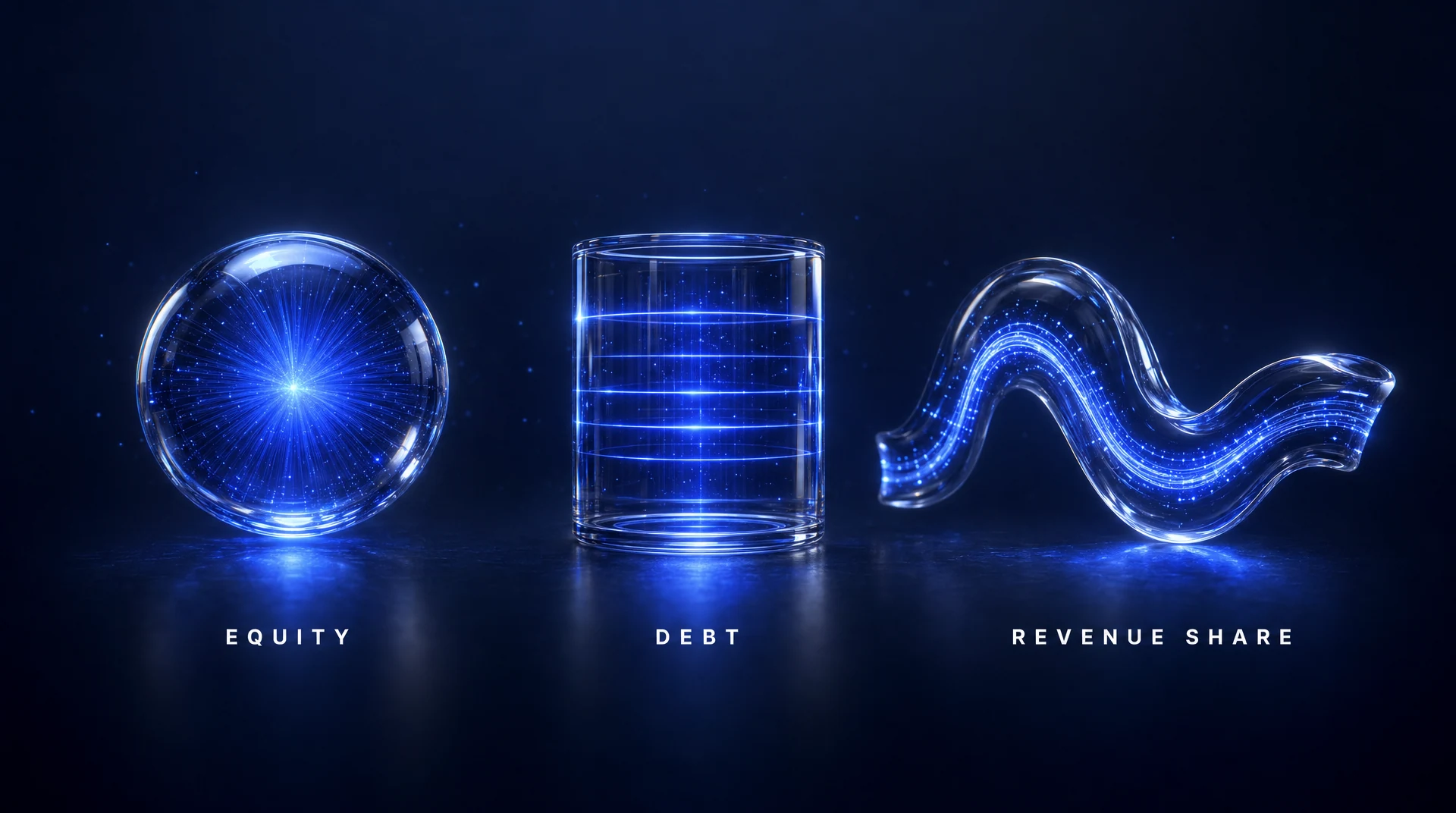
A revenue-share token represents a contractual right to a defined percentage of a defined cash flow over a defined period. It does not represent equity in the entity that produces the cash flow. It does not represent debt secured against the entity's assets. It is its own structure – a legal claim on income, structured to flow through the token holder.
The clearest analogy: a royalty agreement. If a music publisher sells a 20% claim on the recording royalties of a specific catalog for the next ten years, the buyer holds a contract entitling them to 20% of whatever those recordings earn over that period. Tokenize that contract – represent each fractional interest as a token, with the cash flow distributed automatically through the token contract – and you have revenue-share tokenization.
The structure has three properties that distinguish it from equity or debt tokenization:
The token holder is not an owner of the entity. No governance rights. No information rights beyond what the contract specifies. No claim on the entity's assets in a wind-down. The asset owner retains full operational control.
Cash flow is the entire return. No exit through equity appreciation, no debt repayment at maturity. The return is the income stream over the contract period. If the catalog earns less than expected, the token holder earns less. If it earns more, they earn more.
The contract period is finite (usually). Most revenue-share structures have a defined term – five years, ten years, perpetuity in some cases. The token represents the right during that term. After the term ends, rights revert to the asset owner.
This is structurally similar to a royalty financing in traditional finance. The innovation tokenization adds is fractionalization, automated distribution, and (potentially) secondary liquidity.
Reality check before you read further: Run Stobox Compass. Revenue-share tokenization rewards preparation more than most categories – the cash flow analysis is everything. Three minutes, free, tells you if your asset is ready.
The three live sub-categories in 2026
Revenue-share tokenization is the structure quietly enabling some of 2026's most ambitious tokenization projects – and almost nobody is writing about it seriously.
Share on X Share on LinkedInMusic catalogs and master royalties
The largest and most developed sub-category. Music catalogs have established valuation methodology – annual net publisher share earnings multiplied by a multiple based on catalog age, genre, and decay rate. Industry norms in 2026 sit at 6x–15x for typical catalogs, with evergreen hits commanding 15x–20x or more, and some legendary-artist catalogs reaching 20x–30x.
Streaming has stabilized catalog economics in a way that was not true ten years ago. Recurring monthly revenue from streaming platforms makes valuation defensible and cash flow predictable enough to underwrite. Investors targeting tokenized music royalties are looking at 6%–12% annual yields, which compares favorably to many fixed-income alternatives.
The institutional revenue-share structure is increasingly the chosen path because it interfaces with traditional capital sources and offers genuinely durable secondary liquidity – distinct from the earlier wave of fan-engagement NFT tokens, which served different economic purposes.
IP portfolios and licensing income
Tokenized claims on licensing income from intellectual property – patents, brands, content libraries, software IP. Structurally identical to music catalog tokenization, but the underlying cash flow is licensing fees rather than royalties.
This category is earlier than music. Valuation methodology is less standardized. Cash flow is often lumpier (large one-time licensing deals rather than steady streaming income). Legal frameworks for fractionalizing IP licensing rights vary substantially by jurisdiction.
The opportunity sits in specific segments: pharmaceutical licensing income (cash flows are well-modeled, counterparty risk is concentrated in known licensees), brand licensing portfolios (consumer brands with established merchandising programs), and content libraries (TV, film, gaming IP with ongoing distribution income).
For IP owners considering this structure, the structural questions are: who controls licensing decisions during the token term, how are new licensing deals priced into the token holder's claim, and what happens if a major licensee defaults. These are addressable in offering documents but require careful drafting.
SaaS and recurring revenue
The most experimental sub-category. A company with predictable monthly recurring revenue (MRR) sells a token representing the right to a percentage of that revenue for a defined period.
This works in theory. The structures are workable. The challenge is investor demand. SaaS tokenization competes for the same capital that buys SaaS equity (venture, growth, private equity) – and equity carries upside that revenue-share does not. For revenue-share to win the comparison, the deal has to be priced attractively enough to justify giving up equity upside, which means the SaaS company has to want non-dilutive financing badly enough to pay for it.
In practice, this sub-category is most relevant for: SaaS companies that have raised equity, want to extend runway without further dilution, and have predictable enough revenue to underwrite a 3–5 year revenue-share structure. Series B/C+ companies with $5M+ ARR and clean unit economics.
Also relevant for creator-economy revenue streams – established subscription newsletters, predictable ad and sponsorship income, podcast networks. Economically similar to SaaS but with different operational risk profiles.
The legal structure question
Revenue-share tokenization sits in a more nuanced legal position than equity or debt tokenization because the structure has to define very precisely what the token holder is entitled to and what they are not.
In most jurisdictions, a tokenized revenue-share interest is a security – a claim on income that requires registration or an applicable exemption. The exemption choice matters:
- Reg D 506(c) is the default for US-facing revenue-share tokenizations. Accredited investors only, general solicitation permitted, unlimited raise size.
- Reg S for non-US distribution, often paired with Reg D for cross-border raises.
- Reg A+ is theoretically available for retail-eligible revenue-share offerings up to $75M annually, but the SEC qualification process adds 4–6 months and significant cost. Few revenue-share deals to date have used Reg A+; most opt for accredited-only structures to keep timeline and compliance burden manageable.
The wrapper question is also distinctive for revenue-share. Because the token represents a contractual claim rather than equity, the wrapper is often a special-purpose entity (SPV, typically Delaware LLC or equivalent) that holds the underlying revenue-share contract and issues tokens against it. The asset owner – the music publisher, the IP holder, the SaaS company – sells a revenue-share interest to the SPV, and the SPV issues tokens to investors. This adds a layer but creates clean separation between the operating entity and the tokenized claim.
For European revenue-share tokenization, the structures are similar, with national private placement regimes (Luxembourg, Liechtenstein, Ireland) and EU MiCA framework considerations layered in depending on the token's specific characteristics.
In every case, the offering documents need to address: how cash flow is calculated and distributed, what reporting obligations the asset owner has to the SPV and token holders, what happens in scenarios of partial revenue (force majeure, business failure, contract disputes with downstream payers), and what the secondary transfer mechanics look like. These are not boilerplate. Each deal is structured.
For the broader regulatory context, see the complete asset tokenization guide.
What investors are actually looking for

Investor demand for tokenized revenue-share assets is growing but selective. Three buckets:
Family offices and high-net-worth individuals seeking yield-bearing alternative assets uncorrelated with equity markets. Music catalog tokens at 8%–12% yield with limited correlation to broader equities are attractive in this profile.
Crypto-native funds and treasuries allocating to tokenized real-world assets for yield diversification. The on-chain native nature of revenue-share tokens makes them easy to integrate with existing wallet infrastructure.
Specialty investors with thesis-aligned mandates – music royalty funds, IP investment vehicles, creator-economy investors. These investors were buying the underlying assets directly before tokenization. Tokenization gives them a more efficient access mechanism with built-in liquidity optionality.
What investors are not looking for is speculation. Serious revenue-share tokenization in 2026 lives or dies on the underlying cash flow analysis – what does the asset earn now, what is the decay curve, what is the counterparty risk, and what is the realistic 5-year IRR? If those numbers don't work, the deal doesn't get done at any token engineering.
What asset owners should think about before tokenizing
Tokenization rewards preparation more than most categories – because the underlying cash flow analysis is everything.
Share on X Share on LinkedInIf you own a music catalog, an IP portfolio, or a recurring-revenue stream and you are evaluating tokenization, the honest sequence:
Is your cash flow underwriteable? Revenue-share tokenization works when cash flow is documented, predictable enough to model, and resilient to reasonable stress scenarios. If you are pre-revenue, sub-scale, or in a category where cash flows fluctuate dramatically year-over-year, this structure is not your best option. Equity tokenization may fit better.
What percentage are you comfortable selling, and for how long? Revenue-share is non-dilutive in equity terms but it does claim a portion of your cash flow for the contract period. Sell 30% of your music catalog royalties for ten years, and that is 30% of cash flow you do not see during that period. The economics have to make sense – capital raised today has to be worth more to your operations than the cash flow given up over the term.
Who is your investor base, and what jurisdictions do they sit in? This drives the wrapper, the exemption, and the distribution channels. For most revenue-share deals in 2026, the investor base sits in some mix of family offices, crypto-native funds, and specialty alternative-asset investors. Configuring the deal to be accessible to those investors is a structuring decision, not a marketing decision.
Are you ready for the operational requirements? Tokenizing revenue share creates ongoing obligations: cash flow reporting to token holders, distribution mechanics, regulatory filings, and (importantly) compliance monitoring on the underlying asset. If you are a small operation, you need a tokenization platform that handles the operational burden – not a minting tool that ships you a token and waves goodbye.
Stobox 4 is built for this. The platform handles cap-table management, distribution automation, investor reporting, and ongoing compliance monitoring as core functionality. Stobox STV3 is the security token standard, which enforces transfer restrictions, jurisdictional eligibility, and accredited-investor verification at the contract level. Stobox DID handles investor onboarding, meaning your investor base can be reached without forcing them through a vendor-specific KYC system they have no other reason to use.
The honest market context
Revenue-share tokenization in 2026 is real but early. Institutional-scale capital is increasingly engaging with the structure when the underlying asset and the legal framework are credible. The music catalog category is the most mature, the IP licensing category is emerging, and the SaaS / recurring revenue category remains experimental.
For asset owners thinking about this seriously, the recommendation is the same as for any tokenization decision: do the structuring work first, pick the platform second. Revenue-share tokenization has more legal and economic nuance than equity or debt tokenization. The deals that succeed are the ones where the structuring conversation happened before the platform conversation.
Frequently asked questions
What's the minimum revenue size for revenue-share tokenization to make sense?Generally, asset owners with $1M+ in annual documented cash flow from the asset being tokenized. Below that, the structuring and ongoing compliance costs typically don't justify the raise. How is a revenue-share token different from a profit-share token?Revenue-share is calculated on top-line revenue. Profit-share is calculated on net profits after expenses. Revenue-share is more transparent and simpler to audit; profit-share is more capital-efficient for the operator but harder to verify. Most institutional revenue-share tokenizations use top-line revenue. Background: revenue sharing tokens explained. Can I tokenize future cash flows that don't exist yet?Technically yes, but investors require historical cash flow data to underwrite. Pre-revenue projections alone rarely close institutional deals. Established cash flows with at least 12–24 months of data are the realistic floor. What yield do investors expect on tokenized music royalties?Typical 2026 ranges are 6%–12% annual, depending on catalog quality, age, and decay rate. Evergreen catalogs at the lower end (more predictable, lower yield required), newer catalogs at the higher end (higher risk, higher yield required). How do I know if revenue-share tokenization is right for my asset?Run Stobox Compass. Three minutes. The diagnostic identifies whether your cash flow, structure, and investor base align for revenue-share tokenization specifically – or whether equity / debt tokenization fits better.Before you start
Before committing to tokenize a revenue-share asset, run the same readiness check Stobox runs on every engagement. Eight questions. Three minutes. Free. It tells you whether your cash flow, structure, and investor base are aligned for tokenization – and the specific gaps a serious investor would flag before underwriting.
Revenue-share tokenization rewards preparation more than most categories, because the underlying cash flow analysis is everything. Compass is the diagnostic. The structuring work is the deal.
Run your free readiness assessment on Stobox Compass →
Just launched · April 27, 2026 Find out where you actually stand.
Eight questions. Three minutes. The same diagnostic Stobox runs on every client engagement – now free, public, no signup required.
Open Stobox Compass → Free forever No credit card 3 minutes Share this LinkedIn X / Twitter Run the readiness check Stobox Compass – free, three minutes The eight-question diagnostic, run automatically. Score your tokenization readiness before you commit to a vendor. Read next Tokenizing a Fund vs. Setting Up an SPV: The Structuring Decision That Costs Founders 4 Months Wrapper choice cascades for years. Pick wrong and the raise loses 4–6 months.