
Tokenization has two sizes
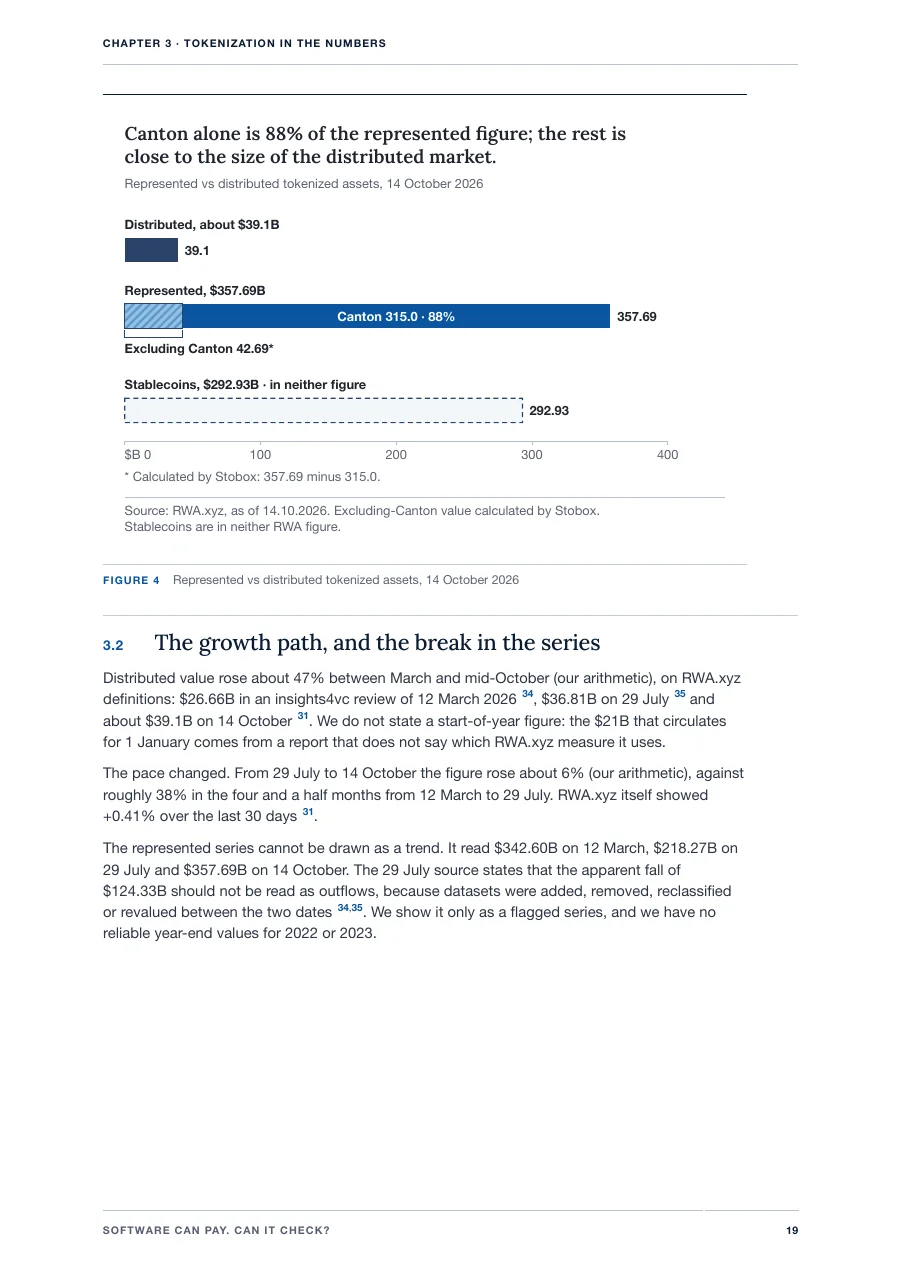
About $39.1B of tokenized assets are distributed to holders and $357.69B are represented, a factor of about nine. One network, Canton, accounts for $315B of the larger figure.
RWA.xyz · 14 Oct 2026 · Grade H







Know which numbers to trust, which risks are real and what to ask any vendor before software moves money
Ten findings and eight vendor questions. Every figure dated, sourced and graded.
What to read first. The ten-finding summary, then chapters 3, 4 and 9.

Every figure carries its date, a named source and a grade for how well it holds up.
Written by Gene Deyev with Claude, Anthropic’s AI model, and checked against primary sources.
The PDF costs an email address. Stobox sells tokenization technology; its products appear in chapter 9 only.
Quote them with confidence: every number below says when it was read and how well it holds up.
About $39.1B of tokenized assets are distributed to holders and $357.69B are represented, a factor of about nine. One network, Canton, accounts for $315B of the larger figure.
RWA.xyz · 14 Oct 2026 · Grade H
Stablecoin supply grew twelve-fold in six years, to a peak of $320.8B on 17 May 2026. It stood at $311.2B on 14 October, about 1.5% up on the year.
DefiLlama · 14 Oct 2026 · Grade H
Press reports of a Coinbase release put x402 at 205 million payments and $53 million in total, about 26 cents each. Independent trackers count 120 to 187 million transactions.
Cryptonews, on Coinbase data · 27 Aug 2026 · Grade M, press-reported
Of seven jobs where AI is used or pitched, the report found third-party measurement for two, a model maker’s own simulated benchmark for one, and nothing for four.
Stobox analysis · 14 Oct 2026
91% of organizations use AI agents and 10% have a strategy for managing non-human identities. Singapore’s new AI guidelines name agentic AI in one paragraph and never mention tokenization.
Okta 2025, as cited by KPMG · MAS, 7 Oct 2026
Growth, concentration, institutional volume and the piece software still lacks, with every source listed.
What to read first. The ten-finding summary, then chapters 3, 4 and 9.
Which market-size number to quote, what the growth data shows, and the dates that bind you between January 2027 and October 2028.
How many agent payments have been made, how little money they moved, and what an agent needs before it touches a security.
A graded evidence base, a regulatory calendar, three scenarios to 2030, and eight questions to put to any vendor.
Short on time? Read the ten-finding summary first, then chapters 3, 4 and 9.
A4, numbered sections, every figure with its source, date and confidence grade, and a list of sources at the end.
Six properties tokenization gives AI, what AI gives tokenization, and where each claim stops.
Stablecoin supply since 2020, who issues it, how much moves on it, the GENIUS Act clock and the case that stablecoins are not money.
Distributed against represented assets, the growth path, what the money is in, and forecasts to 2030.
The x402 scoreboard, who has shipped what, what the count hides, and what an agent needs before it touches a security.
Six dated cases, failures and sceptic cases included, each with a source and a lesson.
Seven jobs examined for evidence, six ideas behind the convergence, and the sceptics.
Singapore, Europe and the United States, the risk numbers, and a regulatory calendar for 2026 to 2028.
Three scenarios, what today’s evidence favours, and the signposts to watch each quarter.
What a machine-readable record needs, and eight questions to put to any tokenization or AI vendor.
Methodology, how figures are graded, disclosures, a glossary, and the numbered sources.

Gene Deyev, Founder and CEO of Stobox. He leads the Stobox team and is the author of the Stobox Tokenization Framework, an eight-phase method for tokenizing an asset.
How it was made. Gene wrote the report together with Claude, Anthropic’s AI model: Gene set the thesis, the rules and the editorial line; Claude did the research and the drafting; every figure was checked against a primary source, and its grade says how well.
It asks whether tokenized assets and AI agents can work together today. It sets out the numbers on both sides, the rules that apply and what software needs before it moves money. It has ten findings, and every figure carries a date, a named source and a grade.
It depends on which number you use. On 14 October 2026 RWA.xyz showed about $39.1B of tokenized assets distributed to holders and $357.69B represented, a factor of about nine. Canton alone accounts for $315B of the larger figure. The report uses the smaller one for market size.
Press reports of a Coinbase release put x402 at 205 million payments and $53 million, about 26 cents each (27 August 2026). Independent trackers count 120 to 187 million transactions. The report rates these counts as medium confidence, and either way the average payment is small.
Supply grew about twelve-fold in six years, from $27B to a peak of $320.8B on 17 May 2026. It stood at $311.2B on 14 October 2026, up about 1.5% so far this year (DefiLlama).
Every figure carries a date, a named source and a grade. H means a primary page or document was read, or two independent reputable sources agree. M means one reputable secondary source. L means a single weak source or sources in conflict, and L figures are never headlines. Claims by Stobox about itself are labelled company-reported.
Yes. Gene Deyev wrote this report together with Claude, Anthropic’s AI model. Gene set the thesis, the rules and the editorial line. Claude did the research and the drafting. Every figure was checked against a primary source, and the grade shown beside it says how well.
Gene Deyev, Founder and CEO of Stobox, wrote it. The PDF is free in exchange for an email address. Stobox sells tokenization technology and readiness assessment, and the report says so on page 2. Stobox products appear in chapter 9 only.

One work email and the PDF is yours. Every figure is dated, sourced and graded, so you can check it.
Updated 3 October 2026