






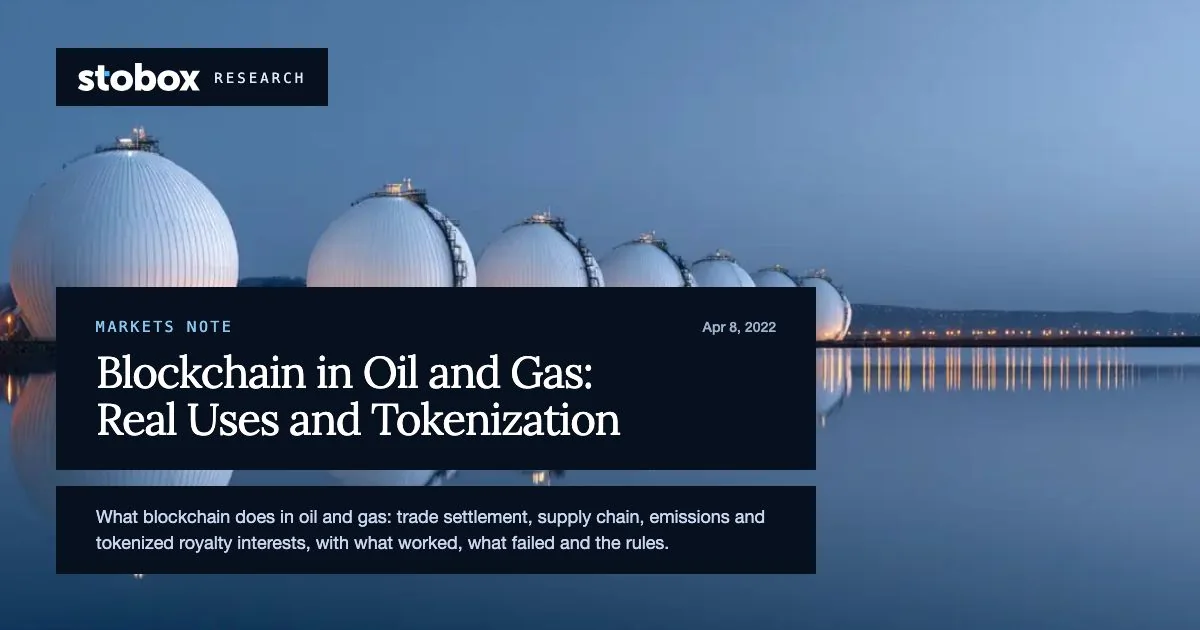
Blockchain in Oil and Gas: Real Uses, Failures and Tokenization
In recent years, blockchain has come a long way from a niche solution to a technology used everywhere, including by major players in the market. The distributed ledger is seen as a way to change and enhance even the most traditional industries.
Contents 9 sections
- What is blockchain actually used for in oil and gas?
- Trade settlement and post-trade reconciliation
- Oilfield services and supply chain
- Royalty and joint-interest accounting
- Emissions and low-carbon fuel tracking
- What did not work
- Tokenized oil and gas interests are securities
- How Stobox tokenizes interests in energy assets
- Questions, answered
Blockchain in oil and gas is used for five jobs: settling and confirming physical trades, reconciling oilfield service volumes with invoices, tracking where fuel and its emissions claims came from, keeping a shared record of who is owed what from a well, and issuing tokenized interests in wells, royalties and mineral rights to investors. The first two have the most evidence. Traders and banks put a US crude oil trade on a shared ledger in 2017, and in 2020 ten operators, including Chevron, ExxonMobil, Equinor and Shell, reported a pilot that cut a water-haulage workflow, from field reading to invoice payment, from 90–120 days to 1–7 days.
The fifth job is a securities offering, not a technology project. US law has named “fractional undivided interest in oil, gas, or other mineral rights” as a security since 1933, and a token does not change that. Stobox is not a broker-dealer, investment adviser, custodian or law firm, and nothing here is legal, tax or investment advice.
Key takeaways
- March 2017: Natixis, IBM and Trafigura put the main steps of a US crude oil trade, from confirmation to cancellation of the letter of credit, on one permissioned ledger built on Hyperledger Fabric.
- June 2020: the OOC Oil & Gas Blockchain Consortium (10 operators) reported a pilot on five Equinor wells in the Bakken that cut the process from 16 steps to 7 and auto-validated 85% of volume measurements.
- Vakt, formed in 2018 by oil majors, traders and trade finance providers, still runs a blockchain-based post-trade platform for physical oil; Maersk and IBM discontinued the TradeLens shipping platform in 2022 because industry-wide collaboration “has not been achieved.”
- Oil and gas interests sold to investors are securities: the Securities Act names them, and the Supreme Court held oil lease assignments to be investment contracts in 1943, three years before Howey.
- The SEC counted more than 20 oil and gas offering fraud cases a year in the years before its 2013 investor alert; one case involved $485 million from at least 7,700 investors.
- Tokenizing an energy interest still needs offering documents ($50,000–$200,000+ with a mint-only platform) and typically 3–6 months; Stobox charges flat fees, never a percentage of the raise.
What is blockchain actually used for in oil and gas?
A blockchain here is a shared ledger that several companies write to and read from, so that a buyer, a seller, a bank, an inspector or a service contractor see the same record instead of reconciling their own. The 2017 crude oil platform below was explicitly permissioned, meaning only invited parties could join. In every case the value comes from getting counterparties onto the same network.
| Use | What the ledger records | Documented example | Evidence |
|---|---|---|---|
| Trade settlement and post-trade | Trade terms, confirmations, inspection results, letter of credit status | Natixis, IBM and Trafigura (2017); Vakt (2018 to today) | Company press release; Vakt’s own site |
| Oilfield services and supply chain | Field volumes, validations, invoices, payments | OOC consortium with Data Gumbo, Bakken water haulage (2019–2020) | Pilot results published by Data Gumbo |
| Fuel provenance and emissions claims | Who bought a lower-carbon fuel and which emissions claim they hold | Avelia, Shell with Accenture and Amex GBT (2022) | Shell announcement |
| Royalty and joint-interest accounting | Ownership decimals, production, costs and payments per owner | No production deployment we could source | Concept; see below |
| Tokenized interests | Holders of a security tied to a well, royalty or mineral right | Stobox: Allegiance Capital Fund | Securities law applies in full |
Trade settlement and post-trade reconciliation
Physical oil trading runs on documents: the confirmation, the nomination, the inspector’s quantity and quality report, the letter of credit. Each party keeps its own copy, and the copies drift apart.
On 28 March 2017, Natixis, IBM and Trafigura announced a ledger on which the buyer, the seller and their banks could all see the status of a US crude oil transaction, “from the time a new trade is confirmed and validated, to when the crude oil is inspected, to its final delivery and cancellation of the letter of credit.” The release said the platform would later let shipping companies, pipeline operators, inspectors and warehouses write to it directly.
Vakt applied the same idea to post-trade work across companies. It says it was formed in 2018 by “a group of oil majors, traders, and trade finance providers” because physical post-trade work was manual and error-prone. On 26 September 2026 its site lists three live products: vSure for digital trade confirmations, vLogistics for nominations with terminals and inspectors, and vActuals, which records quantity and quality data at source on a blockchain. The site carries a BP statement that BP uses Vakt for its European diesel, gas oil and fuel oil business, and a TOTSA statement that its teams have confirmed trades on the North West Europe barges market through vSure since 2022. Vakt’s savings figures on the same page are the vendor’s own and are not independently audited, so we do not repeat them.
Trade finance went a different way. Komgo, founded in 2018 and headquartered in Geneva, is owned by 25 industry shareholders, with board members from Mercuria, Gunvor, OQ Trading and Koch Supply & Trading among others. Its current pages describe it as a fintech selling SaaS applications that digitalize letters of credit and bank guarantees for more than 400 corporates and financial institutions; they do not present the product as a blockchain.
Oilfield services and supply chain
The best-documented upstream case is not glamorous: trucking produced water away from wells. According to the consortium, haulage invoicing and reconciliation are typically manual, with data self-reported or stuck in systems the parties cannot share.
The OOC Oil & Gas Blockchain Consortium was set up under the not-for-profit Offshore Operators Committee. In 2020 its 10 members were Chevron, ConocoPhillips, Equinor, ExxonMobil, Hess, Marathon, Noble Energy, Pioneer Natural Resources, Repsol and Shell. With Data Gumbo’s network, it ran a pilot on five Equinor wells in the Bakken field in North Dakota with the water hauler Nuverra. The results, published on 3 June 2020, were:
- The workflow shortened from 90–120 days to 1–7 days, and from 16 steps to 7, with no manual intervention.
- 85% of volume measurements validated automatically against data from several parties.
- A validated volume triggered the related invoice, so payment tracked field activity.
- Operator and trucking company could reallocate an estimated 25%–35% of the resources the old process used.
“The results of this pilot prove that non-manned volume validations can trigger automated payments to vendors,” said Rebecca Hofmann, Chairman of the OOC Oil & Gas Blockchain Consortium. These are the consortium’s own pilot numbers from one field and one service. The release said the consortium planned to extend the solution to other commodities and services; we cite the 2020 release and make no claim about what the consortium does today.
Royalty and joint-interest accounting
Every producing well has a list of people who are owed money from it, and the list is the hard part. The US Energy Information Administration defines a working interest as one that lets the owner explore, develop and operate the property, with the owner bearing those costs in return for a share of production. A royalty interest gives a share of production or proceeds without the rights and obligations of operating, and normally without bearing the costs.
That split is why a shared ledger is attractive in principle. Working-interest partners are billed for costs, royalty owners are paid from revenue, and each needs the same production figures and ownership shares. A ledger that holds the ownership record and the monthly production, with payments calculated by a written rule, would give every owner the same numbers.
We did not find a production-scale royalty or joint-interest deployment on a blockchain with a primary source we could open, so we describe this as a design, not a result. The reconciliation problem is real; the evidence that operators have moved it onto a shared ledger is not yet public. Our revenue and royalty page sets out how a share of a contracted income stream is drafted, proved and paid.
Emissions and low-carbon fuel tracking
The third use is keeping track of claims, not molecules. In 2022 Shell, Accenture and American Express Global Business Travel announced Avelia, which Shell describes as one of the world’s first blockchain-powered digital book-and-claim solutions for sustainable aviation fuel in business travel. Under book-and-claim, a company pays for the lower-carbon fuel and holds the emissions claim, while the fuel itself is used wherever it is supplied.
A ledger helps here because the risk is a claim sold twice. It does not measure emissions. The number on the ledger is only as good as the meter, the audit or the certificate behind it, which is the same limit that applies to every use in this article.
What did not work
The 2017–2020 wave produced more announcements than networks. The clearest primary record of failure comes from a neighbouring industry, container shipping. On 29 November 2022 Maersk and IBM said they would discontinue TradeLens, a blockchain-enabled trade platform announced in 2018: they had built a viable platform, but full global industry collaboration had not been achieved, and TradeLens had not reached commercial viability as an independent business.
The pattern across the cases above is consistent:
- The network is the product. A shared ledger with one bank and one trader is a database with extra steps. Value appears only when most counterparties join, and competitors are slow to join a platform owned by a rival.
- Pilots measure one lane. The Bakken results covered one service on five wells. Scaling means every contractor, every operator’s accounting system and every contract template.
- The data still starts off-chain. An inspector’s report or a truck ticket is only as reliable as the person or sensor that produced it. Vakt’s answer, recording actuals “at source,” is an admission that the ledger cannot check the physical world by itself.
- The durable part is often the digitization, not the chain. Komgo today sells trade finance software built to remove manual and paper-based processes, and does not describe it as a blockchain product. What lasted was banks and traders exchanging the same digital documents.
None of this means the ledger was wrong. It means the hard work in oil and gas is agreeing on the data, and the technology choice follows. Our analysis of why tokenization projects fail reaches the same conclusion for asset issuance.
Tokenized oil and gas interests are securities
Tokenizing a well, a royalty or a mineral right means issuing a digital token that represents an interest in it, or in a company or fund that holds it. In the US the legal answer came long before blockchain.
The Securities Act definition of “security” expressly includes a “fractional undivided interest in oil, gas, or other mineral rights.” In SEC v. C. M. Joiner Leasing Corp., decided on 22 November 1943, the Supreme Court held that assignments of oil leases sold by mail, with the seller promising to drill a test well, were investment contracts: the buyer was paying “both for a lease and for a development project.” Three years later, SEC v. W. J. Howey Co. set the test still used today: an investment of money in a common enterprise with profits to come solely from the efforts of others.
A token that pays holders a share of a well’s revenue sits squarely inside that test. SEC Commissioner Hester Peirce put it plainly on 9 July 2025: “Tokenized securities are still securities.” The SEC staff statement of 28 January 2026 adds that stock is an equity security “regardless of its format.”
Oil and gas also has a long record of abuse. The SEC’s 2013 investor alert on private oil and gas offerings says its cases grew from a few in 2005 and 2006 to an average of more than 20 a year. In one, Provident Royalties raised $485 million from at least 7,700 investors while telling them 86% would go to oil and gas investments. The red flags it lists include “guaranteed” returns, pitches tied to high oil prices, and pitches touting new technology. A token pitch can hit all three at once, which is why an honest energy offering promises no yield and shows the engineering report.
Which US exemptions apply
Most tokenized energy offerings rely on an exemption rather than full registration. The main options, compared in detail in our Reg D vs Reg S vs Reg CF vs Reg A guide:
| Route | Limit | Who can invest |
|---|---|---|
| Regulation D, Rule 506 | No offering cap | Accredited investors; 506(b) also allows up to 35 non-accredited but sophisticated purchasers |
| Regulation Crowdfunding | $5,000,000 in 12 months | The public, with limits for non-accredited investors, through one intermediary |
| Regulation A, Tier 2 | $75,000,000 in 12 months | The public, after SEC qualification |
| Regulation S | No cap | Buyers outside the US, under offshore transaction conditions |
The state where the well sits also matters: its title records, its division order practice and its securities regulator do not move on-chain. Our US tokenization guide covers the federal and state layers together.
What tokenization changes, and what it does not
| Changes | Does not change |
|---|---|
| The investor register is kept on-chain and updated with each transfer | The interest is a security and needs registration or an exemption |
| Transfer rules (who may hold, lock-up periods) are enforced by the token contract | Production, decline rates and oil prices decide what the interest earns |
| Distributions can be paid to every holder of record by a written rule | Title to the lease is still recorded under state law, off-chain |
| Smaller minimum tickets are practical to administer | A holder can sell only to eligible buyers, and a buyer has to exist; see security token liquidity |
For scale: tokenized real-world assets held about $33.5B of on-chain value in July 2026 by rwa.xyz’s count, and the commodities line of $5.5B is mostly gold, according to our State of RWA 2026 report. The report does not break out oil and gas interests as a separate line.
How Stobox tokenizes interests in energy assets
Stobox has worked on tokenization since 2018: $305M+ in assets structured and supported, 100+ clients, 20+ jurisdictions. In energy, we structured tokenized mineral and royalty interests from US oil and gas extraction for Allegiance Capital Fund as a revenue-sharing security token. Other resource engagements are listed in our natural resources case studies.
The work follows the Stobox Tokenization Framework: 8 phases and 48 steps, published in full. For an oil and gas interest, the phases that decide the outcome come before any token exists:
- Strategy: which interest (working, royalty, overriding royalty, mineral) and which investors you may lawfully reach.
- Asset structuring and legal readiness: proof of title, a reserve or engineering report from an independent party, and the valuation behind the offering amount.
- The tokenization model: securities counsel confirms the token is a security under the applicable test and picks the exemption.
- Token economics and the contract: how revenue becomes distributions, net of which costs, paid when.
- The issuing framework, legal documentation, validation and deployment, and the offering: the issuing vehicle, the documents, the deployed contract, and a sale run by a licensed broker-dealer where one is needed.
Costs are published. Going fully on-chain in Compass is $1,248, a Raisable window is $1,499–$6,999 with the offering documents included, and Stobox never takes a percentage of the raise (pricing). With a mint-only platform, the offering documents from a law firm typically cost $50,000–$200,000+ on top of the platform fee, per our Tokenization Cost Index. Tokens are issued primarily on Base and follow ERC-7943 transfer rules, the Ethereum RWA standard that Stobox backs.
Questions, answered
How is blockchain used in the oil and gas industry?
Mainly as a shared record between companies: confirming and settling physical oil trades, reconciling oilfield service volumes with invoices, tracking lower-carbon fuel claims, and registering holders of tokenized interests. Trade post-processing (Vakt) and the 2020 Bakken water-haulage pilot are the best-documented cases.
What is an example of blockchain in the oil and gas supply chain?
The OOC Oil & Gas Blockchain Consortium’s 2020 pilot with Data Gumbo on five Equinor wells in North Dakota. Validated water-haulage volumes triggered invoices automatically, and the consortium reported the workflow shrinking from 90–120 days to 1–7 days.
Why did many oil and gas blockchain projects stall?
Because a shared ledger is only useful when most counterparties use it, and that level of collaboration is hard to reach. Maersk and IBM gave exactly that reason when they discontinued TradeLens in 2022. Data entry also stays off-chain, so a ledger cannot fix a wrong inspection report.
Are tokenized oil and gas royalties securities?
In the US, interests sold to investors almost always are. The Securities Act names fractional undivided interests in oil, gas or mineral rights, and the Supreme Court treated oil lease assignments sold with a drilling promise as investment contracts in 1943. The token format does not change that.
What is the difference between a working interest and a royalty interest?
A working-interest owner has the right to explore, develop and operate, and bears those costs in return for a share of production. A royalty owner receives a share of production or proceeds without operating rights and normally without bearing costs, per the EIA’s definitions.
Does tokenization make an oil and gas investment liquid?
No. It can make transfers between eligible investors easier to record and enforce, but a sale still needs a willing, eligible buyer and a lawful venue. Resale is also limited by the exemption the offering used.
Can Stobox tokenize my mineral rights or well interests?
Stobox structures tokenized securities tied to energy assets, as it did for Allegiance Capital Fund, and prepares and deploys them for flat fees. Securities counsel signs the legal work, and a licensed broker-dealer runs any brokered sale; Stobox is neither.
If you hold an interest in a producing asset and want to know whether it can be offered to investors, start with the paperwork, not the token. The Readiness Score checks your asset, investors and jurisdiction in about eight minutes and lists what a compliant raise would need.