






Stobox Compass Lite Is Live: Tokenized Fundraising, In Production Today
Stobox Compass Lite – the current production release of Stobox Compass – is officially live at version 1.10. Issuers run a complete tokenized capital raise from a branded page on their own domain: investors commit, verify identity, sign hash-pinned documents, pay in stablecoins straight to the issuer's treasury, and receive their tokens. Non-custodial by construction, verified on-chain, and open for issuer onboarding now.

By Gene Deyev, Founder and CEO of Stobox
17 July 2026 · 14 min read
Contents 11 sections
- What Compass Lite is
- The investor journey: one link, seven steps, no account
- The non-custodial trust model
- The issuer console: your raise, fully operational
- Who Compass Lite is for
- The tokenization engine: what is rolling out on the same account
- What's live today – and what the full release adds
- Pricing: software fees only, never a percentage
- Why "Lite" – and what comes next
- Getting started
- Frequently asked questions
Today we are making it official: Stobox Compass Lite is live in production. After eight years of building tokenization infrastructure at Stobox, the fundraising layer of Stobox Compass is no longer a roadmap item, a beta, or a demo – it is running real offerings for real issuers, on their own domains, with every payment and token delivery verified against the chain. The release shipping today is version 1.10 – the tenth minor release since the platform entered production hardening – and issuer onboarding is open now.
For most of this industry's history, "tokenized fundraising" has been a promise you had to take on faith – a pitch deck, a waitlist, a testnet. What is different today is not the vocabulary; it is that the thing works, end to end, for anyone who qualifies. An issuer can register this afternoon, stand up a branded offering on their own web address, and take a real investor from first click to self-custodied token – with no account for the investor to create, no funds passing through Stobox, and every material step provable on a public block explorer. This post is a full tour of what that looks like, what is live versus what is still rolling out, and how to get started.
What Compass Lite is
Compass Lite is the current production release of Stobox Compass – the Tokenize layer of the Stobox Stack (Organize → Raise → Tokenize). It is a multi-tenant, non-custodial security-token fundraising platform: each issuer gets a branded offering page served on their own web address, and behind it a complete operations console for running the raise end to end.
Two things make it more than a checkout page bolted onto a whitepaper. The first is architecture: Compass is a thin orchestration layer over regulated, standardized rails – hosted identity verification, an on-chain identity registry, stablecoin settlement, cryptographic document signing – assembled into one coherent workflow, so an issuer does not have to stitch together five vendors and hope they agree. The second is a design principle we hold without exception: radical honesty with data – no mock numbers, anywhere. Every figure an investor sees – token price, holders, market cap, treasury balances, the raise progress bar – is read live from the blockchain or computed from verified records, and can be checked on a public explorer. The raise bar counts confirmed payments only. Nothing on the page is a placeholder waiting to be trued up later.
Three properties define the platform, and they are worth stating plainly because each one is a decision competitors routinely make the other way:
- Non-custodial by construction. Funds move directly from the investor's verified wallet to the issuer's treasury. Stobox is never in the fund path – there is nothing to freeze, lose, or misappropriate. Tokens are delivered from the issuer's own wallet, and both sides hold their own keys.
- On-chain truth. Whitelisting, payments, and deliveries are facts proven by transactions – never checkboxes an admin ticks. Eligibility comes from Stobox's on-chain DID registry; a wallet is cleared the moment the chain says so, not when a spreadsheet is updated.
- Review, never reject. Once money has moved, no automated rule can dead-end an investor. Anything ambiguous goes to a human, with a recorded reason. A raise is the worst possible place for a false-negative edge case to silently strand someone who has already paid.
Compass was built on the operating experience behind $305M+ in assets supported, 100+ clients across four continents, and 20+ jurisdictions since 2018 – and on Stobox's work as a contributor to ERC-7943 (uRWA), the emerging Ethereum standard for institutional real-world-asset tokens. Compass Lite is where that experience becomes something a company can simply log into.
The investor journey: one link, seven steps, no account
The clearest way to understand Compass Lite is to follow a single investor through it. They never create an account, set a password, or install an app. They follow one link and move through seven verifiable steps.
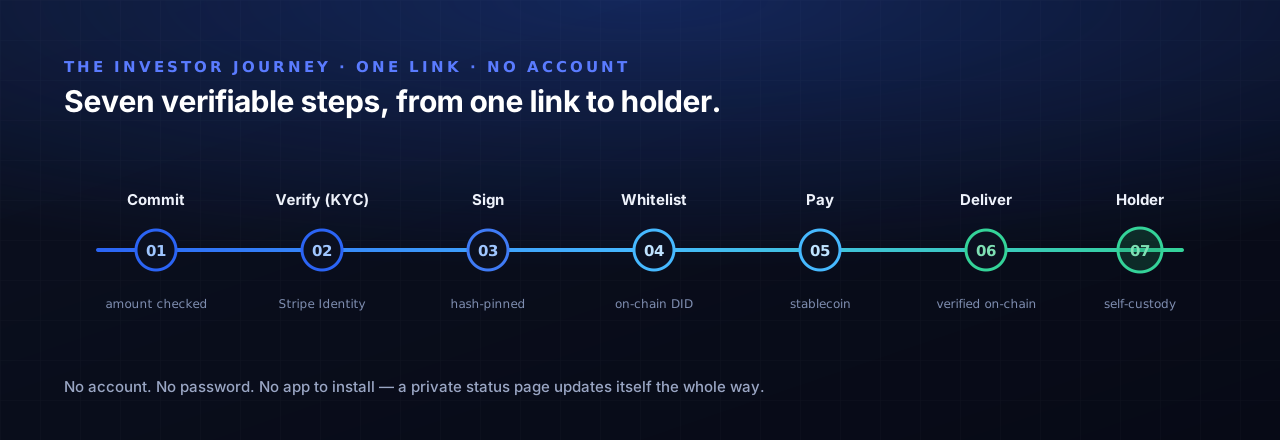
- Commitment. The amount is checked in real time against the minimum ticket, the hard cap, and the remaining allocation. An investor cannot commit to more than is actually available, and a round whose remaining room can't fit the minimum ticket shows a derived "sold out" state that self-corrects with the raise – it is computed, never stored.
- Identity verification. Hosted KYC powered by Stripe Identity, deliberately data-minimized: only pass/fail, verified name, and country of residence are kept. No document images, no date of birth – deliberate minimization that protects the investor and reduces the issuer's liability. Verified once, an investor never re-verifies across that issuer's offerings.
- Confirm and sign. Risk acknowledgments plus every published offering document – subscription agreement, memorandum, risk disclosure, any number of custom documents – each read to the end and signed with a free wallet signature cryptographically pinned to the exact document version and its SHA-256 hash, verified server-side against the chain. There is never a question of who signed what.
- Wallet whitelisting. The wallet is registered on the on-chain Stobox DID registry. The platform reads the registry live and detects fulfilment from two triggers – the operator queue and a two-minute cron – then emails the investor "you're cleared," typically within a couple of minutes. Declined, expired, or blocked states surface honestly rather than hanging.
- Payment. A stablecoin transfer straight from the verified wallet to the issuer's treasury, through an in-app Pay button that catches wrong-network mistakes with a one-click switch, or a pasted transaction hash from any wallet. It is then verified against the chain: right token, right recipient, right sender, right amount.
- Delivery. The issuer sends tokens from their own wallet; the platform verifies the transfer on-chain and independently confirms that identity, payment, and wallet all match before marking the investment delivered.
- Holder. Tokens sit self-custodied in the investor's own wallet, visible in the public holders table.
Underneath all seven steps runs a private, bookmarkable status page that updates itself in seconds – no refreshing, no "check back later." If an investor closes the tab halfway through, progress is saved; they continue where they left off, never starting over. And a round that is not open yet no longer dead-ends the visitor: a "get notified when it opens" capture takes their name and email, sends an issuer-branded confirmation instantly, and hands the pipeline to the issuer's team to work before go-live – one of the headline additions across the v1.9 and v1.10 releases.
The non-custodial trust model
The single most important sentence in this entire post is that Stobox never touches the money. Non-custodial here is not a feature toggle or a marketing adjective – it is the construction of the system. Because there is no point at which customer funds or tokens sit in a Stobox-controlled account, there is nothing for us to freeze, lose, or misappropriate, and nothing an attacker could drain from us even in principle.
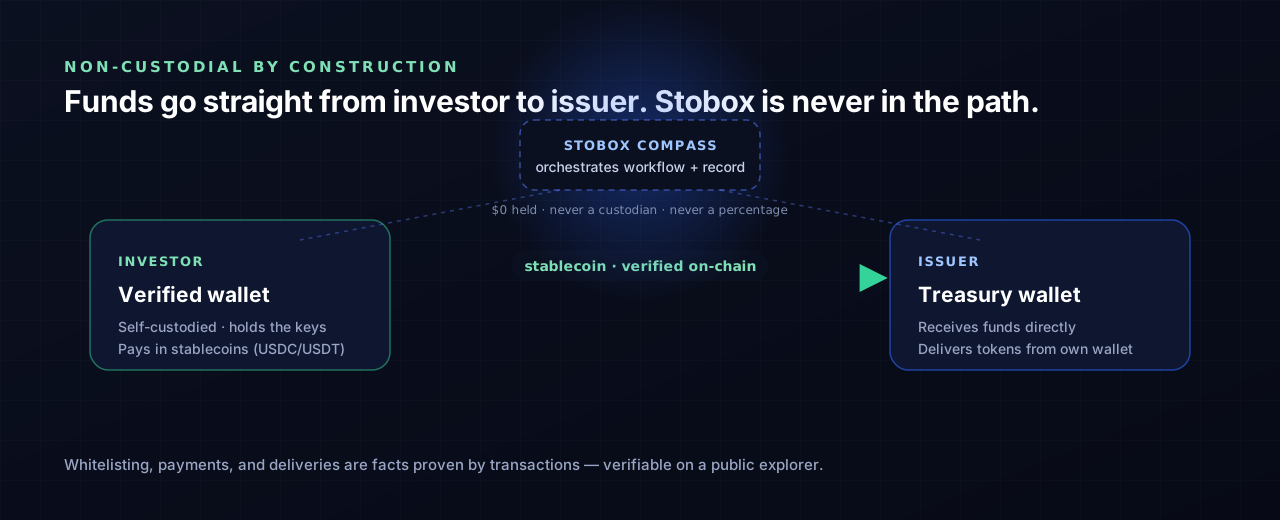
That posture is backed by a security model designed to be shown to counsel, not merely described in a blog:
- Non-custodial by construction. The platform never holds keys, funds, or tokens. Investor money moves directly from the investor's wallet to the issuer's treasury; Stobox is never an intermediary in the fund path, and never takes a percentage of the raise.
- Tamper-evident audit trail. Every state change, admin action, document publish, signature, and payment event is permanently logged – with who did it and when. When money is involved, "what happened and who did it" can never be a matter of memory.
- Hardened operator access. Two-factor authentication, active-device management with remote sign-out, instant lockout when access is revoked, and automatic alerts on suspicious sign-in activity protect the issuer's console.
- Resilient. Backups are encrypted and off-platform; pages degrade gracefully with an honest notice rather than a blank failure. The v1.10 release ships with 313 automated tests behind it.
The issuer console: your raise, fully operational
Behind the public page sits a complete operations workspace. The issuer watches every investment move through the pipeline, each stage linked to its on-chain proof:
- Offering management with a safe draft-to-live lifecycle. Sketch an offering with just a name, complete it at your pace, and publish through a go-live gate that won't let an incomplete or misdated round reach investors – including a warning if an open offering could accept investors without anything to sign.
- Investor pipeline – every investment at a glance across identity, documents, whitelist, payment, and delivery, with a dedicated queue of paid-but-undelivered positions so nothing slips between "they paid" and "they hold."
- Live on-chain cap table – one row per wallet, verified identity matched to live on-chain balance and share of supply. Unattributed holders are flagged with a running total; concentration analytics, lock-up status, and CSV export for counsel are built in.
- Document control – versioned, hash-pinned signable documents with publishing guardrails, so the version an investor signs is provably the version you published.
- Your brand and your domain everywhere. Investor pages render in the issuer's colors and logo; every investor email goes out under the issuer's name from the issuer's own sender address, with zero technical setup; and the offering runs on the issuer's own web address, with certificates provisioned automatically and health checks confirming the page is genuinely serving investors.
Two commitments govern every one of these surfaces. On-chain truth: whitelisting, payments, and deliveries are transactions, not toggles. Review, never reject: once money has moved, ambiguity routes to a human with a recorded reason, never to an automated dead end.
Who Compass Lite is for
Compass Lite is built for the companies the old capital-markets system kept telling "later" – the private businesses with real assets and real revenue that never had a proportionate way to raise against them:
- SMBs and founders raising against a real business, without surrendering a percentage of the raise to intermediaries.
- Real estate and SPVs – one asset, many investors, with legal terms and disclosures on the offering page and eligibility enforced on-chain.
- Funds and asset managers distributing tokenized fund interests to verified, whitelisted investors.
- Energy and infrastructure projects with tangible collateral and cash flow but no clean instrument to finance them.
And on the other side of the table are the investors – who receive a genuine regulated security in tokenized form, self-custodied in their own wallet, through a journey that takes one link and about ten minutes of active effort. If you are new to the space, start with our complete guide to asset tokenization, or see how investing works on the Stobox rails.
The tokenization engine: what is rolling out on the same account
Compass Lite is the fundraising execution layer, live today. The full Stobox Compass release completes the tokenization engine on top of the very same account – and it is worth being precise about what that engine is, because it is the part that turns a successful raise into a living, compliant on-chain asset.
Compass doesn't reinvent custody, identity, or settlement. It orchestrates regulated, standardized infrastructure – ERC-7943, ERC-4337, EAS, and USDC on Base – into one workflow, and keeps only the parts that should be yours: the asset, the keys, and the record. Three capabilities define it:
One living, verifiable handle for your asset – the On-Chain Asset Passport. Each asset gets a lightweight, updatable passport on Base that anchors its state and its document hashes on-chain, while the documents themselves stay off-chain. State and compliance rules evolve independently of the token ledger, so the asset stays current without ever being re-minted – a single source of on-chain truth for holders and counterparties.
The rules live in the token – not in a spreadsheet. Compliance is enforced at the protocol level. Transfer gating is built on ERC-7943 (uRWA), so only eligible, verified wallets can hold or move the token; eligibility is read as a verified yes/no from an attestation layer, and Compass never warehouses identity documents. This is not vaporware – in Compass Lite today, on-chain DID whitelisting is already live in production; the full engine expands it into token-level transfer gating.
You hold the keys. Stobox never touches your funds. Investors and issuers hold their own assets in passkey-secured ERC-4337 smart wallets. Compass orchestrates the workflow and the record; it is not a custodian. Settlement runs in USDC on Base (OP-stack) – portable by design, so no single chain is ever a hard point of failure.
What's live today – and what the full release adds
Everything live today carries forward into the full Stobox Compass release. Nothing gets replaced; the full release completes the tokenization engine and adds the structuring layers on the same account, same data, no migration.
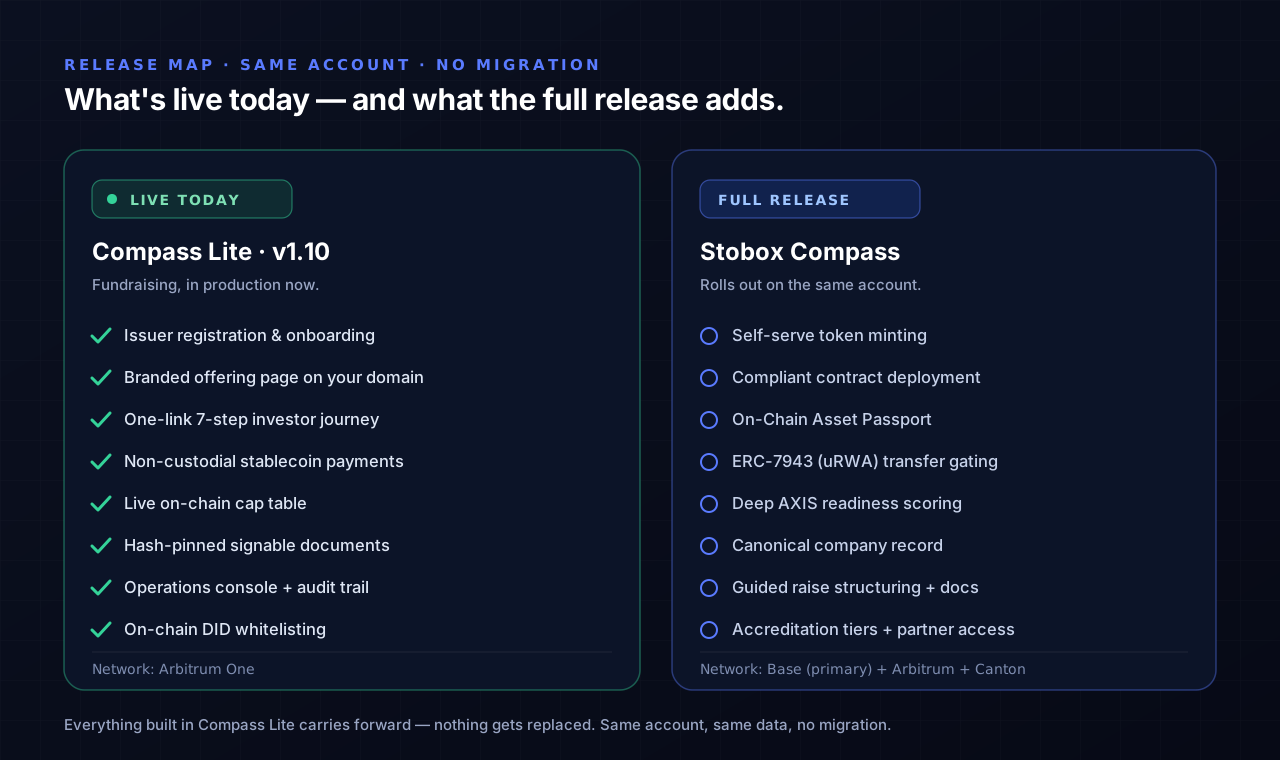
Live today in Compass Lite (v1.10): issuer registration and onboarding; a branded offering page on your own domain; the end-to-end, no-account investor journey; non-custodial stablecoin payments verified on-chain; a live on-chain cap table with identity reconciliation; versioned, hash-pinned signable documents; issuer-branded investor emails from your own sender; the full operations console with pipeline, delivery queue, and audit trail; on-chain DID whitelisting; KYC via Stripe Identity; and operator invites. Raises run on Arbitrum One, and where an asset needs tokens minted, they are issued with hands-on support from the Stobox team.
Added in the full release: self-serve token minting and compliant contract deployment from your console; the On-Chain Asset Passport; ERC-7943 transfer gating at the token level; deep, document-driven AXIS readiness scoring inside your workspace; the canonical company record; guided raise structuring with compliant document generation; accreditation tiers and deal-scoped regulated-partner access; and multi-chain issuance with Base as the primary network, plus Arbitrum and Canton. A free preview of AXIS readiness – the 25-question score – is already available today at stobox.io/readiness.
Pricing: software fees only, never a percentage
Compass follows the principle Stobox has held since 2018: you pay for software and technology, never for a slice of your raise or your asset. Any capital-raised or success fee is handled by a licensed broker-dealer, never by Stobox.
- Readiness – Free. The front door to Compass: the 25-question AXIS readiness check, the top gaps a broker or counsel would flag, no card and no sales call.
- Issuer, $499/month. One subscription, the same for every issuer. Run your raise on Compass Lite and manage your tokenized asset on-chain, with the cap table, the full investor lifecycle, multi-asset management and priority support.
The on-chain actions are priced flat and separately: an asset mint (passport) is $499 and a contract mint (deploy) is $749 – $1,248 to be fully on-chain – on top of the issuer subscription. Third-party gas, government, filing, and broker-dealer fees are paid directly to those parties; Stobox does not mark them up. (All figures are indicative pending final sign-off.)
Why "Lite" – and what comes next
We named this release honestly. Compass Lite is the fundraising-execution layer of Stobox Compass, live and load-bearing today; it is the current release of Stobox Compass, not a separate product. The full release completes the tokenization engine and folds in the structuring layers of the Stack – Stobox Intelligence for the canonical company record and Stobox Raisable for broker-accepted offering preparation – so the structuring work done once keeps compounding into every future raise.
The important part bears repeating: nothing gets replaced. Everything an issuer builds in Compass Lite – the offering, the investor records, the cap table, the signed documents – carries forward into the full release. Same account, same data, no migration. You are not buying into a product that will be deprecated; you are stepping onto the first floor of a platform that keeps adding floors above you.
Getting started
Three steps, starting with the free readiness score:
- Get your readiness score. The free 25-question AXIS readiness check scores your asset, legal, market, and operational readiness in about five minutes – the same methodology Stobox uses in real engagements. No card, no sales call.
- Register and onboard as an issuer at app.stobox.io – set up your workspace, brand, domain, and offering with a draft-to-live lifecycle that won't let an incomplete round reach investors.
- Go live and raise – your branded offering page goes live on your own domain, and you run the entire raise from one console.
Eight years of infrastructure. More than $305M in assets supported, 100+ clients, 20+ jurisdictions. And as of today, a production platform any qualifying company can walk into from a single link.
Frequently asked questions
What is Stobox Compass Lite? The current production release of Stobox Compass – a multi-tenant, non-custodial platform for running tokenized capital raises: a branded offering page on the issuer's own domain, a one-link investor journey, and a full operations console with a live on-chain cap table.
Is Compass Lite actually live in production? Yes – live at version 1.10, with issuers onboarding now at app.stobox.io. Every payment and delivery is verified against the chain, and the platform passed an independent enterprise security review with no critical issues found.
Who is Compass Lite for? Issuers running compliant tokenized raises – SMBs, founders, real estate and SPVs, funds, and energy or infrastructure projects – and their investors, who need only one link and a wallet.
Does Stobox hold investor funds or issuer assets? No. Funds move directly from the investor's verified wallet to the issuer's treasury, and tokens are delivered from the issuer's own wallet. Stobox never holds customer money and never takes a percentage of a raise.
Which blockchain does Compass Lite run on? Raises run on Arbitrum One today, verifiable on a public explorer. The full Compass tokenization engine issues on Base with ERC-7943 (uRWA) transfer gating.
How is investor identity handled? KYC is hosted by Stripe Identity and deliberately data-minimized: Compass keeps only pass/fail, the verified name, and country of residence – never document images or dates of birth. Verified once, an investor never re-verifies across that issuer's offerings.
What does Compass Lite cost? The AXIS readiness check is free; running a raise is a flat $499/month Issuer subscription plus flat on-chain action fees – never a percentage.
What happens when the full Compass release ships? The same account gains layers – deep readiness scoring, the canonical record, guided structuring, and self-serve minting. Everything built in Lite carries forward with no migration.
Ready to see where you stand? Get your free AXIS Readiness Score in five minutes, or explore Stobox Compass to see the full platform. If you would rather talk it through first, book a discovery call – we will map your asset, your jurisdiction, and your raise to what Compass Lite can do for you today.
Questions this raises
Answered plainly.
What is Stobox Compass Lite?
Compass Lite is the current production release of Stobox Compass – a multi-tenant, non-custodial platform for running tokenized capital raises. Each issuer gets a branded offering page on their own domain, a one-link investor journey (commitment, KYC, wallet-signed documents, stablecoin payment, on-chain token delivery), and a full operations console with a live on-chain cap table.
Is Compass Lite actually live in production?
Yes. Compass Lite is live at version 1.10, with issuers onboarding now at app.stobox.io. Offerings run on the issuer's own domain, every payment and delivery is verified against the chain, and the platform has passed an independent enterprise security review with no critical issues found.
Who is Compass Lite for?
Issuers running a compliant tokenized raise – SMBs and founders, real estate and SPVs, funds and asset managers, and energy or infrastructure projects – and their investors, who need only one link and a wallet: no account, no password, no app to install.
Does Stobox hold investor funds or issuer assets?
No. Compass Lite is non-custodial by construction. Funds move directly from the investor's verified wallet to the issuer's treasury; tokens are delivered from the issuer's own wallet. Stobox never holds customer money and never takes a percentage of a raise.
Which blockchain does Compass Lite run on?
Compass Lite raises run on Arbitrum One today, with every figure investors see readable and verifiable on a public explorer. The full Compass tokenization engine issues on Base as the primary settlement layer, with ERC-7943 (uRWA) transfer gating.
How is investor identity handled?
KYC is hosted by Stripe Identity and deliberately data-minimized: Compass keeps only pass/fail, the verified name, and country of residence. It never stores document images or dates of birth. An investor verified once never re-verifies across that issuer's offerings.
What does Compass Lite cost?
The AXIS readiness check at stobox.io/readiness is free. Running a raise is a flat software subscription – Issuer at $499/month, the same for every issuer – plus flat per-action on-chain fees. Stobox charges for software and technology only, never a percentage of the raise or the asset.
What happens when the full Stobox Compass release ships?
The same account simply gains layers: deep AXIS readiness scoring, the canonical company record, guided raise structuring with compliant document generation, and self-serve token minting with compliant contract deployment. Everything built in Compass Lite carries forward – same account, same data, no migration.