






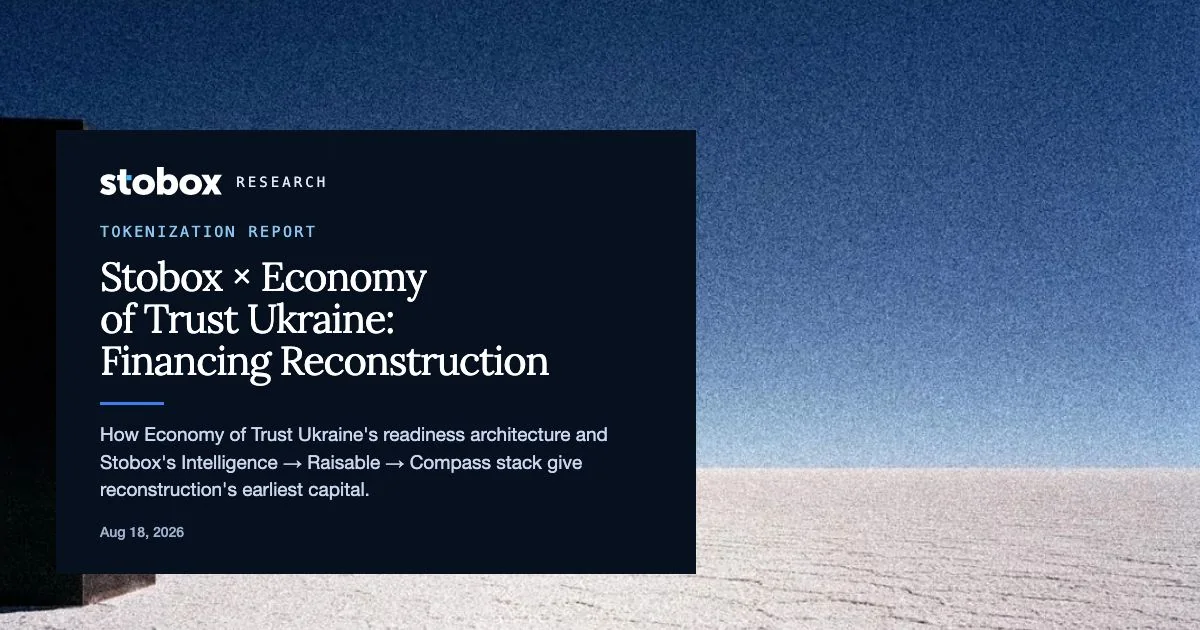
Financing What Doesn't Exist Yet: Stobox, Economy of Trust Ukraine, and the Capital Path for Reconstruction
Ukraine's reconstruction is an €800 billion+ need with a structural financing gap at the earliest stage: nobody funds the proving phase, because early capital has no path back to liquidity. Economy of Trust Ukraine built the governance architecture; Stobox provides the tokenization infrastructure that gives the earliest money a defined exit. Here is how the two fit together.
Contents 10 sections
Summary
Post-conflict reconstruction has a familiar failure pattern: money moves, but nobody can verify where, why, or with what result – so the serious money stops moving. Ukraine's rebuild is the largest test of that pattern in a generation: an assessed €800 billion+ need across 330,000+ damaged sites, against a decade-scale foreign-investment opportunity, per the country's own recovery assessments. Economy of Trust Ukraine (EoTU) was built to break the pattern with governance: municipal projects, organized into a verifiable pipeline, with readiness computed rather than asserted. Stobox is the ecosystem's named tokenization infrastructure partner – the layer that turns a project's verified record into something the earliest capital can actually buy, hold, and exit. This article lays out how the two fit together, and why the combination addresses reconstruction's least glamorous and most binding constraint: the money that must arrive first is the money with the worst exit.
Key Takeaways
- Reconstruction's binding constraint is not construction capital – it is the six-figure design-and-feasibility phase every project must clear before construction capital will look at it.
- EoTU organizes that phase: 675+ mayors, 849 municipalities, 30 Regional Economic Zones, twelve sectoral task forces, and gate-by-gate readiness records (its published figures).
- Early capital avoids the proving phase because it is illiquid and unverifiable. Tokenization fixes the second problem directly and the first as a consequence.
- The Stobox stack – Intelligence → Raisable → Compass – converts a gate-cleared project record into a regulated, tokenized security with a defined exit path.
- None of this is charity economics: it is a repricing of the earliest, most information-poor stage of a very large pipeline.
The paradox at the start of every rebuild
A country that must rebuild everything needs its first money at the point of maximum uncertainty. Before a bridge, a water plant, or an industrial park can attract a construction lender, someone has to pay for the unglamorous proving phase: feasibility studies, master plans, engineering assessments, legal structuring. On EoTU's own figures, that phase costs roughly €100,000 to €700,000+ per project – and a mid-size project typically consumes about half a million dollars in feasibility and master-planning work before a single counterparty can even assess it.
Construction-stage capital – development banks, mezzanine lenders, insured private credit – engages only after that phase produces an investable package. Which leaves the question every reconstruction program trips over: who funds the proving?
The honest answer today: almost nobody, and for two rational reasons.
- The risk is genuinely highest there. No governed evidence exists yet. An investor is underwriting a concept, in a wartime economy, with no diligence trail.
- The exit is worst there. Even when the project succeeds, the early backer holds an illiquid position for years – through design, procurement, construction, operation – with no secondary market and no defined liquidity event.
The result is structural: viable projects die at the cost of proving they are real. Not because the assets are bad, but because the earliest slice of the capital stack is unpriceable and unexitable.
What EoTU built: governance before capital
Economy of Trust Ukraine attacks the first problem – verifiability – at its source: the municipalities where projects are born.
Its published architecture, in brief:
- Direct municipal relationships: working relationships with 675+ mayors across 849 municipalities, roughly 80% of the country's non-occupied municipal base, with 30 Regional Economic Zones structured around 216 municipalities and further expansion tiers onboarding.
- A sectoral delivery machine: the Infrastructure International Coalition (IIC), organized into twelve task forces matching the twelve core infrastructure sectors – energy, water, waste, industrial base, mobility, hospitality, communications, three classes of real estate, workforce development, healthcare – with named engineering leadership and an international master project manager coordinating cross-sector work.
- Computed readiness, not asserted readiness: each project moves through a gate architecture in which evidence is checked for source and freshness, and a project's stage is a computed verdict rather than a self-description. A project is not "ready" because its sponsor says so; it is ready when its record clears the gate.
- An anti-corruption precondition: governance certification is required before a project reaches the investor-facing pipeline at all – a design choice that treats trust as an input, not a hoped-for output.
This is the part of reconstruction finance that cannot be improvised later: the governed evidence trail. It is also, deliberately, the same shape of artifact the capital markets side needs – which is where Stobox comes in.
What Stobox adds: the record becomes an instrument
Stobox joined the EoTU Business Coalition as the ecosystem's tokenization infrastructure partner. The division of labor is clean: EoTU governs whether a project is real; Stobox makes the resulting record financeable. The stack works in three layers.
Stobox Intelligence – one canonical record per project. Technical feasibility, financials, legal and ownership structure, permits, task-force assessments – organized into a single source-linked record where every fact carries its document and its date, scored by the AXIS Readiness Score across seven pillars (Asset Quality, Legal & Compliance, Transparency, Technology & Protocol, Liquidity & Markets, Governance, Risk Mitigation). Diligence stops being re-established three or four times by different parties – the engineer, the agency, the lender, the insurer – because a governed conclusion finally transfers between them.
Raisable – the regulated offering. From that record, Raisable structures a dual-track Regulation D 506(c) + Regulation S offering and routes it to a licensed broker-dealer of record. Stobox charges a flat fee rather than a percentage of the raise, so the project's economics are not consumed by the machinery that finances it.
Compass – the tokenized security and its lifecycle. The early backer's stake is issued as a permissioned tokenized security with an On-Chain Asset Passport, non-custodial by design, with eligibility and transfer rules enforced in the contract itself. The holder has a registered, on-chain claim – not a paper promise in a drawer.
The exit path, made concrete
Put the two architectures together and the earliest capital's position changes shape:
- A municipality originates a project; it enters the pipeline through EoTU's feasibility program.
- Sectoral task forces shape it; the readiness architecture computes its gate status; evidence accumulates as a governed record.
- Early capital funds the proving phase – the gates where risk is highest – in exchange for a stake in the project's rights.
- When the project clears its readiness gates, its record is already in the shape an offering needs. The Stobox stack converts it: Intelligence organizes, Raisable structures, Compass issues.
- The early backer now holds a liquid, on-chain-registered security instead of an illiquid multi-year position – and can exit into the much larger pool of construction-stage and yield-seeking capital that was never willing to fund the proving phase but is happy to buy a proven, governed asset.
And because the pipeline produces projects in annual cohorts rather than one at a time, tokenization happens incrementally: each cohort of gate-cleared projects can be converted and offered as it qualifies. One illiquid, all-or-nothing liquidity event becomes a rolling series of smaller, exitable units. That single design property – rolling tokenized exits – is what turns the proving phase from a charitable act into an investable asset class.
Why this is a repricing, not a subsidy
It is worth being precise about what changes economically, because none of it relies on sentiment:
- Information risk falls because evidence is governed, source-linked, and fresh – the record answers diligence questions instead of the sponsor answering them differently each time.
- Liquidity risk falls because the exit is a defined conversion of a record into a regulated instrument, on infrastructure that already exists, rather than a hoped-for refinancing years away.
- Verification cost falls per project because the first project pays for the record structure and every subsequent project in the pipeline reuses it.
What remains is the risk that should be priced – war, execution, demand – now separable from the risks that were merely artifacts of missing infrastructure. Capital can finally distinguish a good project with a thin file from a bad project with a thick one.
What this means for the people involved
For municipalities: a path from "we need a water plant" to "our project is an investable, governed record" that does not depend on winning a lottery of donor attention.
For early-stage investors: the proving phase of a very large pipeline, with computed readiness on the way in and a tokenized, regulated exit on the way out – the two things that stage has never had.
For international partners and coalition members: a delivery architecture where each participant's work product – engineering, legal, financial – lands in a shared governed record instead of a private PDF, and compounds across the pipeline.
For the rebuild itself: the failure pattern inverted. Money moves because everyone can verify where, why, and with what result.
The honest caveats
Reconstruction investing carries risks that no architecture removes: war risk and physical destruction, currency and capital controls, regulatory evolution in Ukraine's virtual-asset and securities law, and the fact that parts of this institutional machinery are newly formed and not yet operating at scale. EoTU's own investor materials disclose these plainly, and that candor is itself part of the governance argument. Nothing here is a solicitation; any actual offering happens through definitive documents and licensed intermediaries, jurisdiction by jurisdiction.
But the structural claim stands on its own: reconstruction will be financed in gates, and the gate everyone skips is the one where projects are born or die. Building the verification and exit infrastructure for exactly that gate is not a side quest of the rebuild. It is the rebuild's capital formation, done in the right order.
FAQ
What is Economy of Trust Ukraine (EoTU)?
EoTU is a Ukrainian economic-development ecosystem that organizes municipal reconstruction into an investable pipeline. Its published figures include working relationships with 675+ mayors across 849 municipalities, 30 Regional Economic Zones covering 216 municipalities, and an Infrastructure International Coalition organized into twelve sectoral task forces.
What is Stobox's role in the EoTU ecosystem?
Stobox is a member of the EoTU Business Coalition and the ecosystem's named tokenization infrastructure partner. When a project's readiness record is complete, the Stobox stack converts it into a regulated, tokenized security: Intelligence organizes the evidence, Raisable structures the offering through a licensed broker-dealer, and Compass issues and operates the on-chain instrument.
Why does reconstruction financing fail at the earliest stage?
Every municipal project needs a six-figure design and feasibility phase before any construction-stage capital will engage, and the capital willing to fund that phase barely exists: the risk is highest, no governed evidence exists yet to underwrite against, and the position is illiquid for years. The result is that viable projects die at the cost of proving they are real.
How does tokenization give early reconstruction capital an exit?
Once a project clears its readiness gates as a governed record, that record can be converted into a regulated tokenized security. Early backers then hold a liquid, on-chain-registered claim instead of an illiquid multi-year position, and successive project cohorts can be tokenized as they qualify, creating a rolling series of exit opportunities.
Is this investment advice or an offer?
No. This article is educational. Stobox is a technology and infrastructure provider; any offering would be made only through definitive documentation and licensed intermediaries, and prospective investors should conduct independent diligence with qualified counsel.
Stobox is a technology and infrastructure provider and a member of the Economy of Trust Ukraine Business Coalition. EoTU pipeline figures cited above are from EoTU's published materials. This article is educational and is not legal, tax, or investment advice.
Questions this raises
Answered plainly.
What is Economy of Trust Ukraine (EoTU)?
EoTU is a Ukrainian economic-development ecosystem that organizes municipal reconstruction into an investable pipeline. Its published figures include working relationships with 675+ mayors across 849 municipalities, 30 Regional Economic Zones covering 216 municipalities, and an Infrastructure International Coalition organized into twelve sectoral task forces.
What is Stobox's role in the EoTU ecosystem?
Stobox is a member of the EoTU Business Coalition and the ecosystem's named tokenization infrastructure partner. When a project's readiness record is complete, the Stobox stack converts it into a regulated, tokenized security: Intelligence organizes the evidence, Raisable structures the offering through a licensed broker-dealer, and Compass issues and operates the on-chain instrument.
Why does reconstruction financing fail at the earliest stage?
Every municipal project needs a six-figure design and feasibility phase before any construction-stage capital will engage, and the capital willing to fund that phase barely exists: the risk is highest, no governed evidence exists yet to underwrite against, and the position is illiquid for years. The result is that viable projects die at the cost of proving they are real.
How does tokenization give early reconstruction capital an exit?
Once a project clears its readiness gates as a governed record, that record can be converted into a regulated tokenized security. Early backers then hold a liquid, on-chain-registered claim instead of an illiquid multi-year position, and successive project cohorts can be tokenized as they qualify, creating a rolling series of exit opportunities.
Is this investment advice or an offer?
No. This article is educational. Stobox is a technology and infrastructure provider; any offering would be made only through definitive documentation and licensed intermediaries, and prospective investors should conduct independent diligence with qualified counsel.