







October 2026 in Review: The RWA Market, the Stobox Build, and Rome
A month when the tokenized asset market grew while its largest category stood still, issuers started refusing tokenized versions of their own shares, and the SEC spent its attention on custody rather than on a statute. Plus a look inside Stobox RWA Terminal, where Orbit stands in testing, and where to find us in Rome on 3 November.
October was not a growth month for tokenization. It was a consent month, a custody month and a counting month, and all three are more useful than growth.
Executive Summary
The headline number went up and the most important number did not. Tokenized real-world assets finished October somewhere between $39 billion and $46 billion depending on which tracker you trust, and the gap between those two figures is itself one of the month’s findings. Inside that total, the category that carried the market for two years, tokenized US Treasuries, stood still and then slipped, while the money moved toward equities, gold and private credit. Meanwhile the argument changed shape. Companies began putting in writing that they do not want tokenized versions of their own shares trading without them, the SEC spent its October on custody and on examinations rather than on a tokenization statute, and a joint venture between OKX and the owner of the New York Stock Exchange filed to open a venue for tokenized stocks that trade around the clock. At Stobox we spent the month on two things: finishing Stobox RWA Terminal, which opens this month, and pushing Orbit through the last stages of closed testing.
Key Takeaways
- The market has no agreed size. RWA.xyz and Token Terminal were about $7 billion apart in October. Until the industry agrees what counts as distributed value, every market-size chart is an argument rather than a measurement.
- Treasuries stopped being the whole story. The flagship category went flat and then slightly negative over the 30 days to 29 October, with more than $600 million of outflows from the largest single fund, while the overall market kept climbing.
- Consent became the live issue. Of roughly 63 companies on the initial list for a tokenized stock venue, 33 have opted out. That is the clearest signal of the month: issuers want a say in whether a tokenized claim on their equity exists.
- The SEC worked on plumbing, not on a statute. A custody proposal on 1 October whose definitions reach tokenized securities, and tokenization named in the fiscal 2027 examination priorities on 23 October.
- Stobox RWA Terminal is finished and opens this month. One entry point, a non-custodial wallet on Base, a catalogue that names every price source and venue, and a board of real-world projects carrying their stage and who assessed them.
- Orbit is in the last stages of closed testing. Code freeze candidate in, a full operational dry run completed, independent audits next. No mainnet date until the audits are done.
- Rome, 3 to 5 November. Gene speaks on 3 November, Stobox is shortlisted for Best Tokenization and RWA Project, and the floor is where the real work happens.
The market in October
What the numbers did, and what they are worthTwo trackers, one market, seven billion dollars apart
Start with the problem under every chart you saw last month. RWA.xyz reported roughly $39.02 billion of distributed tokenized asset value on 9 October and about $39.23 billion on 15 October, excluding stablecoins, against roughly $21.5 billion at the start of the year. That is growth of about 81% in nine months, and it is a real number. Token Terminal, counting differently, put the same market near $46.3 billion over the same period.
Neither is wrong. They measure different things: distributed value against represented value, which categories count, whether stablecoins are in or out, how many chains are indexed. But a market whose size is reported with a $7 billion spread does not yet have an audited denominator, and the people deciding whether to allocate into it can see that.
Figure 1 · October 2026, to scale
The market, its biggest category, and the gap between counters
The flagship category stood still
Tokenized US Treasury funds were the proof case for the whole sector: a boring instrument, an obvious buyer, and a settlement advantage that needed no story. In October that engine idled. RWA.xyz showed about $14.54 billion on 29 October, roughly 0.51% below where it stood 30 days earlier, after about $14.7 billion in late September. Over the same 30-day window BlackRock’s BUIDL fund recorded more than $600 million of outflows, and sat near $2.2 billion on 20 October.
This is not a collapse. It is a category finding its level while the rest of the market grows around it, which is exactly what happens when the easy money has already been placed and the next dollar has to come from somewhere harder. The growth in October came from equities, from gold, and from private credit, which is to say from assets that need documents rather than from assets that need a rate.
A caution worth repeating about every figure in this section: much of the reported value is held rather than traded. One October analysis found more than half of reported RWA value sitting idle. Value on chain is not the same thing as a market.
Issuers started saying no, in writing
The most interesting thing that happened in October did not happen on a chart.
On 4 October, OKXICE, a 50-50 joint venture between the exchange OKX and Intercontinental Exchange, the owner of the New York Stock Exchange, notified the SEC that it intends to open a Tokenized Securities Venue under the SEC’s Innovation Exemption of 17 September. The plan: around 63 US companies, trading 24 hours a day, seven days a week, each stock paired against a stablecoin. No launch date was given.
Then the companies answered. By late October, 33 of them had opted out, close to half the original list. The month before, 26 companies had formally objected to the tokenization of their own shares and the Securities Industry and Financial Markets Association had asked the SEC to make silence count as a refusal rather than as consent.
A tokenized claim on a company that the company did not agree to is not innovation. It is an unanswered letter with a contract address.
The October lessonFor anyone building in this sector, that is the signal to take seriously. The constraint on tokenized equities in 2027 will not be throughput or custody. It will be whether the issuer said yes, in a document, in a way a lawyer can read two years later.
Washington worked on the plumbing
October’s regulatory activity was deliberate and unglamorous, which is usually a good sign.
- Custody proposalThe SEC proposed a framework for how investment advisers and regulated funds may custody crypto assets, under the Advisers Act and the Investment Company Act. Releases IA-7023 and IC-36353, file number S7-2026-35, published in the Federal Register on 6 October with a comment date of 7 December. The proposed definition of crypto asset reaches tokenized securities, which is why this matters here. Press release 2026-100.
- OKXICE filesNotice of intent to launch a Tokenized Securities Venue under the Innovation Exemption, about 63 companies, 24/7 trading against stablecoins, no launch date.
- Securitize StocksSecuritize launched tokenized access to major US equities for eligible investors.
- Comments closeThe comment window closed on the SEC’s proposed crypto asset offering rules, the package trailed as Regulation Crypto Assets.
- Examination prioritiesThe SEC’s Division of Examinations named tokenization among its focus areas for fiscal 2027, across more than 34,000 registrants. Press release 2026-109.
- Securitize and StellarSecuritize, the transfer agent behind several of the largest tokenized funds, said it will integrate with Stellar, which held about $3.77 billion of distributed RWA value that day.
Note what is absent. There is still no US statute: the CLARITY Act failed to invoke cloture in the Senate on 15 September 2026, so every one of the items above is an agency acting inside existing law. Rules written that way can be unwritten, and the firms building on them know it.
Stobox RWA Terminal
What we finished in October, screen by screenStobox RWA Terminal is the single front door to everything we build, and it opens this month. One entry point, two modes. As an individual you get a wallet, assets and trading. As a business you get an organization, projects and a readiness assessment. It runs on Base, and only on Base: one network means one set of costs, one explorer and one place for things to go wrong.
Stobox never holds the funds. The wallet is yours, created with a passkey or connected from the one you already use.
One door, and behind it the whole stack
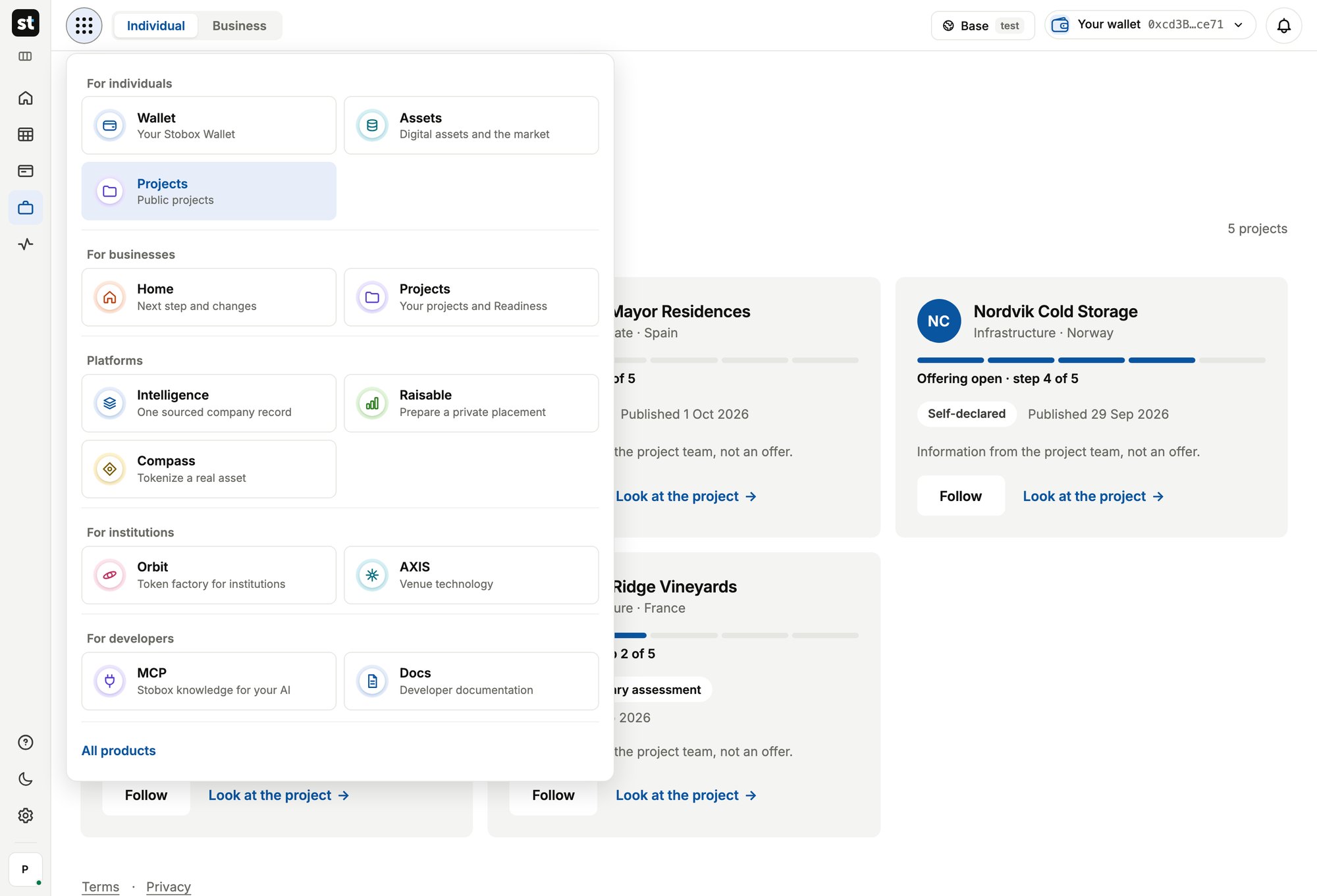
The nine-dot launcher in the corner is the map of what Stobox is. Wallet and Assets for a person. Projects for a business, with Readiness. Then the platforms: Intelligence, one sourced company record; Raisable, to prepare a private placement; Compass, to tokenize a real asset. Then the institutional pieces: Orbit, the token factory, and AXIS, venue technology. And, for developers, an MCP server that gives Stobox knowledge to your own AI, and the docs.
Real-world assets on Base, with their stage printed on them
This is the screen we would point at if we could only show one. The projects board lists real-world assets that issuers have published: a solar park in Portugal, apartments in Spain, cold storage in Norway, rental property in Ireland, vineyards in France. Renewable energy, real estate, infrastructure, agriculture.
Three things on every card, and they are the whole argument:
- Where it is on the ladder. Concept, Documents ready, Structuring, Offering open, Token live, drawn as a five-step bar so nobody has to guess what “in progress” means.
- Who says so. Each card carries its signature: Self-declared, Stobox preliminary assessment, or Analysed with Stobox Intelligence. The reader knows how much work stands behind what they are reading before they read it.
- What it is not. Information from the project team, not an offer. On every card, in the same size as everything else.
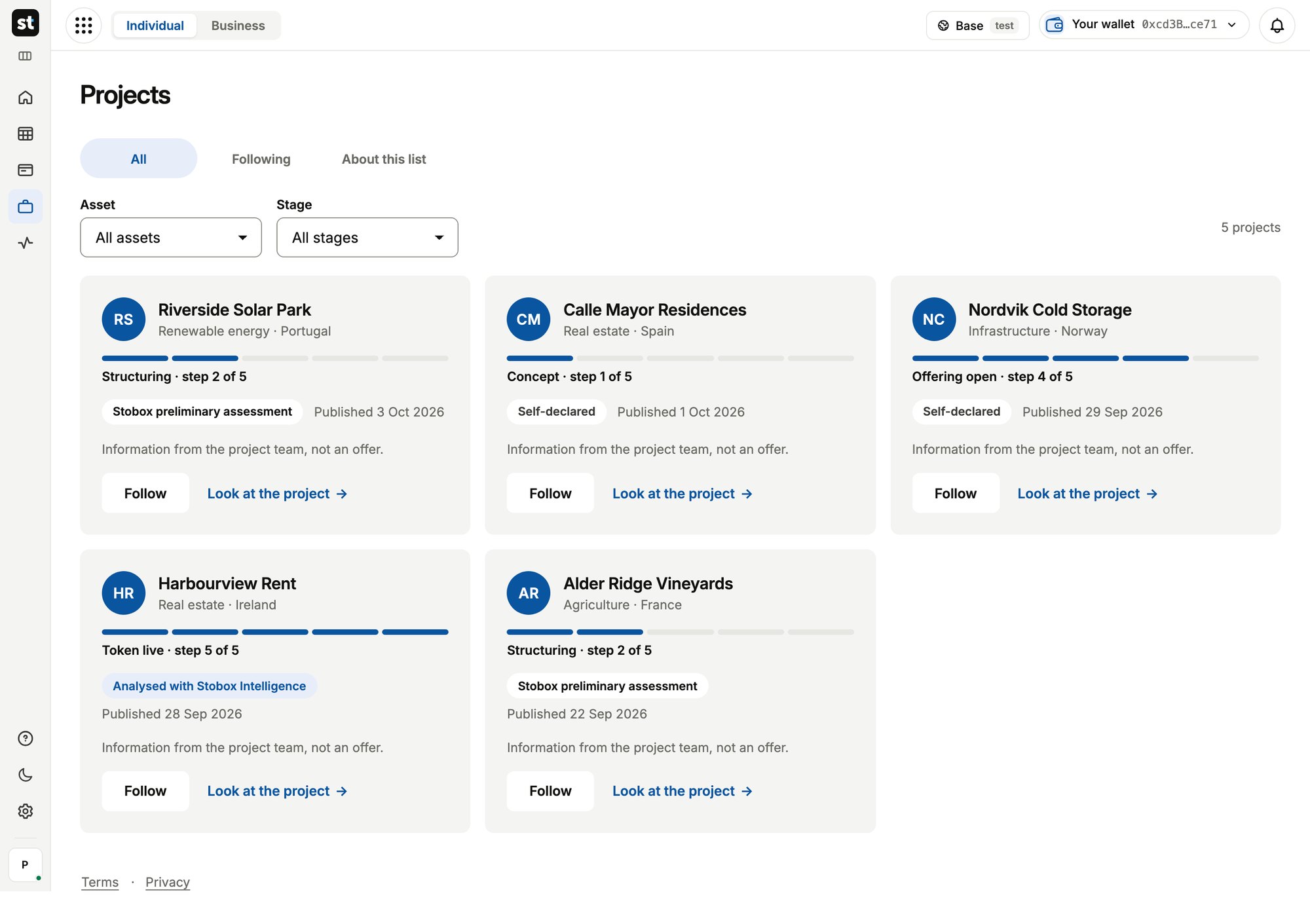
These are captures of the current build, taken on 1 November 2026 on a local development copy with the seeded test projects the team builds against. The projects are samples, not clients, and the data in them is test data.
Tokenized stocks: shown, named, and not tradable yet
The catalogue at opening carries tokenized stocks beside the live assets, and we are deliberately careful about them. They are shown, with their venue, and not tradable inside the terminal at launch. They are listed the way Base lists them, by ticker and company name, and they are not shown to people in the United States.
Figure 2 · The catalogue when the doors open
What is in it, and what you can do with each part
Stobox Token, Ether, Coinbase Wrapped BTC, USD Coin and Euro Coin, all on Base.
Listed as Base lists them, by ticker and company name, in alphabetical order, with the venue named and a neutral link. No logos, no rankings, no selections, nothing sorted by what went up.
Not shown to people in the United States.
A single honest line rather than an empty tab or a token we would not stand behind.
Published issuer projects with their stage, their signature and the plain line that they are not an offer.
The decision that shaped the rest of the month
Not a feature, a boundary. The terminal is the display case, and the analysis lives in the products that produce it. Intelligence reads the documents and holds the record. Compass holds the token and the register. Raisable holds the raise. The terminal holds the index and a short link to each, and it is forbidden to keep a second copy of a fact, its own document analysis or its own values.
That sounds like housekeeping. It is the difference between one record you can point at and a quiet second truth that drifts away from the first one, and the second outcome is the thing that breaks a data room two years after the deal.
The unglamorous half of October
Hardening, not features: a security review of sign-in, two-factor on production, off-site encrypted backups with a restore drill actually run rather than assumed, and a full disaster recovery exercise on 30 October that produced 22 findings and two corrections to our own instructions. The legal texts that a user and an outside reader see were handed to counsel to write rather than drafted by the people building the product.
We also settled how the company describes itself. The one-page version, fixed on 28 October: AI infrastructure for private capital. Since 2018, 100+ companies across 20+ countries and four continents, $305M+ in assets structured and supported.
Orbit, in the last stages of testing
The protocol under the next generation of Stobox tokensStobox Orbit is the largest piece of engineering we have undertaken and the one that changes what Stobox is. It is a permissioned tokenization protocol: contracts that issue and govern tokens for real-world assets, built on the ERC-7943 (uRWA) standard, to which Stobox is a contributor. In practice it is a new backend, and it is where tokenized shares and other instruments will be issued from.
A plain token can be sent by anyone to anyone. A security cannot. So in Orbit every transfer is checked against the token’s own rules before it executes, and anyone can ask the question first, for free, and get an answer that names the rule. A compliance bug can stop trading. It can never corrupt supply.
Figure 3 · One transfer, seven questions
What the protocol asks before a balance moves
Where it actually stands
Orbit is in closed testing, on testnet. Through October it moved from building to proving, and the honest summary at the end of the month is this.
- Code freeze candidate mergedThe service code for a first client is in, and the branch is frozen for review rather than still moving under the reviewers.
- A full operational dry runThe whole thing stood up on a production-shaped deployment rather than on a developer machine: images built reproducibly, every service healthy, backup and rollback exercised, encrypted traffic between zones verified.
- The dry run found a real oneThree services were reading the wrong registry role, so no request reached the signing step at all. That is exactly the class of fault a dry run exists to catch, and it is fixed and merged.
- Independent auditsA repeat of the dry run on the frozen build, then outside audit teams. Mainnet comes after that, and not before.
We are not giving Orbit a mainnet date. Testing runs until it is done, the audits have to be clean, and the switch is thrown by hand. A protocol that governs other people’s securities does not get shipped to a calendar.
Where we are on the roadmap
What ships next, in what order, and what holds it upA roadmap is a statement of intent, not a promise. Here is the honest version.
Figure 4 · The next three steps
What each step adds, and what has to be true first
Stobox RWA Terminal opens. Wallet, assets with a named price source and venue, trading, the business space, projects and the free readiness assessment. Access open and free at launch.
Done and in test. The remaining work is operational rather than architectural.
The project as a company file: the stage header, every process in one status vocabulary, product cards, the six business facts, the right-hand column.
The specification corrected so that the terminal keeps no record and no values of its own. That correction was made at the end of October.
The reader as a first-class entity, personal and shared links with expiry, entry by an emailed code, the data room with access levels, the reader’s view, who looked, and a question to the team.
A working mail channel, legal texts for an outside reader written by counsel, and a security review before the first stranger receives a link that will live for years.
Insights drawn from the Intelligence record, the token read from Base, compliance, the round, the partner link and the payment screen.
Extraction accuracy measured on a real document set before any AI-derived insight is shown to an outside reader. Not estimated. Measured.
A project moves up a five-step ladder, and only the last step is set by the chain rather than by a person.
Figure 5 · The ladder a reader sees
Five steps, and tokenization is the last one
On price, one thing and no figures: the private room an issuer shares with a named reader is free. A reader invited by name does not occupy a paid seat, because the room is how an issuer shows their work, not a seat we sell. Going public is a different act, and it is gated rather than priced separately: a project reaches the open board only with a subscription, a verified company and our approval. The figures belong in the product on the day the feature opens, not in a blog post ahead of it.
Two things about the order, because they are counter-intuitive and we would rather explain them than be asked.
The order of building is not the order of shipping. Value says Intelligence first, then tokenization, then the raise. That holds for the order the tabs open to users. Building starts along the longest path instead, which means the pieces that depend on someone else’s calendar go first and the pieces we control entirely are slotted around them. Base comes early for exactly that reason: it is cheap, it needs nobody outside the team, and it gives the token view real numbers before anything else is connected.
We are naming the gates rather than the dates. The room cannot open to an outside reader until there is a mail channel, until counsel has written the texts that reader sees, and until a security review has looked at a link that will be alive in somebody’s inbox for years. Those are not scheduling risks. They are conditions, and a product that opens before they are met is a product that gets one chance to be wrong in public.
What we are deliberately not publishing here: internal estimates, team capacity and the dates attached to them. We have them, they move, and a figure that moves twice in a month is worth less than the gate it was supposed to describe.
Rome, 3 to 5 November
Where to find us this week

The Tokenization and RWA category is being awarded for the first time this year. We will say how it went either way.
If you are going, this is the useful part: Gene is there for conversations, not for stand traffic. Tokenizing something and want a straight answer about what it would actually take. Running an issuance platform and wondering where we overlap and where we do not. Building custody, identity or payment rails and want to compare notes. Write before you arrive and we will find a time that is not a corridor.
We have spent eight years writing the records behind other people’s assets. Rome is three days of finding out whose records need writing next.
Stobox · Rome, 3 to 5 November 2026
We keep building and we keep taking clients. That is the whole plan for November: the terminal opens, Orbit goes to audit, and we talk to the people who want to put a real asset on chain properly rather than quickly.
So if you are looking at Intelligence, or you want to tokenize something, come and talk to us. You do not have to arrive with the answers. We cover the whole way through: reading the documents you already have into one record, structuring the thing, issuing the token with its rules inside it, and giving the people who need to read it a room to read it in. That is the point of building all of it ourselves.
Talk to usWhat we are watching in November
Four things, and we will report on all four.
- Whether the treasury category turns. A second flat month would mean the easy allocation is finished and the sector has to earn the next dollar with assets that need documents.
- How many more issuers opt out. The opt-out count is the cleanest live measure of whether tokenized equities proceed with consent or without it.
- What the custody comments say. The SEC’s crypto custody proposal takes comments until 7 December, and the definition that reaches tokenized securities is the line to read.
- Our own gates. Stobox RWA Terminal opens this month, and Orbit goes to independent audit. We will say here when the doors are open, and what is behind them on day one rather than in the version after.
Stobox Technologies Inc. is a technology provider. It is not a broker-dealer, an investment adviser, an exchange or a custodian, and nothing above is investment, legal or tax advice. Market figures are attributed to the public trackers and primary sources named beside them and were read on the dates stated. Product captures are from the staging build and carry test data. Roadmap items are statements of intent, not commitments. SiGMA and AIBC are trademarks of their respective owners and are shown to identify the event Stobox is attending.