






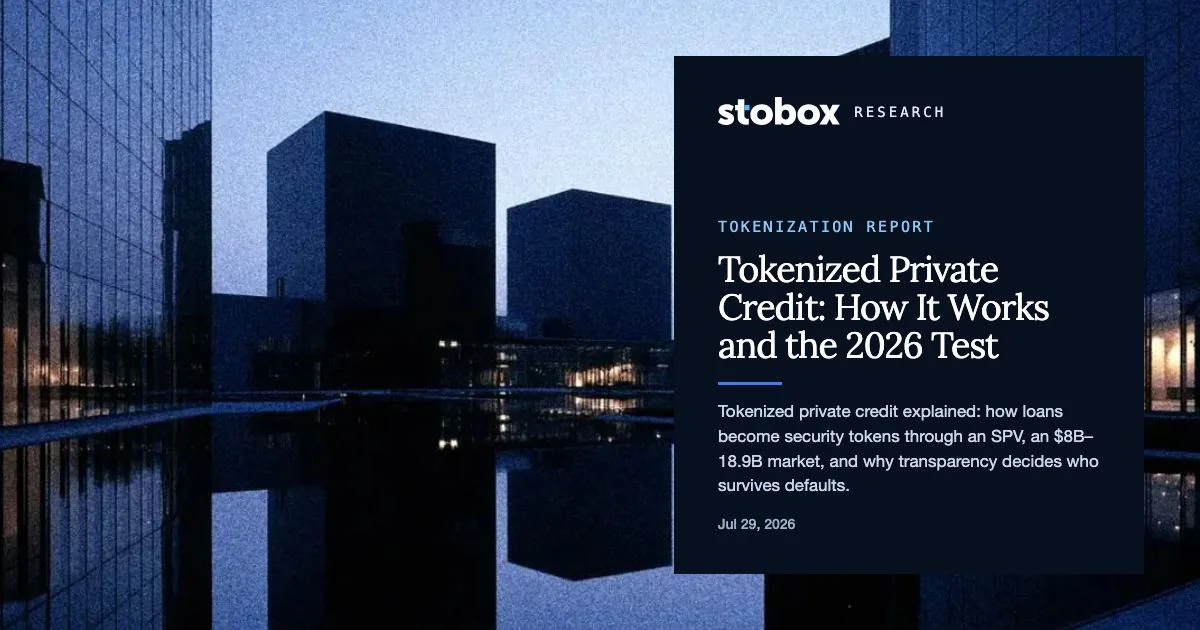
Tokenized Private Credit Meets Its First Downturn: Why Transparency, Not Tokens, Decides Who Survives
Private credit became one of the largest tokenized RWA segments just as default rates rose. The collision is the real test: tokenization does not fix credit risk, it fixes the opacity that makes credit crises worse.
Contents 7 sections
Tokenized private credit is a private loan, or a pool of loans, whose ownership is recorded as a security token on a blockchain. The loans sit in a fund or special purpose vehicle (SPV); the token is a note issued by that vehicle or an interest in it, so the holder owns a legal claim on off-chain debt. Private credit tokenization works in five moves: a lender originates loans, places them in the vehicle, the vehicle issues notes or fund interests as tokens under a securities exemption, transfer rules in the token contract limit who may hold them, and servicing data, interest and redemptions flow to the wallets on the register. What tokenization does not change is the borrower. A loan that would default on paper defaults on-chain too.
Stobox is a technology provider, not a broker-dealer, investment adviser, custodian or law firm, and nothing here is investment advice.
Key takeaways
- Size depends on the tracker. The Stobox State of RWA 2026 report puts tokenized private credit at $8B–18.9B, with $33.7B originated all-time. On 26 September 2026, rwa.xyz showed $7.90B of distributed and $36.65B of represented tokenized credit across 2,609 assets and 197,557 holders.
- It scaled into stress. Proskauer's Private Credit Default Index, which counts only senior secured and unitranche loans, read 2.73% for Q1 2026, up from 1.84% in Q3 2025. Broader measures that count more of the market report higher rates, and no two agree, which is the opacity problem in one number.
- Tokenization does not change credit risk. It changes visibility, servicing and settlement.
- Most tokenized credit does not trade. Activity is dominated by mint-and-redeem cycles, and one mid-2026 analysis found 56% of reported RWA value idle.
- The institutional template is a data stack, not a token. Galaxy's $75 million tokenized CLO came with a trustee-custodian doing real-time collateral monitoring and a separate platform verifying loan performance continuously.
Executive Summary
Private credit has become one of the largest segments of the tokenized real-world asset market, and it reached that position at the wrong moment. The overall on-chain RWA market reached about $33.5 billion in July 2026 per rwa.xyz, and $38.54 billion of distributed value on 26 September 2026. Over the same months the traditional asset class came under visible strain: default indices rose through the first quarter, and a major manager, Blue Owl, ended regular quarterly liquidity payments in one of its retail credit funds.
This is the collision that matters. Tokenization does not change whether a borrower can repay a loan. What it changes is whether investors can see the loan clearly, whether servicing is automated, and whether reporting arrives continuously instead of after a fund limits redemptions. The first on-chain credit stress event will separate platforms that tokenized a spreadsheet from those that built compliance and transparency infrastructure underneath. This report argues that distinction is the whole game.
How private credit tokenization works
A tokenized credit product is a legal structure first and a token second. The sequence below is the standard one; the full walkthrough is in our guide on how to tokenize private credit.
- Loan origination. A lender or credit fund originates loans: direct lending, receivables, trade finance, asset-backed debt. Underwriting happens here, off-chain, exactly as it would without a token. Receivables follow the same path, covered in how to tokenize invoices and receivables.
- SPV or fund. The loans are placed in a bankruptcy-remote SPV or in a fund. This vehicle is what investors actually have a claim against.
- Note or fund-interest token. The vehicle issues notes (a debt claim with a coupon and maturity) or fund interests (a share of NAV), represented as security tokens. In the US this is usually a private placement: under Rule 506(c) every purchaser must be accredited and the issuer must take reasonable steps to verify it; offshore sales go under Reg S. The exemptions are compared in Reg D vs Reg S vs Reg CF vs Reg A.
- Transfer rules. The token contract checks eligibility, jurisdiction and lockups on every transfer, so a token can only move to a wallet cleared to hold it. ERC-3643 and ERC-7943 are the two common standards; see ERC-3643 vs ERC-7943. Some funds wrap shares in a vault interface, which needs the same gate: ERC-4626 vaults for tokenized private credit.
- Reporting and servicing. Loan performance, NAV, interest and redemptions flow from the servicer to holders. This is the step that decides whether the product survives a default, and the rest of this report is about it.
The Moment Private Credit Went On-Chain, and Why the Timing Is the Story
Private credit is now one of the largest tokenized asset classes, and it arrived there just as the underlying market entered a stressed period. That timing is not a footnote. It is the test.
Start with the size, because the size itself is disputed. The State of RWA 2026 report gives a range of $8 billion (active on-chain assets, conservative) to $18.9 billion (broader counting), with $33.7 billion originated all-time. On 26 September 2026 rwa.xyz counted $7.90 billion of distributed tokenized credit and $36.65 billion of represented value, the latter including assets recorded on platforms where the token is not freely transferable. Choose a definition before you quote a number.
Now the other side of the ledger. The traditional private credit market that these tokens reference is under visible strain. Proskauer's Private Credit Default Index, covering 697 loans and $189.2 billion of principal, recorded 2.73% for Q1 2026, up from 1.84% in Q3 2025 (Proskauer).
Redemption pressure has reached household names. In February 2026 Blue Owl sold $600 million of loans from Blue Owl Capital Corporation II, a semi-liquid private credit fund for US retail investors, and said the fund would end regular quarterly liquidity payments (CNBC).
The data does not all point one way, and that is part of the argument. Proskauer's Q2 2026 reading fell to 2.51% across 716 loans (Proskauer). "The slight decline in the overall default rate this quarter reinforces the resilience of the private credit market despite continued economic uncertainty," said Stephen A. Boyko, co-founder of Proskauer's Private Credit Group. Wider measures that count more of the market report higher default rates than this index, and the gap between them tells you how little outsiders can see inside a private loan book.
So the picture is a fast-growing on-chain segment attaching itself to an asset class under strain and hard to read from outside. The optimistic read is that tokenization is finally reaching the market it was built for. The honest read is that this is the first real exam.
What Tokenization Does Not Fix
Direct answer: tokenization does not change credit quality. If a borrower cannot service a loan, the loan defaults whether the claim lives in a bank's servicing system or in a smart contract.
This is the single most important thing for a CEO or allocator to internalize before reading another tokenization pitch. The blockchain is a ledger and a settlement rail. It is not an underwriter.
There is a second, subtler risk. Tokenized markets can import the bad habits of the market they digitize. A segment that grows fast attracts originators who compete on volume, and the pressure to loosen underwriting to win market share does not disappear because the note is on-chain. No standardized on-chain credit rating exists yet, and redemption terms differ widely from product to product.
There is also a liquidity illusion to dismantle. A token is not a market. The State of RWA 2026 report notes that tokenized Treasuries and private credit, the two largest segments, trade thinly, with activity dominated by mint-and-redeem cycles rather than secondary transfers; by one mid-2026 analysis, 56% of reported RWA value sits idle. Liquidity needs eligible buyers, a venue and transfer rules designed for it.
The uncomfortable conclusion: a lot of "tokenized private credit" today is a fundraising wrapper, not a liquid instrument. That is not a failure by itself. But it means the value tokenization adds has to come from somewhere other than the token.
Where the Real Value Is: Transparency as Infrastructure
Direct answer: tokenization earns its keep by fixing the opacity, manual servicing, and delayed reporting that make private credit fragile, not by minting a token. In a downturn, that visibility is worth more than it is in a boom.
Private credit's weak points are well known to anyone who has allocated to it: loan-level data arrives late and in the manager's format, valuations are infrequent, servicing is manual, and the investor learns about stress when the fund limits redemptions. These are the problems programmable infrastructure can address. A register that updates at every transfer, eligibility checked by the token contract, and payment and delivery settled in one transaction (delivery-versus-payment, where both legs complete or neither does) remove reconciliation work and counterparty exposure that paper processes carry.
The most instructive institutional deal already builds this in. Galaxy's tokenized CLO was not just a token launch; it was a full data-and-custody stack (Galaxy press release, 15 January 2026):
| Role | Party in Galaxy CLO 2025-1 |
|---|---|
| Issuance and tokenization of the debt tranches, on Avalanche | INX |
| Bond trustee, qualified custodian, collateral and administrative agent with real-time collateral monitoring | Anchorage Digital Bank |
| Continuous verification of loan performance and collateralization | Accountable |
| Anchor investor, about $50 million | Grove |
| Loans financed at closing | About $75 million, scalable to $200 million |
The Accountable line is the thesis in one row. In a market where the default rate itself is disputed, knowing which loans are performing, continuously, is the advantage.
Apollo's tokenized feeder fund makes the same point from the asset-manager side. ACRED, the Apollo Diversified Credit Securitize Fund, launched on 30 January 2025 and gives tokenized access to Apollo Diversified Credit Fund, initially on Aptos, Avalanche, Ethereum, Ink, Polygon and Solana (Securitize and Apollo release). Investors come in through Securitize Markets, the broker-dealer subsidiary, and Securitize also serves as the fund's digital transfer agent and fund administrator, with native redemptions at daily NAV. The token is the smallest part of that sentence.
A definition worth quoting
Tokenized private credit is the representation of loans to businesses or consumers as blockchain-based digital securities, where the token is a legal claim on off-chain debt held through a regulated fund or special purpose vehicle, and where compliance, servicing, and reporting are enforced programmatically rather than manually.
The 5-Stage Framework: From Tokenizable to Survivable
Direct answer: a credit product survives a downturn on-chain only if it was built through five stages in order, not by minting a token at the end of a legacy process. This maps to how a company becomes investment-ready and digitally connected to capital markets.
The stages below reframe the standard tokenization path around one question: what will still stand when a loan in the pool defaults? They compress the eight phases of the Stobox Tokenization Framework.
| Stage | What it delivers | The downturn test it passes |
|---|---|---|
| 1. Intelligence | Verified, structured data on the underlying loans and originator | Investors can see credit quality before, not after, a default |
| 2. Digital transformation | Automated servicing, real-time loan-level reporting | A missed payment is visible in hours, not at quarter-end |
| 3. Legal preparation | Enforceable claim, correct fund or SPV wrapper, securities compliance | The token holder actually has recourse to the asset |
| 4. Capital strategy | Investor onboarding, KYC, jurisdiction gating, redemption mechanics | Redemptions are governed by rules, not by a panicked gate |
| 5. Tokenization | Compliant issuance, atomic settlement, controlled secondary venue | Value can transfer without importing counterparty risk |
Notice that stages 1 through 4 all happen before a single token exists. That is deliberate. Whether a token can ever be liquid is decided by structuring choices made before the first one is minted: who may hold it, where it may trade, and how redemptions work when many holders want out at once.
This is where Stobox Compass fits as an infrastructure layer rather than a token factory. Professional tokenization of a credit instrument is not the act of issuance; it is the asset structuring, legal framework, compliance architecture, investor infrastructure, and lifecycle management that make the issuance defensible. Stobox Compass issues security tokens primarily on Base, with Arbitrum and Canton where a counterparty requires it, and the point of that stack is stages 1 through 4, not stage 5 alone. Stobox has built tokenization infrastructure with this compliance-first lens since 2018, backs ERC-7943, the Universal RWA Interface, and works with the ERC-3643 permissioned-token standard, so that transfer restrictions, whitelisting, and reporting are enforced at the token level rather than bolted on later. Fees are flat, never a percentage of the raise; the line items are in the Tokenization Cost Index.
How to Act on This
Direct answer: your move depends on which side of the loan you sit on, but every reader should treat transparency infrastructure as the primary diligence question, not an afterthought.
For CEOs and asset owners raising against a credit book. Do not lead with the token. Lead with your data. The originators who will raise on-chain through the downturn are the ones who can prove loan-level performance continuously. Build stages 1 and 2 (verified data and automated servicing) before you talk to a tokenization partner. If your servicing is a monthly spreadsheet, tokenizing it just puts a stale number on a fast rail. Explore the readiness path before issuance.
For investors and allocators. Apply the same underwriting discipline you would to any private credit fund: the manager's strategy, risk management and underwriting process. Then add one question: what can I verify on-chain, and how often? Treat zero secondary transfers as a liquidity fact, not a marketing detail. And know your redemption mechanics before you need them, because the funds that limited withdrawals in 2026 did so when their investors most wanted out.
For financial institutions and fund managers. The institutional template already exists in the Galaxy and Apollo deals: independent custody, continuous data verification, a regulated wrapper, and a compliant issuance layer. The differentiator in 2026 is not being on-chain. It is being auditable on-chain. Use the Stobox learn library and the glossary to align internal teams on what compliant tokenized credit actually requires.
Across all three, the constant is the same: the token is the smallest part of the work. The compliance and transparency infrastructure underneath is what determines whether the product survives contact with a default.
If you hold a credit book and want to know which of the five stages you have already covered, start with the Stobox readiness assessment.
Questions this raises
Answered plainly.
What is tokenized private credit?
Tokenized private credit is a private loan, or a pool of loans, whose ownership is recorded as a security token on a blockchain. The loans sit in a fund or special purpose vehicle, and the token is a note issued by that vehicle or an interest in it. The token is a legal claim on off-chain debt; the loan agreement, the vehicle and securities law still govern it.
How does private credit tokenization work?
A lender originates loans and places them in an SPV or fund. The vehicle issues notes or fund interests as security tokens, sold under an exemption such as Reg D 506(c) or Reg S. Transfer rules in the token contract limit who can hold it, servicing data and NAV are reported to holders, and interest and redemptions are paid to the wallets on the register.
How large is the tokenized private credit market in 2026?
It depends on the tracker. The Stobox State of RWA 2026 report puts private credit at $8B (active on-chain, conservative) to $18.9B (broader counting), with $33.7B originated all-time. On 26 September 2026 rwa.xyz showed $7.90B of distributed and $36.65B of represented tokenized credit across 2,609 assets.
Does tokenization reduce the risk of a loan defaulting?
No. A loan recorded on a blockchain has the same borrower and the same probability of default as the same loan in a servicing spreadsheet. Tokenization changes how visible the loan is, how servicing and payments are automated, and how transfers settle. It does not underwrite the borrower.
Why do most tokenized credit products barely trade?
Because a token is not a market. Analyses of on-chain transfer data show tokenized private credit trading thinly, with activity dominated by mint-and-redeem cycles rather than secondary transfers, and one mid-2026 analysis found 56% of reported RWA value sitting idle. Secondary liquidity needs eligible buyers, a venue and transfer rules planned before issuance.
Which institutions are already tokenizing private credit?
Two examples with public terms: Galaxy closed Galaxy CLO 2025-1 on Avalanche in January 2026, with about $75 million of loans financed and an anchor allocation of about $50 million from Grove. Apollo and Securitize launched ACRED in January 2025, a tokenized feeder into Apollo Diversified Credit Fund with daily NAV redemptions, first on six networks.
Can a company tokenize private credit compliantly today?
Yes, if it builds in the right order: verified loan data and servicing first, then the legal vehicle and securities exemption, then investor onboarding and transfer rules, and issuance last. Standards such as ERC-3643 and ERC-7943 enforce eligibility at the token level. Stobox is a technology provider, not a broker-dealer, investment adviser, custodian or law firm.
Is on-chain private credit safer than traditional private credit?
Not inherently. It carries the same credit risk. The possible advantage is transparency: loan-level data that holders can check can make problems visible sooner. That only holds if the issuer builds the reporting in, rather than assuming the blockchain provides it.