






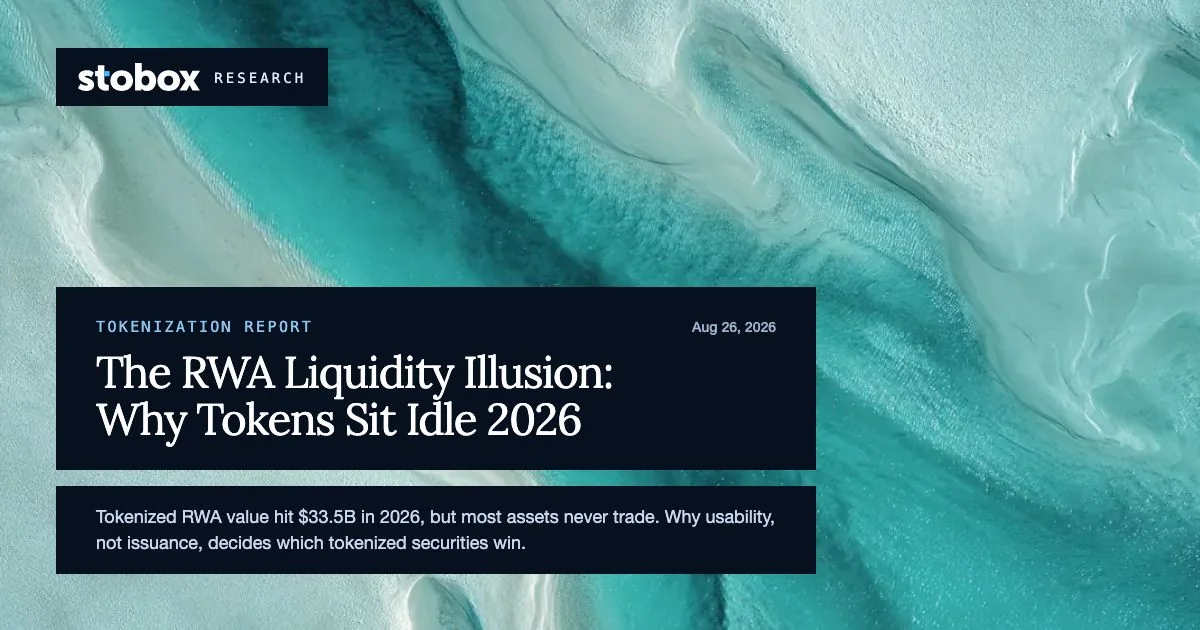
The RWA Liquidity Illusion: Why Tokenized Assets Sit Idle in 2026
On-chain RWA value quadrupled to $33.5B, yet most of it never trades. The real 2026 story is not issuance. It is usability: the assets that can be traded, posted as collateral, and settled are the ones winning.
Contents 10 sections
- Executive Summary
- Key Takeaways
- Introduction: The Number Everyone Quotes Is the Wrong One
- What the 2026 Data Actually Shows
- Why Minting Is the Easy Part
- The 5 Stages of a Liquid Tokenized Asset
- The Evidence: Distribution Beats Balance Sheet
- Definition: What "Liquid Tokenization" Actually Means
- How to Act on This
- FAQ
Executive Summary
The tokenized real-world asset market looks like a runaway success. On-chain value (excluding stablecoins) reached roughly $33.5B in July 2026 on the canonical tracker, about four times its early-2025 level. That headline hides the real story. Most of that value never moves. By one analysis, over half of reported RWA value sits idle, and under 10% of tokenized value is actively used in DeFi lending. Most tokenized Treasuries and private credit still mint and redeem rather than trade on a secondary market. This edition argues one thesis: 2026 is an issuance boom, not a liquidity boom. The assets that win are not the ones that get minted. They are the ones engineered to be usable: tradable, postable as collateral, and settleable. Liquidity is built, not granted. That distinction now separates serious tokenization from expensive digitization.
Current figures, each with its source, are kept in the State of RWA 2026 report.
Key Takeaways
- On-chain RWA value (ex-stablecoins) reached roughly $33.5B in July 2026, up about 400% since early 2025, but most of that value is held rather than traded.
- Over half of reported RWA value sits idle, and under 10% of tokenized value reaches DeFi lending, exposing a gap between issuance and genuine liquidity.
- Distribution beats balance sheet: Circle's USYC overtook BlackRock's BUIDL as the largest tokenized Treasury fund in March 2026 largely because it was wired into a major venue, not because it was a better fund.
- Regulated trading rails are arriving (SEC-approved Nasdaq and NYSE tokenized-trading rules, DTC pilot settlement), but the first tokenized equities target the deepest large caps because thin markets create price dislocations.
- Liquidity is a design decision made before launch: compliance architecture, eligible-buyer channels, market-maker commitments, and collateral integration determine whether a tokenized asset trades or stalls.
Introduction: The Number Everyone Quotes Is the Wrong One
The RWA market has crossed from experiment to regulated reality, and the numbers are genuinely large. But the industry keeps quoting the wrong metric, and executives evaluating tokenization as a capital strategy are being sold a supply figure as if it were a demand figure. Market capitalization measures how much has been issued and is held on-chain. It says nothing about how much actually trades.
That confusion has consequences. A CEO who tokenizes an asset expecting instant liquidity, an asset owner who assumes a token equals a market, an investor who treats "on-chain" as a synonym for "liquid": all three are reading the wrong number. The 2026 data is unambiguous. Issuance has quadrupled. Usability has not kept pace.
This is not a reason to dismiss tokenization. It is the opposite. It is the reason to take the operational side seriously. The projects that will define the next phase are already visible, and they share one trait: they treated liquidity as something to be engineered, not assumed.
What the 2026 Data Actually Shows
The direct answer: tokenized RWA supply exploded, but secondary trading and productive use lagged far behind, leaving most on-chain value inert.
Start with the trackers, which disagree because they count differently. rwa.xyz, the canonical dashboard, showed $33.5B of distributed on-chain RWA value (ex-stablecoins) in July 2026; Chainalysis-based analyses put it near $31B (+400% since early 2025); Canton's late-2025 report said $36B. Counting the underlying assets those tokens reference produces a much larger figure. Counting the underlying assets those tokens reference, rwa.xyz reports $369B.
The composition matters more than the headline. On-chain value (excluding stablecoins) reached $33.5B on the canonical tracker, roughly 4x early 2025, led by tokenized Treasuries and private credit, with tokenized equities emerging as the fastest-growing new category after Nasdaq's approval. Treasuries dominate to the point of concentration risk. Synthesising the RWA.xyz total ($32 billion of non-stablecoin RWA) against the tokenized-Treasury subtotal (~$15 billion) yields an insight neither figure states alone: Treasuries are now close to half of all tokenized real-world value on-chain.
Now the part the marketing skips. Most tokenized Treasuries and private credit show mint-and-redeem patterns rather than secondary trading, and by one analysis over half of reported RWA value sits idle. The DeFi utilization figures are just as stark. Only about $2.5B of the estimated $30B in total tokenized RWAs are actively utilized in open DeFi lending. That's less than 10%.
| Metric | 2026 figure | What it tells you |
|---|---|---|
| On-chain RWA value (ex-stablecoins) | ~$33.5B (July 2026) | Supply, not liquidity |
| Growth since early 2025 | ~400% | Issuance is booming |
| Tokenized Treasuries share | ~$15B, near half of total | Heavy concentration in one class |
| RWA value in DeFi lending | ~$2.5B of ~$30B | Under 10% is productively used |
| Reported value that sits idle | Over half | The core liquidity gap |
The pattern is consistent across independent sources: a large, fast-growing pile of tokens, most of which barely move.
Why Minting Is the Easy Part
The direct answer: tokenization creates the possibility of a market, but the market for each asset still has to be built, and that work happens off the blockchain.
Tokenization creates the possibility of liquidity; the market for each asset still has to be built. The mechanics of minting are trivial by 2026 standards. If one million real shares are in custody, the issuer mints one million tokens at a 1:1 ratio, one token for every one real share. Once minted, these tokens can be bought, sold, or held like any other digital asset. That is the whole appeal of the demo. It is also where most projects stop.
The friction shows up the moment you try to move an asset. You can mint a tokenized T-bill in a few clicks, but try moving it between venues on a Friday afternoon and watch the lights turn red. Whitelist delays. Transfer windows. Off-chain signoffs. The tech says instant, the gatekeepers say maybe Monday. Liquidity that looks deep can vanish under stress because transfers are approval-gated.
Fragmentation compounds the problem. Canton's State of RWA Tokenization 2026 report found measurable inefficiencies from market fragmentation, including 1–3% pricing gaps for identical assets across chains and 2–5% friction costs when moving capital crosschain. And the market-maker base is thin. Common challenges: fragmented trading venues, inconsistent listing standards, and a limited number of active market makers willing to quote RWA tokens continuously.
The lesson experienced issuers already learned is blunt. Minting is only one step. The real work includes rights, compliance, custody, onboarding, transfers, servicing and investor trust. An asset can be tokenized and still fail commercially if the issuer has no qualified buyer channel. Technology does not fix a weak legal claim. Technology cannot fix an unclear legal claim, weak investor documentation or unresolved jurisdictional issues. Tokenization may improve transferability, but liquidity depends on market access, eligible buyers, pricing, disclosure, trading venues and compliance rules. This is the infrastructure-first, compliance-first lens: most tokenization projects fail not on the blockchain but on what sits underneath it.
The 5 Stages of a Liquid Tokenized Asset
The direct answer: liquidity is not a switch you flip at listing. It is the last output of a sequence, and skipping earlier stages guarantees an idle asset later.
Serious issuance follows a progression that maps to how a company becomes capital-market ready and then digitally connected to modern markets. Call it The 5 Stages of a Liquid Tokenized Asset: intelligence, digital preparation, legal structuring, capital strategy, and liquidity engineering.
- Intelligence. Structured, verified, investor-ready data on the asset and issuer. Without it, no serious buyer can perform due diligence, and no market maker will quote. This is the readiness layer, and it is where Stobox Intelligence belongs.
- Digital preparation. Clean cap-table, custody, and reporting infrastructure so ownership and lifecycle events are auditable in real time.
- Legal structuring. The wrapper, jurisdiction, and rights that define what a token holder actually owns.
Tokenization bridges legal, technical, and distribution layers, from SPV creation and smart contract deployment through minting, yield distribution, and redemption. The legal structure behind the token determines what rights holders actually possess, which varies significantly by issuer.
To see which facts a counterparty asks for first are missing from your own data room, run the free record gap check.
- Capital strategy. Identifying and onboarding the eligible-buyer channel before issuance, not after.
- Liquidity engineering. Market-maker commitments, venue listings, and collateral integrations designed in from the start.
The order is not optional. A realistic sequence acknowledges that exchange trading is the last thing to arrive, not the first. For most issuers today, a realistic liquidity sequence is: primary issuance with broad investor distribution, post-issuance collateral utility as the first active liquidity layer, programmatic redemption or OTC as the secondary exit mechanism, and exchange trading as a longer-term development once investor base depth and market maker participation increase.
This is where a professional tokenization stack earns its place. Stobox Compass treats tokenization as asset structuring, legal framework, compliance, investor infrastructure, and lifecycle management, not as a mint button. Compass issues security tokens primarily on Base (also Arbitrum and Canton), and the point of that architecture is precisely to keep an asset transferable and usable across the venues where liquidity actually lives.
The Evidence: Distribution Beats Balance Sheet
The direct answer: in 2026, the assets that trade are the ones wired into demand, and the market has already shown that distribution matters more than brand or fund quality.
The clearest proof is the Treasury league table. In tokenized RWAs, distribution beats balance sheet. Circle's USYC overtook BlackRock's BUIDL as the largest tokenized Treasury fund in March 2026, not because USYC is a better fund, but because it was wired into Binance. When the underlying asset is a near-identical Treasury bill across every issuer, the only differentiator is where the token can be used.
The second proof is collateral. Idle assets become productive when they can be posted without unwinding the position. In April 2026, BlackRock, Standard Chartered, and OKX announced a joint framework allowing BlackRock's BUIDL fund to be posted as yield-bearing collateral for trading on OKX, with Standard Chartered acting as regulated off-exchange custodian. Institutions can hold BUIDL in custody at Standard Chartered while trading on OKX, with U.S. Treasury yield accruing throughout. Margin capital that previously sat idle now works while it waits. That is liquidity engineering, not issuance.
The third proof is the regulated-trading rollout, which is deliberately starting where liquidity already exists. The SEC approved Nasdaq and NYSE rule changes in Q1 2026 permitting tokenized securities trading, with first trades expected by Q3 2026. The sequencing tells you everything. The first tokenized stocks under the exemption are expected to be the highest-liquidity U.S. large caps, names like Apple, Microsoft, Nvidia, Tesla, Amazon, and Meta, because they offer the deepest underlying markets to support reliable arbitrage and redemption. Tokenization works best when the underlying market is deep enough that arbitrageurs can keep the token price tightly pegged to the underlying share price. The corollary is the warning. For a stock with billions in daily volume, even large token order flow can be absorbed by mint-and-redeem activity. For a thinly traded micro-cap, the same flow would create persistent price dislocations.
Even private credit, the largest and most-hyped RWA category, illustrates the point rather than refuting it. Unlike equities or funds, private credit suffers from limited liquidity, weak price discovery and opaque reporting, problems that onchain tokens could directly address. The opportunity is real precisely because the base market is illiquid. But addressing those problems requires transparent reporting and structuring discipline, not a token wrapper alone.
Definition: What "Liquid Tokenization" Actually Means
Real World Asset tokenization is the process of representing ownership rights of physical or financial assets as blockchain-based digital securities. A liquid tokenized asset goes one step further: it is a digital security engineered so that holders can trade it, post it as collateral, or redeem it through pre-built, compliant channels, rather than a token whose only exit is minting and redeeming with the issuer.
The difference is not cosmetic. An asset that cannot be traded, posted, or integrated is, in practical terms, a digitized cap-table entry. The market value may be recorded on-chain, but the economic utility that justified tokenizing it never materializes.
How to Act on This
The direct answer: stop measuring tokenization by issuance and start measuring it by usability, then build for usability from stage one.
For CEOs and founders. Do not tokenize to generate a headline number. Before you mint, answer one question: who is the eligible buyer, and through which venue will they trade or exit? If you cannot answer, you are building an idle asset. Start with the readiness assessment and structured company data, because a market maker cannot quote what they cannot diligence.
For asset owners. Treat liquidity as a line item in the project, not a byproduct. Budget for market-maker engagement before launch, for collateral integrations, and for the compliance architecture that keeps transfers from freezing under stress. The correct partner is one that handles structuring, compliance, and lifecycle management end to end. This is where Compass functions as the implementation layer, keeping the asset usable rather than merely minted. See the tokenization overview for the full lifecycle view.
For investors. Discount the market-cap figure. Ask what fraction of a given product's supply actually trades or is deployed as collateral, and on which venues. An offering with a distribution and collateral strategy is worth more than a larger offering with neither. The investor view is a useful frame for separating usable supply from idle supply.
The macro tailwind is genuine, and it favors disciplined issuers. Boston Consulting Group projects tokenized RWAs reaching $16T in AUM by 2030, a base-case scenario that implies roughly 50% CAGR from current levels. That growth will not accrue evenly. It will concentrate in assets that were built to be used.
FAQ
What is the RWA liquidity illusion? It is the gap between how much tokenized value exists and how much of it actually trades or is used. On-chain RWA value reached about $33.5B in 2026, but over half sits idle and under 10% reaches DeFi lending. High issuance is being mistaken for high liquidity.
How large is the tokenized RWA market in 2026? On the canonical tracker, on-chain value excluding stablecoins reached roughly $33.5B in July 2026, up about 400% since early 2025. Counting the underlying assets those tokens reference produces a figure near $369B. Different trackers report $31B to $36B depending on their counting method.
Why do most tokenized assets sit idle? Because minting a token does not create a market. Most tokenized Treasuries and private credit follow mint-and-redeem patterns rather than secondary trading. Liquidity requires eligible buyers, market makers, trading venues, and compliance rules that allow transfers, none of which appear automatically.
How does secondary liquidity actually get built for a tokenized security? Through deliberate design: engaging market makers before launch, establishing eligible-buyer distribution, integrating collateral use, and listing on venues with real depth. A common realistic sequence runs from primary issuance to collateral utility to OTC or programmatic redemption, with exchange trading arriving last.
Why should executives care about the mint-and-redeem problem? Because it determines return on the tokenization project itself. An asset that only mints and redeems offers little advantage over traditional structures. The value of tokenization comes from usability: trading, collateral, and faster settlement. Without those, the exercise is expensive digitization.
Can small and mid-market companies achieve real liquidity for tokenized assets? Yes, but not by copying large-cap Treasury playbooks. Smaller and thinly traded assets are more vulnerable to price dislocations, so they need stronger structuring, clear investor documentation, and pre-arranged buyer channels. The liquidity has to be engineered deliberately, since it will not arrive on its own.
Does regulated exchange trading solve the liquidity problem? It helps, but it is not a cure. The SEC approved Nasdaq and NYSE rule changes permitting tokenized securities trading in 2026, with first trades expected by Q3. Those trades start with the deepest large caps precisely because thin underlying markets still produce dislocations. Regulation opens the door; demand still has to walk through it.
Why is distribution more important than brand in tokenized RWAs? Because when the underlying asset is nearly identical across issuers, the only differentiator is where the token can be used. Circle's USYC overtook BlackRock's BUIDL as the largest tokenized Treasury fund in March 2026 largely because it was wired into a major trading venue, showing that distribution and integration drive adoption more than issuer size.
What role does compliance architecture play in liquidity? A central one. Approval-gated transfers, whitelist delays, and off-chain signoffs can make liquidity disappear under stress. Compliance built into the token's design, rather than bolted on, is what allows an asset to move across venues and be posted as collateral without freezing, which is the difference between a usable asset and an idle one.