






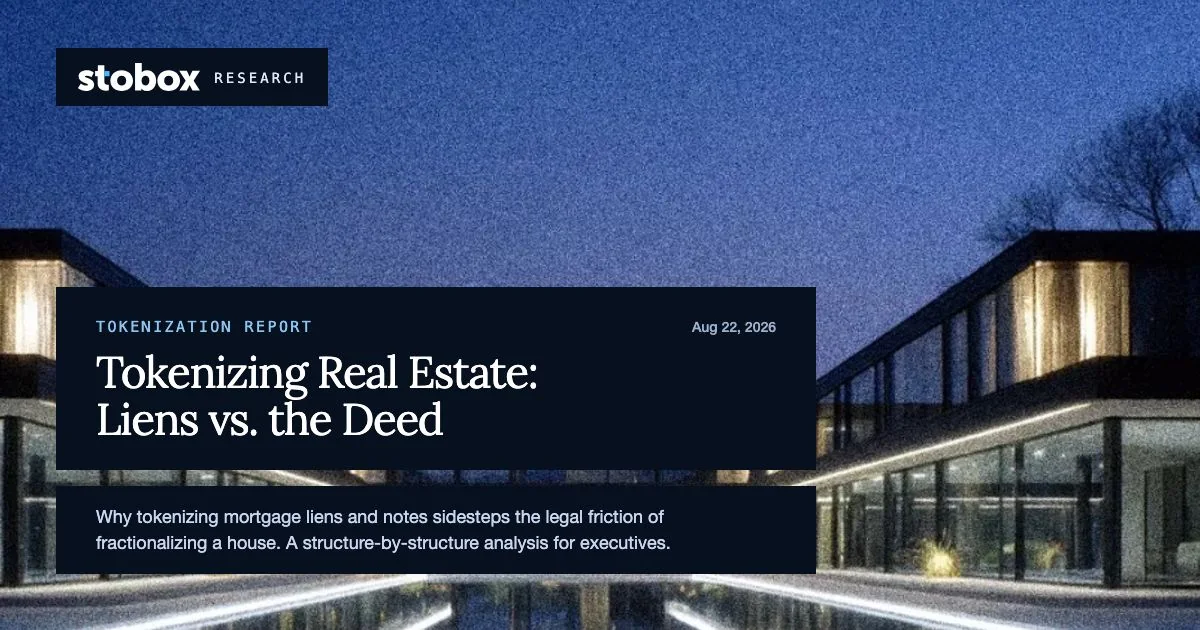
Tokenizing Real Estate the Legal Way: Why Liens Beat Fractionalizing the House
Naive LLC-wrapper fractionalization of a home collides with US property and securities law. The cleaner path may be tokenizing county-recorded instruments: the mortgage note and lien, not the deed.
Contents 8 sections
Executive Summary
The default pitch for tokenizing real estate is simple: put a house in an LLC, split the LLC into tokens, sell the fractions. The mechanics are clean on a slide and messy in a courthouse. US residential property law is built to protect occupants, not to make homes liquid. Homestead protections, partition rights, transfer taxes, and due-on-sale clauses all push against slicing a deed into tradable pieces. Meanwhile, the SEC has made clear that a token wrapper does not change what the asset is.
There is a quieter structure already operating at scale. Instead of tokenizing the property itself, issuers tokenize the legally enforceable, county-recorded instrument attached to it: the mortgage note and its lien. This edition compares both structures on their legal mechanics, and argues that for most US residential assets, tokenizing the debt is the more defensible path than tokenizing the deed.
Key Takeaways
- Fractionalizing a home through an LLC wrapper creates a security under US law: the SEC treats these interests under the Howey test regardless of the blockchain used to represent them.
- US residential property law protects occupants, not liquidity. Homestead exemptions, partition rights, and transfer taxes all create friction that pure equity fractionalization cannot design away.
- Tokenizing a mortgage note and its recorded lien attaches the token to a legally enforceable, county-recorded instrument, which is a cleaner claim than fractional equity in a house someone lives in.
- Figure Technologies has recorded more than $18 billion in cumulative HELOC originations on the Provenance blockchain, filing each loan into county land records, proving that lien-based tokenization scales.
- The SEC's January 2026 staff statement confirms tokenized securities remain securities: the structuring, not the token, determines whether a project is compliant.
The house is the hard asset to tokenize, not the easy one
Direct answer: residential real estate is one of the most legally protected asset classes in the United States, which makes naive fractionalization of a home the hardest version of tokenization, not the entry-level one.
The reason executives assume real estate is the obvious first tokenization target is that it is large, familiar, and illiquid. Those are real attractions. Explore how Stobox and other infrastructure providers actually structure these deals and a different picture emerges: the tokenization rarely fails on the blockchain. It fails on what sits underneath: the legal instrument, the compliance architecture, and how ownership is recorded and enforced.
The standard playbook is well documented. Many tokenization projects use special purpose vehicles such as limited liability companies to hold the physical property, and investors then purchase tokens representing fractional ownership in the LLC, which has the legal title to the property. The token holder never owns the house. They own a membership interest in an entity that owns the house.
That indirection is where the friction begins.
Why LLC-wrapper fractionalization collides with US law
Direct answer: three separate bodies of law (securities, occupant-protective property law, and transfer taxation) each impose costs on fractionalized home ownership that the token itself cannot remove.
It is a security, and everyone now agrees
The first wall is federal securities law. Under US law, most real estate tokens offered to investors will be treated as securities because they involve an investment of money in a common enterprise with an expectation of profit derived from the efforts of others, satisfying the familiar Howey test, which means federal securities law applies even if the tokens trade on a blockchain and even if the investors are located outside the United States.
The SEC has removed any ambiguity. In July 2025, Commissioner Hester Peirce stated that blockchain technology does not have magical abilities to transform the nature of the underlying asset, and that tokenized securities are still securities, a position later echoed by a joint statement from the SEC's Divisions of Corporation Finance, Investment Management, and Trading and Markets. The January 2026 staff statement went further. Tokenizing an existing security or issuing a new tokenized instrument does not change the core securities law analysis or relieve issuers, sponsors, or intermediaries of registration obligations.
The practical consequence: tokenized real estate lives in the world of exempt offerings, using Reg CF, Reg D, Reg A+, and in some cases Reg S for offshore placements. That usually means accredited-investor restrictions, transfer limits, and ongoing reporting. The "liquidity" story shrinks the moment you read the exemption you are relying on.
Occupant-protective property law does not care about your cap table
The second wall is unique to homes. US residential property law is designed to keep people housed, and that intent runs against fractional trading.
Consider homestead protection. A homestead declaration protects an owner from unsecured creditors and certain other debts, but it does not shield them from first or second mortgage lenders who hold a security interest in the home, and if payments are not current on that secured credit, the owner risks foreclosure. This is the key asymmetry: homestead law protects the occupant's equity from creditors but not from a properly recorded lien. That tells you which instrument the legal system treats as enforceable.
Now consider partition. If tokens ever map to direct co-ownership rather than a well-drafted entity, the risk is severe. Because the right to partition is absolute, the fractional interest of co-tenants is not a deciding factor, and a co-tenant with even a small interest in a property can file a partition action, because it may be very difficult or impossible to market a fractional interest in a property. One holder of a tiny fraction could, in a poorly structured deal, force a sale of the entire home. Real estate speculators already acquire small shares of property specifically to file a partition action and force a sale. Tokenization would hand that lever to anyone with a wallet.
Transfer costs and due-on-sale clauses tax every move
The third wall is transactional. Every transfer of a property interest can trigger recording obligations and, in many jurisdictions, transfer taxes. And a critical constraint sits in most mortgages. County and state land registries remain the legal record of title, and mortgages, taxes, and HOA liens still govern priority, while due-on-sale clauses may restrict equity transfers. A due-on-sale clause lets a lender call the loan if ownership changes hands. Fractional equity trading is exactly the kind of change these clauses were written to catch.
Stack the three walls together and the naive structure looks less like innovation and more like an expensive way to recreate a private REIT with worse liquidity.
The alternative: tokenize the recorded instrument, not the deed
Direct answer: instead of tokenizing fractional equity in the house, issuers can tokenize the mortgage note and its county-recorded lien, which are already legally enforceable, transferable financial instruments.
A mortgage note is a promise to repay. The lien is the recorded security interest that makes that promise enforceable against the property. Both are designed to be assigned and sold. That is a fundamentally different legal starting point than fractional home equity.
The market is already moving here. One common model tokenizes an off-chain fund or uses a lending protocol where an originator pools loans and sells them to a special-purpose vehicle, which then issues debt tokens backed by these loans, allowing investors to hold the tokens or use them as collateral. The token represents a claim on debt cash flows, not a fractional deed to someone's residence.
The clearest proof point is Figure Technologies. Figure HELOC is a tokenized real-world asset representing a home equity line of credit originated by Figure, issued and managed on the Provenance blockchain. Crucially, the recording discipline is real. All of Figure's loan originations are recorded on the Provenance Blockchain as a hashed record and, through its DART application, in county land records, with ownership of loans updated on-chain as loans are bought and sold in its marketplace. And the scale is not theoretical. Figure facilitated $5 billion in HELOCs in 2024 and accumulated more than $18 billion in cumulative originations from late 2018 to September 2025, achieving the number one market share in the non-bank HELOC lending market.
The reason this works is that the on-chain record complements, rather than replaces, the legal system of record. The county land record still governs. The token tracks ownership of an instrument that the county already recognizes. That is a far cleaner marriage than asking a court to treat a token as proof of home ownership, which remains uncertain. Blockchain provides an immutable ledger, but its ability to legally recognize token ownership as valid property ownership remains uncertain in many jurisdictions, and property laws sometimes do not recognize blockchain records as legitimate proof of ownership.
Definition block
Real estate lien tokenization is the process of representing ownership of a legally enforceable, county-recorded debt instrument (a mortgage note secured by a lien on real property) as blockchain-based digital securities, where the on-chain record tracks ownership of the instrument while the county land registry remains the legal record of title.
The 5-Layer Structuring Test for tokenizing real estate
Direct answer: whether you tokenize the deed or the debt, a defensible structure has to pass five layers in order, and most failures happen at layers two and three, not at the token layer.
This framework maps to the way tokenization actually gets built and operated: intelligence, then legal preparation, then compliance, then infrastructure, then lifecycle management.
| Layer | Question | Deed / equity fractionalization | Lien / note tokenization |
|---|---|---|---|
| 1. Instrument | What legal thing does the token represent? | Membership interest in an LLC that owns a home | Ownership of a recorded note and lien |
| 2. Property law | Does occupant-protective law create friction? | High: homestead, partition, due-on-sale | Lower: liens are enforceable by design |
| 3. Securities law | Is it a security, and under what exemption? | Yes: Reg D / A+ / CF, transfer limits | Yes: debt security, but a familiar structure |
| 4. Recording | Does the county system of record agree? | Token is not recognized title | On-chain record can mirror county filing |
| 5. Lifecycle | Who manages transfers, reporting, defaults? | Cap table, distributions, secondary limits | Servicing, payments, foreclosure rights |
The point of the table is not that lien tokenization is free of law. It is a security too. The point is that it starts from an instrument the legal system was built to transfer, so it fails fewer layers.
How to act on this
Direct answer: choose the instrument before you choose the chain, and treat structuring, not tokenization, as the hard part of the project.
For the CEO or founder considering a raise against property: do not start with "let's tokenize the building." Start with the instrument. If you need liquidity against real estate, a debt structure (a note and lien, or a fund of such notes) is usually more defensible than fractional equity in an occupied home. A serious infrastructure partner should be able to walk you through both, with the trade-offs, before anyone mints anything.
For the asset owner or developer: map your assets to the five layers above before committing to a structure. Commercial and income-producing property behaves differently from residential homes, and the exemption you rely on shapes who can invest and how they can exit. This is where asset structuring and legal framework matter more than token standards.
For the investor: read what the token actually represents. A token backed by a recorded lien with clear servicing and foreclosure rights is a different risk than a token representing a fractional membership interest with transfer restrictions and partition exposure. Ask where the legal record of title lives and what happens on default.
Across all three, the through-line is the same: tokenization is not the creation of a token. Professional tokenization requires asset structuring, a legal framework, compliance architecture, investor infrastructure, and lifecycle management. That is the work Stobox Cabinet is built to support, and it is the difference between a project that survives contact with property law and one that does not. For the underlying mechanics, our learning resources go deeper on structuring choices.
FAQ
What is real estate tokenization? Real estate tokenization is representing rights tied to real property as blockchain-based digital securities. In most structures the token does not hold the property directly. The tokens themselves do not hold the property; instead they represent legal rights tied to a structure, usually an LLC or other entity that owns the property, and buyers become fractional owners or investors in that entity.
Why is fractionalizing a house legally risky? Because US residential property law protects occupants, not liquidity. Homestead protection, absolute partition rights, transfer taxes, and due-on-sale clauses all create friction. A co-tenant with even a small interest can file a partition action, because it may be very difficult or impossible to market a fractional interest in a property.
How does tokenizing a mortgage note differ from tokenizing the deed? A note and lien are legally enforceable, recorded instruments designed to be assigned and sold. Tokenizing them attaches the token to a claim the legal system already recognizes, rather than asking a court to treat a token as proof of home ownership. Tokenized mortgages are blockchain-based digital assets that represent ownership rights to mortgage debt or home equity.
Is a tokenized real estate interest a security in the US? Almost always, yes. If a token qualifies as a security it must adhere to federal securities regulations, including SEC registration unless exempted, and the SEC evaluates whether tokens meet the Howey Test.
Does putting a security on a blockchain change its legal status? No. Whether an instrument is a security depends on the economic substance and legal rights associated with it, not the technology used to represent ownership, and a security does not cease to be a security solely because it is tokenized or recorded on a blockchain.
Does homestead protection stop a mortgage lien from being enforced? No. The homestead exemption cannot prevent a secured creditor from initiating foreclosure proceedings. This is precisely why a recorded lien is a more enforceable claim than fractional equity protected by homestead law.
Can lien-based tokenization actually scale? It already has. Figure has tokenized $15.3 billion in assets and settles over $600 million in loans on Provenance monthly. The recorded-instrument model has real production volume, not just pilots.
Do county land records still matter after tokenization? Yes, and this is central. County and state land registries remain the legal record of title. The strongest structures make the on-chain record mirror the county filing rather than trying to replace it.
Which structure should a company choose? It depends on the asset and the goal. Both are securities and both require real structuring. The five-layer test above (instrument, property law, securities law, recording, lifecycle) is the practical way to decide, and it should be run before selecting a chain or a token standard. This is analysis, not legal advice; specific deals require qualified counsel.