






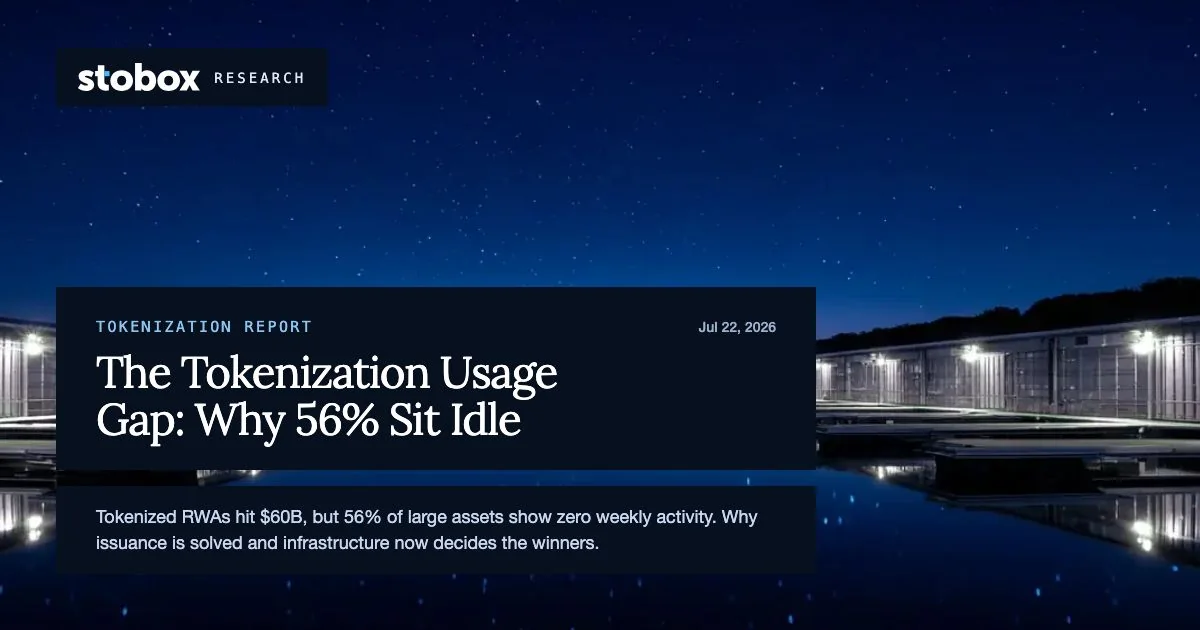
The Tokenization Usage Gap: Why 56% of Tokenized Assets Sit Idle – And What Separates Live Markets From Dead Tokens
The tokenized RWA market crossed $60B, but 56% of large tokenized assets show zero weekly on-chain activity. The real contest is no longer issuance – it is whether a token becomes a functioning market.
Contents 9 sections
Executive Summary
The tokenized real-world asset market crossed $60 billion in 2026. That number is real, and it is misleading. A joint report from BeInCrypto Research and RWA.xyz found that 56% of tokenized assets worth more than $100,000 recorded zero weekly on-chain transfers – roughly $32.9 billion of value that exists on a blockchain but does not move. Only 379 of 1,289 large assets showed any weekly activity at all. The lesson for executives is direct: tokenization has quietly won the issuance battle. Minting a compliant token is becoming a commodity. What remains unsolved is usage – whether a tokenized asset becomes a functioning market with distribution, verified onboarding, redemption rails, and secondary liquidity. Only one asset class, U.S. Treasuries, has reached production grade. This edition argues that the next phase of tokenization will be won on infrastructure, not on supply, and shows how to tell a live market from a dead token.
For how the trackers differ and what they show now, see the RWA market size report.
Key Takeaways
- The tokenized RWA market reached roughly $60 billion in 2026, yet 56% of assets over $100,000 – about $32.9 billion – recorded zero weekly on-chain activity, exposing a gap between headline supply and real usage.
- Market value is extremely concentrated: just 62 assets hold about 88% of total tokenized RWA value, and five products account for roughly half, meaning most tokenized assets are thinly used or static.
- Only tokenized U.S. Treasuries have reached "production-grade" maturity; private credit, real estate, funds, and equities remain constrained by weaker liquidity, limited investor access, and operational complexity.
- Tokenization makes ownership programmable and transferable, but it does not manufacture buyers, sellers, market makers, or settlement depth – those come from the infrastructure layer beneath the token.
- Institutional rails are moving from pilot to production, with DTCC running live tokenized trades in July 2026 ahead of an October launch, which raises the bar for what a credible tokenized asset must support.
The Headline Number Hides the Real Story
Tokenization did not fail to scale. It scaled, then split in two. The supply of tokenized assets grew fast while actual on-chain usage stayed thin – and that divergence is now the most important signal in the market.
Start with the growth, because it is genuine. The total value of tokenized real world assets on public blockchains reached $31 billion as of July 2026, up from roughly $5 billion at the start of 2025. Broader measures that include more products and asset classes put the figure higher. A report by BeInCrypto Research and RWA.xyz found that the tokenized RWA market reached approximately $60 billion as of May 2026, excluding stablecoins and repurchase agreements. By any definition, this is no longer a pilot-stage curiosity.
Now the part that changes how you should read every "record TVL" headline. Across 1,289 tokenized assets worth more than $100,000, 910 showed zero weekly transfers. Those dormant assets represented $32.9 billion in value, or 56% of the market measured for transfer activity. Only 379 assets showed weekly movement.
The concentration is just as stark. Just 62 assets account for about 88% of total tokenized RWA value, while five products alone represent roughly half of the market. A handful of large treasury and fund products carry the sector; the long tail barely moves.
This is why the size of the market and the health of the market are two different questions. Assets may be brought on-chain, but that does not mean they are actively traded, transferred, or used across financial infrastructure.
What the Dormant Value Actually Tells Us
Dormancy is not automatically failure – but most of it is a warning. The market has largely proven it can put assets on-chain and has not yet proven it can make them circulate.
The report itself draws a useful line. The report draws a distinction between "Distributed" assets and "Represented" assets. Represented assets use blockchain more like an internal ledger or digital record of an off-chain position. A meaningful share of the idle value falls into this category. The report distinguishes between Distributed assets, which can move across public blockchain rails, and Represented assets, which mainly use blockchain as a digital record. Around $27 billion of the dormant value came from Represented assets. Many were designed for recordkeeping and institutional settlement rather than public trading.
So part of the $32.9 billion is doing exactly what it was built to do – serving as a digital record, not a tradable instrument. But that generosity only goes so far. As one expert cited in the coverage put it bluntly, "Wrapping an asset and parking it is 'tokenization theater'. The real work is making tokens usable – as collateral, in DeFi, in live settlement."
The structural conclusion is the one executives should internalize. The findings challenge one of the central promises of tokenization: that putting traditional assets on blockchain rails will automatically improve liquidity, access and market efficiency. Tokenization can make ownership records programmable and transferable, but it does not guarantee buyers, sellers, market makers, settlement depth or secondary-market activity.
Real World Asset tokenization is the process of representing ownership rights of physical or financial assets as blockchain-based digital securities. Note what the definition does not say. It does not say that representation creates a market. A token is a claim on an asset plus a set of transfer rules. Whether anyone can actually buy, sell, price, or finance that claim is a separate – and far harder – problem.
Why Only One Asset Class Made It to Production Grade
Tokenized U.S. Treasuries are the only category to reach production maturity because they solved a demand problem first, then let the technology follow. Every other category is still working backward from a token toward a market that does not yet exist.
The report's verdict is specific. U.S. Treasuries are currently the only tokenized RWA category to reach "production grade." Other sectors, including private credit, commodities, real estate and tokenized equities, remain less mature because of weaker liquidity, limited investor access, regulatory restrictions or operational complexity.
The reason is not that Treasuries are technically special. It is that they answer a live question. Tokenized U.S. Treasuries have become the strongest RWA category because they solve a real and immediate market problem. Investors want dollar yield, short-duration exposure and on-chain collateral that can be used across crypto markets without relying only on stablecoins. A tokenized Treasury has a buyer the moment it exists.
Contrast that with tokenized private credit, which is large but structurally different. Private credit is now the largest segment in the tokenized real-world asset (RWA) space. As of January 2026, it accounts for over $18 billion of the $36 billion tokenized RWA market, according to rwa.xyz. The appeal is clear – RWA.xyz shows that tokenized private credit products on-chain average ~9.81% in borrower yields – well above most tokenized treasuries (3.78%). But private credit is negotiated, illiquid, and jurisdictionally fragmented by nature. Tokenizing it does not remove those frictions; it wraps them.
The tradeoff even shows up in the token standard itself. Regulated securities typically use permissioned standards, and that permissioning is precisely what limits liquidity. Choosing ERC-3643 has direct implications for your token model: Liquidity is structurally lower. Transfer restrictions mean fewer potential holders and counterparties. Your liquidity model needs to account for a restricted market. Compliance and liquidity are in tension, and pretending otherwise is how tokens end up dormant.
The Real State of Tokenization, By Category
The table below maps where each major RWA category sits – not by hype, but by whether it has crossed from representation into circulation.
| Category | Approx. on-chain size (2026) | What drives it | Usage maturity |
|---|---|---|---|
| Tokenized U.S. Treasuries | ~$13.4B by early April | Dollar yield, on-chain collateral | Production grade |
| Tokenized private credit | ~$18B (largest single segment) | 8–12% borrower yields, institutional origination | High supply, thin secondary liquidity |
| Tokenized gold / commodities | ~$5.9B | Rising gold prices, PAXG and XAUT | Moderate, price-driven |
| Tokenized equities | ~$1.3–2.2B | Fastest-growing, new issuers | Early, rapidly expanding |
| Tokenized real estate / funds | >$1B each | Access, fractionalization | Early, largely represented |
Treasury figures reflect that total value surpassed $10 billion in late February and reached $13.4 billion by early April according to RWA.xyz. Gold sits behind it: gold is the next highest class of RWA and its on-chain tokenized value has grown to $5.9B (led by PAXG and XAUT). Equities are small but accelerating: tokenized equities – currently a modest $1.3-2.2 billion – grew by nearly 50% in a single recent 30-day stretch, the fastest pace of any RWA segment.
The pattern is consistent. Where a token maps to a liquid, standardized, familiar instrument, usage follows. Where it maps to an illiquid, bespoke asset, the token inherits the illiquidity.
The 5 Layers of a Live Tokenized Market
The dormancy data points to a practical framework. A tokenized asset only becomes a functioning market when all five layers below are built – and this maps directly to the three-stage path from intelligence to capital readiness to tokenization.
- Intelligence layer – verified, structured, investor-ready data about the asset and issuer, so buyers can price and diligence it. This is where Stobox Intelligence fits, and where most projects underinvest.
- Legal and compliance layer – the enforceable structure that makes the token a real security, with transfer rules that satisfy regulators without strangling liquidity.
- Distribution layer – verified investor onboarding and access to the actual buyers, because a token with no reachable demand cannot trade.
- Liquidity and lifecycle layer – market-making, redemption infrastructure, corporate actions, and reporting, so the asset can be exited and serviced over time.
- Settlement and interoperability layer – connection to the rails where capital already sits, so the token is not stranded on an island.
Skip any layer and you get a Represented asset that sits at $0 in weekly volume – a token, not a market.
How Institutional Rails Are Raising the Bar
Institutional settlement is moving from pilot to production in 2026, which means the standard for a credible tokenized asset is rising fast. Projects that only mint a token will look increasingly thin against infrastructure that plugs into existing capital markets.
The clearest signal is DTCC. The Depository Trust & Clearing Corporation (DTCC) announced on July 15 that it successfully converted assets held at The Depository Trust Company (DTC) into tokens that were then used in real production trades, ahead of the DTCC Tokenization Service launch planned for October 2026. The scope is deliberately liquid: the DTCC will begin limited production trades of tokenized real-world assets in July 2026, bringing Russell 1000 equities, major ETFs and US Treasuries onto blockchain infrastructure for the first time through a pilot backed by more than 50 firms including BlackRock, Goldman Sachs and JPMorgan.
Crucially, the design channels tokens toward existing depth rather than fragmenting it. DTC's tokenization service will enable firms to tokenize DTC-custodied real-world assets while maintaining traditional investor protections, aiming to channel tokenized assets into existing deep liquidity pools. That is the anti-dormancy playbook in institutional form: connect to liquidity, do not manufacture an isolated token.
The regulatory scaffolding is also firming up. July 18 marked one year since enactment of the GENIUS Act, the timeframe Section 13 of the Act sets for regulators to promulgate implementing regulations. The Act's effective date framework continues to point to Jan. 18, 2027. The direction is clear even if the timeline is cautious – as the SEC's no-action relief framework demonstrated, the pilot could enable new blockchain-based trading methods, smart contract workflows, and round-the-clock transfers, while DTC remains the source of settlement finality and official records. You can read primary coverage of the DTCC milestone via the Paul Hastings crypto policy tracker.
The takeaway for asset owners: the bar for "credible tokenization" is being reset by the incumbents. A token that cannot connect to compliant onboarding, real distribution, and genuine settlement will not compete with one that can.
How to Act on This
The dormancy data is not a reason to avoid tokenization. It is a specification for doing it correctly. Here is what it means by reader type, and where Stobox Compass – the tokenization infrastructure layer for compliant digital assets – fits as an implementation partner.
If you are a CEO or founder considering tokenization: do not start with the token. Start with the question the dormancy data forces: who will actually hold and trade this, and through what rails? Sequence your work as intelligence, then legal preparation, then capital strategy, then issuance. Professional tokenization requires asset structuring, a legal framework, compliance, investor infrastructure, and lifecycle management – not a mint button. Explore the tokenization approach and the readiness path before committing to a chain.
If you are an asset owner (real estate, private credit, funds): accept that your asset's illiquidity travels with the token. Your job is to build the missing layers – verified investor onboarding, redemption mechanics, transparent NAV and reporting, and a distribution channel to real buyers. This is exactly where most of the dormant $27 billion in Represented assets stalled. Stobox has operated RWA tokenization infrastructure since 2018, with $305M+ in assets structured and supported across 100+ clients, and issues security tokens primarily on Base (also Arbitrum and Canton) – the point is the full lifecycle, not the token alone.
If you are an investor or allocator: treat on-chain activity as a due-diligence metric, not a footnote. The 56% inactivity figure highlights liquidity risk. Assets that look large on a dashboard may be difficult to exit, price or finance if real transaction activity is low. Before allocating, ask for transfer history, secondary-market venues, and redemption terms. A large AUM figure with zero weekly volume is a red flag, not a green one. Deepen your framework in the Stobox learn hub.
The through-line for all three: the winners of the next phase will not be whoever tokenizes the most. They will be whoever builds the infrastructure that turns a token into a market.
FAQ
What is the tokenization usage gap? It is the difference between how much value is tokenized on-chain and how much of it is actually traded or used. In 2026, roughly $60 billion of RWAs are tokenized, but 56% of large assets recorded zero weekly on-chain transfers. The gap shows that issuance has outpaced real market activity.
Why do so many tokenized assets show zero activity? Some were never designed to trade – they use the blockchain as a digital record rather than a live market. Around $27 billion of the dormant value came from these "Represented" assets. The rest reflects missing infrastructure: no distribution, no market makers, and thin secondary liquidity.
How does tokenization actually improve liquidity? It does not do so automatically. Tokenization makes ownership programmable and transferable, but liquidity still requires buyers, sellers, market makers, and settlement depth. Those come from the infrastructure and distribution built around the token, not from the token itself.
Why are tokenized U.S. Treasuries the only production-grade category? Because they solve an immediate demand problem: investors want dollar yield and on-chain collateral. A tokenized Treasury has a ready buyer the moment it exists, so usage follows issuance. Illiquid assets like private credit or real estate inherit their off-chain illiquidity when tokenized.
Is tokenized private credit a good tokenization candidate? It is the largest single RWA segment, at over $18 billion, and offers higher yields – around 9.8% versus 3.8% for tokenized treasuries. But it is negotiated and illiquid by nature, so secondary trading remains thin. It can work with strong onboarding, servicing, and redemption infrastructure.
Why should executives care about on-chain activity metrics? Because headline AUM can be misleading. Just 62 assets hold about 88% of tokenized RWA value, so most products are thinly used. For investors, low activity signals real liquidity risk – an asset that is hard to exit, price, or finance.
Can companies tokenize an asset without deep technical resources? Yes, but the token is the easy part. The hard part is asset structuring, legal framework, compliance, investor onboarding, and lifecycle management. Working with an infrastructure partner that handles those layers is what prevents a token from becoming a dormant wrapper.
How does the DTCC pilot change the standard for tokenization? DTCC ran live tokenized production trades in July 2026, with a full service launch planned for October, covering Russell 1000 equities, major ETFs, and Treasuries. Its design channels tokenized assets into existing deep liquidity pools rather than isolated markets – raising the bar for what a credible tokenized asset must support.
What separates a "live" tokenized market from a "dead" token? A live market has all five layers: verified data, enforceable legal structure, real distribution, liquidity and lifecycle infrastructure, and connection to settlement rails. A dead token has only the mint. If any layer is missing, the asset tends to sit at zero weekly volume.
Does regulatory clarity fix the usage gap on its own? No. Regulation like the GENIUS Act framework and the SEC's no-action relief removes legal blockers and is genuinely helpful. But clarity does not create buyers or build distribution – those remain the issuer's responsibility. Compliance is necessary but not sufficient for a functioning market.