






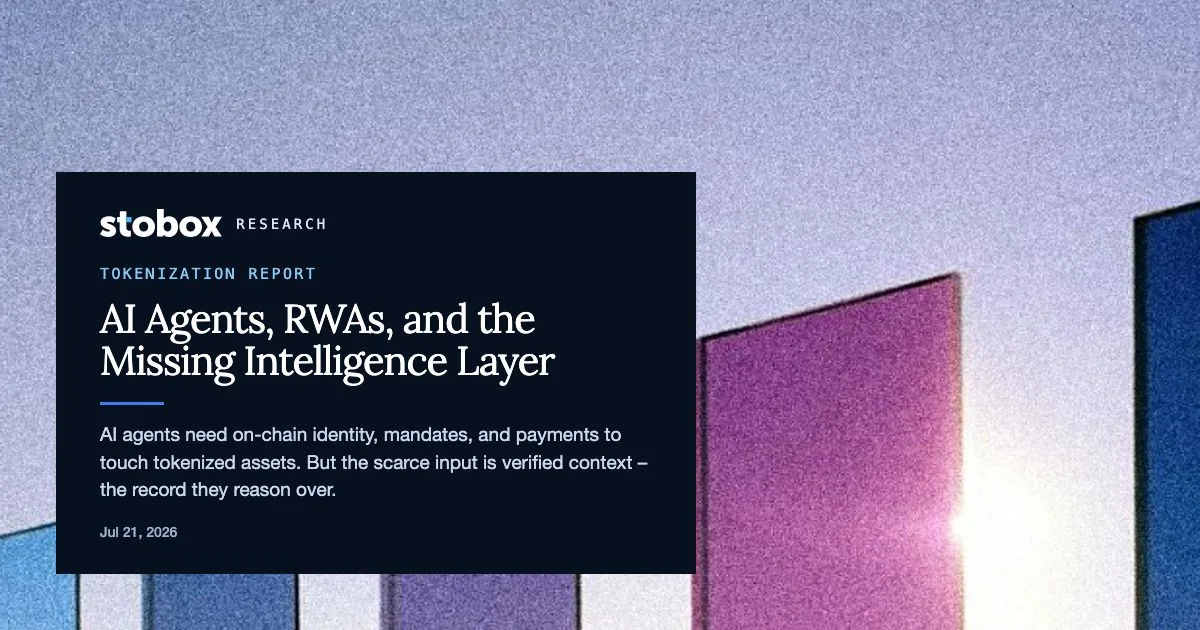
The Missing Primitive for On-Chain AI Agents Isn't a Mandate – It's Verified Context
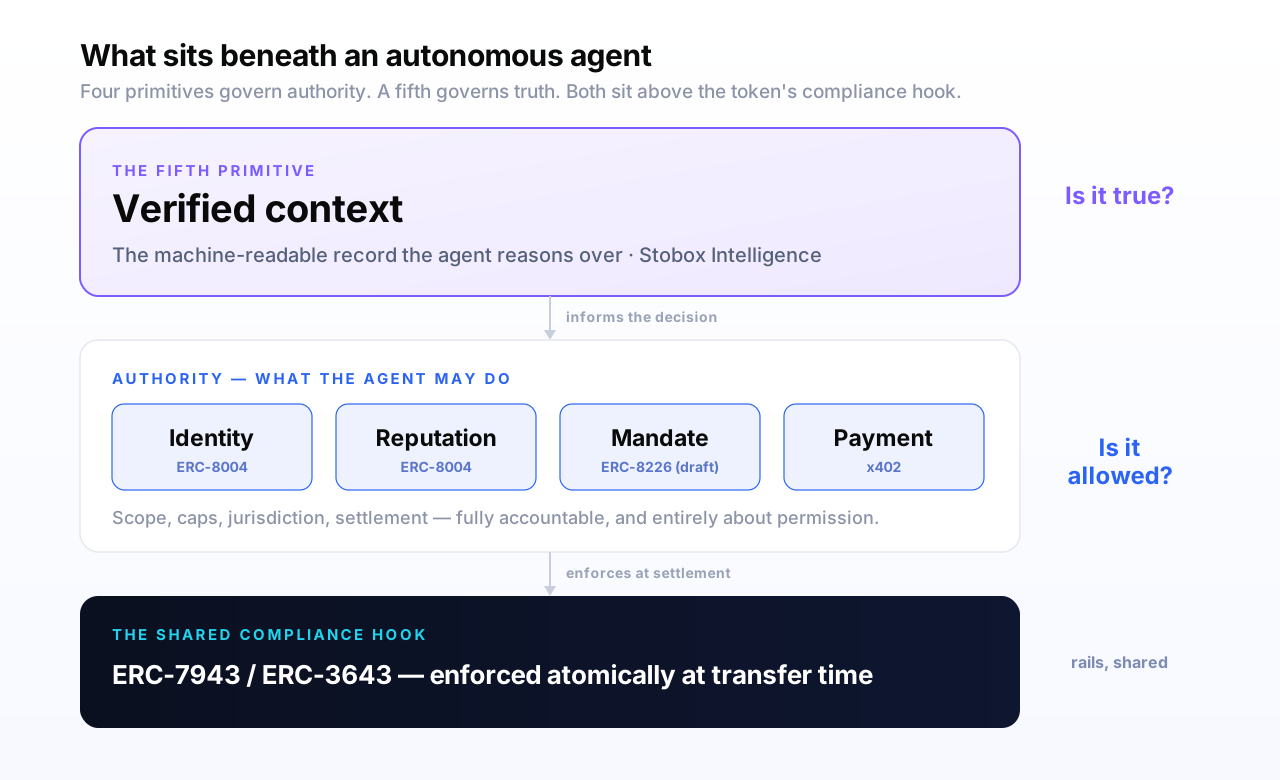
Brickken is right that AI agents need on-chain identity, reputation, mandates, and payments before they can touch regulated assets. But a fifth primitive sits above all four: the verified, machine-readable record an agent reasons over. A mandate says what an agent may do. It never says what is true.
Summary
Brickken published a sharp piece last week arguing that autonomous AI agents remain a "contingent liability" until four primitives live on-chain: identity, reputation, mandate, and payment. On the core claim – that better models do not fix institutional accountability – we agree completely, and it is worth saying so plainly about a competitor's work. But there is a fifth primitive sitting above all four, and it is the one Stobox has spent years building: the verified, machine-readable record the agent actually reasons over. A mandate governs what an agent is allowed to do. It says nothing about what is true. Give an agent a flawless on-chain mandate and point it at a stale, unstructured, or ungoverned record, and you get a confident, compliant-looking, wrong action – at machine speed, with a transaction hash attached.
Key Takeaways
- Brickken's four-primitive stack – ERC-8004 identity and reputation, ERC-8226 (a draft mandate standard), x402 payments, and agentic tokens – is a credible framing of the authority problem for AI agents. It is not a framing of the truth problem.
- All of it enforces inside the compliance hook of the token standard: ERC-3643 or ERC-7943 (uRWA). Brickken authored ERC-7943; Stobox backed it and ships it live in production issuance. That substrate is shared ground, not a battleground.
- The scarce input for an agent acting on a regulated asset is the same one that gates enterprise AI generally: verified, structured, governed context. Authority without context is precision aimed at the wrong target.
- Stobox's answer is to ship both sides of the mandate – a verified record to read (Stobox Intelligence) and compliant issuance to act on (Compass) – today, not as a draft ERC.
- Read verified truth first; transact under a bounded mandate second. Both halves have to exist for autonomous agents to be trustworthy on real-world assets.
Where Brickken Is Right
It is rare to read a competitor's piece worth co-signing, so we will be direct about the parts that are correct.
Autonomous agents that can spend, sign, and negotiate on behalf of a principal cannot keep authenticating like SaaS – shared API keys, opaque billing, no verifiable identity, and no formal record of what they were authorized to do. In the domains that justify autonomy in the first place – legal, financial, healthcare – that gap is not a rough edge. It is the exact question a regulator asks after something goes wrong: who authorized this system to take this action, on whose behalf, within what limits? Answering that with a PDF and a back-office spreadsheet does not survive audit.
Brickken's response – on-chain identity, an immutable reputation trail, a scoped and time-bounded mandate, and a settlement primitive that is cryptographically attributable to a specific wallet in a specific block – is the right shape for the authority problem. And their most important architectural point is one we have made ourselves in a different context: the gap between intent and execution is not friction, it is where institutional review belongs. Preparing an unsigned payload for a human or a policy to inspect before it broadcasts is a compliance primitive, not an inconvenience.
Most importantly, all of it terminates in the same place we do. A mandate check, in their own words, fires inside the pre-transfer compliance hook of the regulated token – ERC-7943 (uRWA) or ERC-3643. Brickken authored ERC-7943. Stobox backed it and issues on it in production. The rails under this entire conversation are settled and shared. That is a good thing, and it is worth naming instead of pretending otherwise.
What the Four Primitives Leave Out
Here is where we part company with the framing, not the facts.
Identity tells you who an agent is. Reputation tells you how it has behaved. A mandate tells you what it is permitted to do, for whom, and within what caps. Payment tells you it settled. Stack all four and you have an agent whose authority is fully accounted for. You still have no guarantee whatsoever that the agent is acting on correct information.
This is not a hypothetical edge case. It is the dominant failure mode of enterprise AI right now, and we wrote about it at length in our analysis of the enterprise data-readiness gap: the reason most agentic pilots fail is not model quality and not missing infrastructure – it is that the data underneath is fragmented, stale, unstructured, and ungoverned. Agents make this worse, not better, because they reason across multiple steps without a human catching each error, so a small inaccuracy in the underlying record compounds into a large, confident, and fully "authorized" mistake.
Now transpose that onto a regulated asset. An agent with a perfect ERC-8226-style mandate – correct scope, correct caps, correct jurisdiction hash, valid until the right date – executes a transfer on a security token whose cap table, valuation basis, offering terms, or investor eligibility it pulled from an unverified source. Every primitive Brickken lists did its job. The identity resolved. The reputation was clean. The mandate validated inside the transfer hook. The payment settled. And the action was still wrong, because none of those four primitives ever asked whether the thing the agent believed about the asset was true.
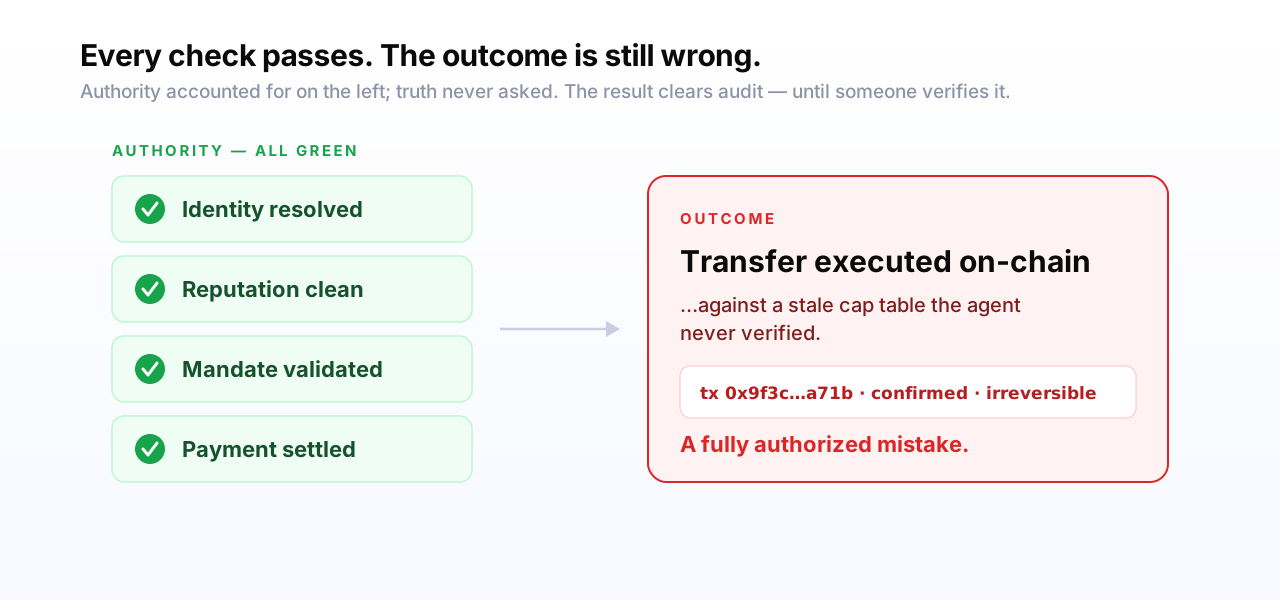
That is the missing primitive: verified context. Not a nice-to-have layer bolted on for analytics – the substrate of correctness that sits above authority the way the token standard sits below it.
The Fifth Primitive: A Record an Agent Can Trust
This is the layer Stobox has been building, and it is why our positioning has been "Intelligence and Tokenization" rather than tokenization alone. Before an asset can be issued, financed, or traded – by a human or an agent – the company behind it has to become one canonical, verifiable, machine-readable record. That is exactly what Stobox Intelligence does: it turns a company into a structured record scored across readiness pillars, verified rather than asserted, and built to be read by machines as much as by people.
We operate that knowledge layer – the Stobox Intelligence Graph – as a live endpoint an AI system can query directly, not as a static PDF or a slide. That is the deliberate mirror image of Brickken's insight about API keys. They removed the shared secret from the payment path so every action is attributable. We are removing the unverified source from the reasoning path so every action is grounded. An agent that reads a verified graph before it acts is doing the on-chain-mandate equivalent of due diligence – automatically, every time, against a record it did not have to trust blindly.
And when the agent does act, it acts on infrastructure that is already live and already compliant. Stobox Compass issues security tokens on ERC-7943 today, on Base, with the same pre-transfer compliance hook that any serious mandate design has to plug into. So the full sequence exists in production, not on a standards-track roadmap: a verified record to read, and a compliant asset to act on, with the mandate and payment layer maturing in the middle exactly as Brickken describes.
Read First, Transact Second
Compressed to one line for anyone building agentic systems on real-world assets: read verified truth first, transact under a bounded mandate second – and make sure both halves actually exist.
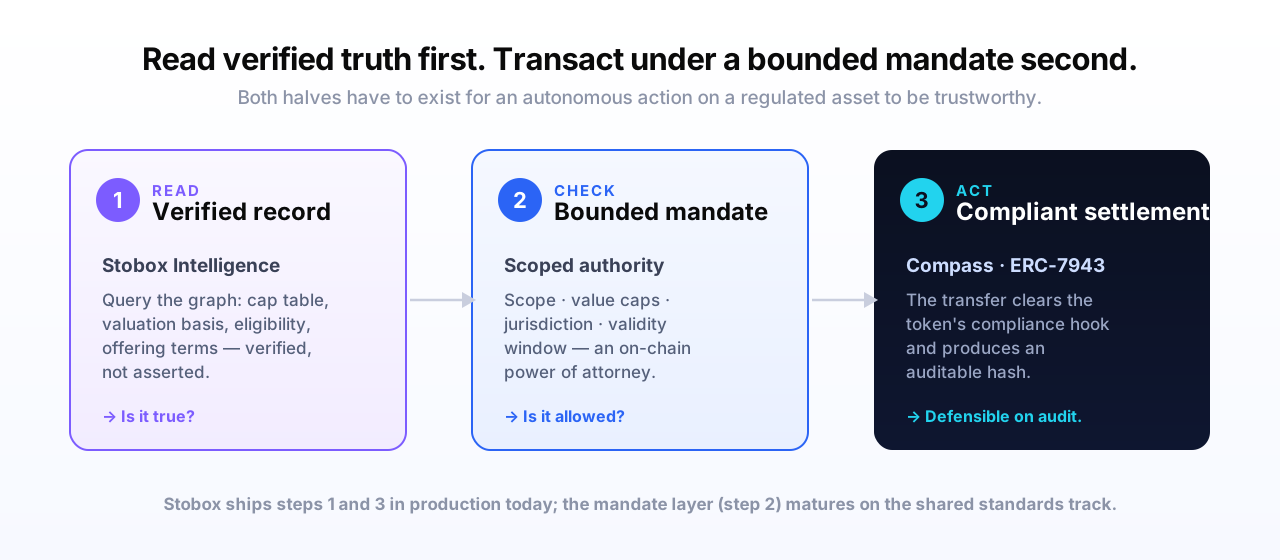
Brickken's piece is strong on the second half, and honest that much of it is still forward-looking – a draft ERC, a thin CLI, a "tomorrow" workflow. The standards work deserves real respect: formalizing on-chain mandates on top of ERC-7943 is a genuinely useful contribution, and it enforces through a hook Stobox already ships. But the first half – the verified record the agent reasons over – is where accountability actually begins, and it is not a draft. It is the layer we have shipped, and the layer that turns a mandate from a permission slip into a decision an institution can defend.
An agent with authority and no verified context is a liability that clears audit right up until the moment someone checks whether it was right. That is the gap worth closing next. It is the one we built for.
FAQ
What does an AI agent need before it can transact a tokenized real-world asset? Four on-chain primitives are becoming standard – identity, reputation, a bounded mandate, and a settlement method – and they compose inside the compliance hook of standards like ERC-7943. But those govern authority, not truth. The agent also needs a verified, machine-readable record of the asset and the company behind it, or it will act correctly on wrong information.
Is a mandate enough to make an autonomous agent safe on regulated assets? No. A mandate bounds what an agent is allowed to do – scope, value caps, jurisdiction, and validity window. It says nothing about whether the data the agent is acting on is current, structured, and verified. A perfectly scoped mandate executed against a stale or ungoverned record still produces a confident, compliant-looking, wrong action.
Where do agent mandates actually get enforced on-chain? Inside the pre-transfer compliance hook of the token standard itself – for real-world assets, ERC-3643 or ERC-7943 (uRWA). The token contract checks eligibility and, in mandate designs, the agent's scope and caps atomically at transfer time. This is why the token-compliance substrate matters as much as the agent layer above it.
What is the Stobox Intelligence Graph? It is Stobox's AI-native knowledge layer – a verified, structured, machine-readable model of a company and its assets, scored across readiness pillars. It is the reading layer an agent needs before it transacts, and Stobox operates it as a live endpoint that AI systems can query directly.
How is Stobox's position different from an agent CLI or a mandate standard? Stobox ships the two things an agent has to have on either side of a mandate: a verified record to reason over (Stobox Intelligence) and live, compliant issuance to act on (Compass, on ERC-7943). The mandate and payment standards are necessary infrastructure we support; they are not sufficient on their own.
If you are building agentic systems on real-world assets: start with the record, not the model. Explore how Stobox Intelligence turns a company into a verified, machine-readable foundation, and how Stobox Compass issues compliant security tokens on ERC-7943 today. If you want to compare the compliance substrate directly, our breakdown of ERC-3643 vs ERC-7943 is the place to start.
If you want to talk through where autonomous agents fit your issuance or capital strategy: book a discovery call. We will walk through the reading layer and the transaction layer, and where the mandate and payment standards realistically sit between them.
Questions this raises
Answered plainly.
What does an AI agent need before it can transact a tokenized real-world asset?
Four on-chain primitives are becoming standard – identity, reputation, a bounded mandate, and a settlement method – and they compose inside the compliance hook of standards like ERC-7943. But those govern authority, not truth. The agent also needs a verified, machine-readable record of the asset and the company behind it, or it will act correctly on wrong information.
Is a mandate enough to make an autonomous agent safe on regulated assets?
No. A mandate bounds what an agent is allowed to do – scope, value caps, jurisdiction, and validity window. It says nothing about whether the data the agent is acting on is current, structured, and verified. A perfectly scoped mandate executed against a stale or ungoverned record still produces a confident, compliant-looking, wrong action.
Where do agent mandates actually get enforced on-chain?
Inside the pre-transfer compliance hook of the token standard itself – for real-world assets, ERC-3643 or ERC-7943 (uRWA). The token contract checks eligibility and, in mandate designs, the agent's scope and caps atomically at transfer time. This is why the token-compliance substrate matters as much as the agent layer above it.
What is the Stobox Intelligence Graph?
It is Stobox's AI-native knowledge layer – a verified, structured, machine-readable model of a company and its assets, scored across readiness pillars. It is the reading layer an agent needs before it transacts, and Stobox operates it as a live endpoint that AI systems can query directly.
How is Stobox's position different from an agent CLI or a mandate standard?
Stobox ships the two things an agent has to have on either side of a mandate: a verified record to reason over (Stobox Intelligence) and live, compliant issuance to act on (Compass, on ERC-7943). The mandate and payment standards are necessary infrastructure we support; they are not sufficient on their own.