






Robinhood Is Right About Tokenized Stock. That Is Exactly Why Issuers Should Tokenize First
Vlad Tenev says public companies cannot control every product built on their shares. He is right, and the lesson for issuers is not to fight the wrappers but to own the one token that carries real rights: the share on their own register.
Contents 9 sections
- What Robinhood actually sells
- Why Tenev is right on the principle
- Why AMC is not wrong to be angry
- The real divide: a wrapper versus the register
- If you do not tokenize, someone else defines your on-chain market
- What issuer-controlled tokenization actually takes
- What investors should ask before buying a tokenized stock
- How Stobox approaches it
- The bottom line
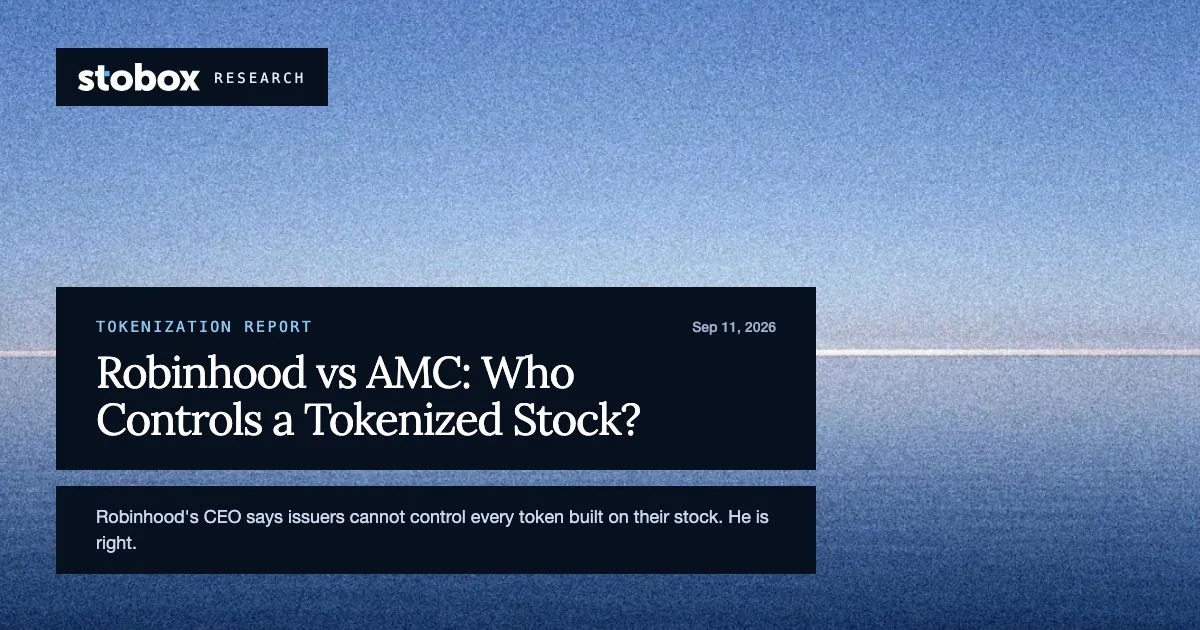
On September 9, 2026, Robinhood CEO Vlad Tenev went on CNBC and said something that a lot of public companies did not want to hear. Issuers, he argued, "should have control over rights and obligations of stock they issue, but that doesn't mean they control everything about it." In other words: once your shares trade in public markets, you do not get a veto over every financial product that someone else builds on top of them.
He said it in the middle of a public fight with AMC Entertainment. AMC's CEO, Adam Aron, had discovered that Robinhood was offering tokens tied to AMC stock, said AMC had no connection to the product and did not authorize or endorse it, and demanded that Robinhood "cease and desist." He called it a fake market and said AMC's lawyers would look at legal options, including taking the matter to the SEC.
We think Tenev is right. We also think most of the commentary is drawing the wrong conclusion from it. The lesson for issuers is not "fight the wrappers." It is "own the one token that actually carries the rights of your shares, before someone else defines your on-chain market for you."
This piece explains why.
What Robinhood actually sells
It helps to be precise, because the word "token" is doing a lot of work in this dispute.
Robinhood's Stock Tokens are not shares. According to Tenev and to reporting by CoinDesk and crypto.news, they are debt securities issued by Robinhood Assets Jersey Limited, backed one-to-one by underlying shares that Robinhood holds as collateral. They launched for European customers in June 2025, they run on Robinhood Chain, which is built on Arbitrum technology, and they are not available to customers in the United States.
Holders get economic exposure to the stock, including dividends. They do not get voting rights. Robinhood owns the underlying shares, so the votes attached to those shares sit with Robinhood, and Tenev declined to say how the company plans to exercise them.
So when a European investor buys an "AMC token" on Robinhood, what they own is a claim on Robinhood that tracks AMC. It is a very different thing from owning a share of AMC, even if the price moves together most of the time.
Most of the time is the key phrase. CoinDesk reported that one AMC-linked token pair on an on-chain market changed hands at roughly 60 times AMC's reference share price. A thin, fragmented market can print prices that have nothing to do with the company. That is exactly the kind of thing that makes a CEO pick up the phone to their lawyers.
Why Tenev is right on the principle
Strip away the heat and the principle Tenev is defending is an old one.
Companies have never controlled every instrument that references their stock. American Depositary Receipts let investors in one market hold claims on shares listed in another, often without the issuer doing anything. Exchange-traded funds hold baskets of stocks without asking any of the companies inside them for permission. Options, total return swaps and structured notes are written on public shares every day. None of these require the issuer's consent, because none of them are the issuer's shares. They are contracts between other parties that happen to reference those shares.
The U.S. Securities and Exchange Commission has already mapped this out for tokenized products. In a joint staff statement on January 28, 2026, the staffs of the Divisions of Corporation Finance, Investment Management, and Trading and Markets described two broad routes. A security can be tokenized by or on behalf of its issuer. Or it can be tokenized by a third party unaffiliated with the issuer, using either a custodial model, where the third party holds the real security and issues a token against it, or a synthetic model, where the token only tracks the price. The statement's central point is simple: a security does not stop being a security because it is recorded on a blockchain, and what matters is the economic substance and legal rights of the instrument, not the technology.
Robinhood's product sits squarely in the third-party column. It is a wrapper, and wrappers have always existed. Tenev put it plainly: issuer consent "depends on what exactly you're doing," and a product like his "should not automatically require issuer consent."
We agree. A world in which every company could veto every financial product that references its stock would be a world with no index funds, no ADRs and far less liquidity. The principle is sound.
Why AMC is not wrong to be angry
Agreeing with Tenev on the principle does not mean AMC's complaint is empty. Aron is reacting to three real problems.
The first is rights. Token holders get price exposure without a vote. If a meaningful part of a company's retail base migrates to wrappers, the people who feel like owners are not the people who vote. For a company like AMC, whose retail shareholders are a large part of its identity, that matters.
The second is price integrity. A share has one market that the issuer, its transfer agent and regulators can see. Wrappers can trade in venues the issuer does not see at all, at prices that drift far from the reference. When a token tied to your name trades at 60 times your share price, it is your brand that looks broken, not the venue's.
The third is confusion about what is being sold. This is not the first time. In July 2025, when Robinhood offered tokens linked to OpenAI to European users, OpenAI publicly said that "these 'OpenAI tokens' are not OpenAI equity," that it had not partnered with Robinhood, and that any transfer of OpenAI equity requires its approval. Tenev acknowledged at the time that the tokens were "not technically equity." When the holder, the issuer and the platform all describe the same instrument differently, investors are the ones left holding the ambiguity.
So both men are describing something true. Tenev is right that issuers cannot control every product built on their stock. Aron is right that the result can look, to an ordinary investor, like a market in his company that his company has nothing to do with.
The real divide: a wrapper versus the register
The way through this is to stop treating "tokenized stock" as one thing. There are two very different objects hiding behind the same phrase.
A third-party token is a claim on a claim. The investor has a contract with the platform. The platform holds, or tracks, the real share. The investor's rights are whatever the platform's terms say: usually price exposure and perhaps dividends, rarely votes, and always dependent on the platform continuing to operate and honor the arrangement.
An issuer-sponsored token is the share itself, recorded on a ledger that the issuer, or its transfer agent, controls. The token is not a mirror of the security. It is the security. Voting, dividends, transfer restrictions and investor eligibility can all live in the same record, because the issuer designed it that way.
The first kind is a product. The second kind is infrastructure. And the regulatory direction of travel is toward the second.
On September 1, 2026, the SEC proposed the first comprehensive overhaul of its transfer-agent rules in roughly 40 years, and the release names tokenization directly. As we wrote in our digest for September 2 to 8, transfer agents are the official book of record for who owns a security. Modernizing that book so it can live on a distributed ledger is a bigger deal than any single token launch, because it touches the legal status of the record itself. It is a proposal, not a rule, and the comment period is still open. But the signal is clear: the future of tokenized equity is being built around the register, not around wrappers.
That reframes the AMC dispute. The question is not whether Robinhood should be allowed to sell a wrapper. It is why AMC's own shareholders cannot already hold the real thing on-chain, with their votes attached, on a register AMC controls.
If you do not tokenize, someone else defines your on-chain market
Here is the uncomfortable part for issuers, and the reason we agree with Tenev rather than with the instinct to fight him.
Demand for on-chain exposure to real companies is not going away. Tokenized stocks grew sharply this year, and platforms have every incentive to serve that demand. If an issuer does nothing, the market will be served anyway: by wrappers, on venues the issuer does not choose, with prices the issuer does not see, and with rights the issuer does not grant. The issuer's name will be on the product. The issuer's judgment will not.
The alternative is to get there first. When a company offers its own shares, or a class of them, in tokenized form on a register it controls, three things change.
Rights stay with the share. Holders of the issuer's token are shareholders, with the votes and distributions the company's documents give them. There is no gap between the people who feel like owners and the people who are.
The issuer sets the rules. Who may hold the security, in which jurisdictions, with which lock-ups and transfer restrictions, can be enforced in the token itself, rather than trusted to someone else's terms of service. This is what permissioned token standards are for.
There is one price that counts. Wrappers may still exist, as ADRs still exist next to listed shares. But when the real share is available on-chain, a wrapper trading at 60 times the reference stops being "the AMC token" and becomes what it is: someone else's product with a price problem.
None of this requires a company to fight anyone. It requires a company to decide that its own register, not a third party's wrapper, is where on-chain ownership of its shares should live.
What issuer-controlled tokenization actually takes
Doing this properly is not a matter of minting a token. It is a sequence of decisions that most of the work sits inside. In our experience, it comes down to five things.
1. Choose the model deliberately. Using the SEC staff's own vocabulary, decide whether you are tokenizing as the issuer, and what that means for your existing share classes. Issuer-sponsored tokenization of an existing class is a different project from issuing a new class natively on-chain.
2. Keep control of the register and the contract. The point of issuer tokenization is lost if control of the smart contract, the admin keys or the investor list quietly sits with a vendor. The issuer, or its regulated transfer agent, should hold that control, and the arrangement should survive any single provider going away.
3. Put the rights in the record. Voting, distributions, transfer restrictions and investor eligibility should be encoded where the security lives, and match the company's legal documents exactly. A token whose on-chain rules disagree with the shareholder agreement is a lawsuit waiting to happen.
4. Get the facts about the company in order first. A tokenized share is only as trustworthy as the record behind it. Before issuing anything, a company should be able to show, from source documents, what it owns, what it owes, who controls it and what rights each class carries. Investors, and increasingly the AI tools they use to research companies, will read that record.
5. Plan for the secondary market, not just the issuance. Most tokenized assets that fail do not fail at the mint. They fail afterwards, when there is no compliant place for them to trade and no one watching the price. Liquidity has to be designed in from the start, with regulated partners where the law requires them.
What investors should ask before buying a tokenized stock
The same distinction matters just as much from the other side of the trade. Before buying anything labelled as a tokenized stock, an investor should be able to answer four questions.
Who issued the token? If the answer is the company itself, or its transfer agent, you are likely holding the share. If the answer is a platform or a special purpose vehicle, you are holding a claim on that entity.
What exactly do I own? Read whether the instrument is the security, a debt note backed by the security, or a contract that only tracks the price. The SEC staff's January statement uses exactly these categories.
Which rights come with it? Check votes, dividends and what happens in a merger, a split or a delisting. Rights that are not in the documents do not exist.
Where is the price formed? A token that trades far from the reference share is telling you something about its market, not about the company.
How Stobox approaches it
This is the problem Stobox has worked on since 2018. Over those eight years we have structured and supported $305M+ in assets for 100+ clients across 20+ jurisdictions, and the most consistent lesson has been the one this dispute illustrates: the token is the easy part. The record, the rights and the control are the work.
Our view of issuer tokenization rests on a few principles.
The issuer keeps control. Stobox is a non-custodial technology provider. When a company issues through Compass, our tokenization engine, the issuer keeps control of the contract. We build the infrastructure; we do not become the owner of the register. Regulated activity, such as brokerage, custody and legal advice, is carried out with licensed partners.
Rights are enforced by standard, not by trust. Stobox is a backer of ERC-7943, known as uRWA, a universal standard for compliant real-world-asset tokens that lets transfer restrictions and eligibility rules be enforced in the token itself. Compass issues primarily on Base, with Arbitrum and Canton also supported.
The record comes before the token. Stobox Intelligence builds one canonical, machine-readable record of a company: datapoints, each linked to its source document, covering the company, the offering and the project. It lets a company see, before it issues anything, where it is ready and where it is not, and it gives investors and their AI tools a verified record to read instead of a guess. Intelligence v1 is in preparation.
That is the practical answer to the question Tenev and Aron are arguing about. You cannot stop other people from building products that reference your stock. You can make sure that the real, rights-bearing version of your stock exists on-chain, under your control, with a record behind it that anyone can check.
The bottom line
Vlad Tenev is right: issuers do not control everything built on their shares, and they never have. Adam Aron is right that a wrapper trading under his company's name, without votes and at a price that makes no sense, is bad for his shareholders.
Both statements point to the same conclusion. The answer to third-party tokenization is not a veto. It is issuer tokenization done properly: the share itself, on a register the company controls, with the rights attached and the record behind it.
The companies that understand this early will not spend the next few years sending cease-and-desist letters. They will spend them building the on-chain market for their own shares, on their own terms.
If you want to see where your company stands before you decide, the Stobox readiness score is free and takes a few minutes.
Sources
- CoinDesk, Tenev's defense of Stock Tokens, the AMC dispute and the 60x price example, September 9, 2026
- crypto.news, Tenev's quotes, the issuing entity, availability and chain
- CNBC, the September 9, 2026 interview
- SEC staff statement on tokenized securities, January 28, 2026
- CNBC, OpenAI's statement on Robinhood's OpenAI tokens, July 2, 2025
- Stobox Weekly RWA & Tokenization Digest, September 2 to 8, 2026, the SEC transfer-agent proposal