The four weeks to 24 November were the period when tokenization stopped being announced and started running on the systems that already move the world’s securities. The US central securities depository switched on tokenized settlement. A venue co-owned by the parent of the New York Stock Exchange opened 24/7 trading of tokenized US stocks, with 67 companies on record refusing to be part of it. The European Central Bank said tokenized bonds will be accepted as collateral. Singapore and Hong Kong settled tokens in central bank money. At Stobox we read this the same way we read every infrastructure cycle: once the rails exist, the binding question becomes who is allowed onto them and on what record. Meanwhile on-chain value fell.
Who moved the market
Twenty of the institutions in this edition
These four weeks in one minute
- DTCC went live. The DTCC Tokenization Service launched on 28 October with 20 participants, including Citi and J.P. Morgan, on Canton and a private Besu network. Solana follows in the second half of 2027.
- OKXICE opened, and 67 issuers said no. The OKX and ICE venue began trading at noon ET on 23 November with 113 confirmed assets. Its 5 November notice lists 67 objecting issuers, among them all of Apple, Microsoft, Alphabet, Amazon, Meta, NVIDIA and Tesla.
- The issuer-sponsored model traded first. On 4 November Canton Strategic Holdings traded its own tokenized common stock under the Innovation Exemption, with an SEC-registered transfer agent keeping the register on-chain.
- Central banks closed the loop. The ECB will take DLT Pilot Regime assets as collateral from June 2027. MAS settled SGD100m of tokenised bills in wholesale CBDC. The HKMA moved to 24/7 settlement in tokenised central bank money.
- The market shrank. Distributed tokenized RWA value was $41.19 billion on 25 November, down 3.23% in 30 days, and stablecoin supply lost $16.97 billion.
- From Stobox: Stobox RWA Terminal 5.0.16 reached Production on 24 November, alongside a new stobox.io.
The thirteen developments below were selected on their importance to the tokenization industry, not their relationship to Stobox. This edition covers four weeks instead of one, because the series paused after the previous edition of 27 October.
The infrastructure is no longer the open question. Permission is: which issuers agree, which assets a central bank accepts, and whose record counts as the register.
Figure 1 · every development by date
Four weeks, thirteen moves
Week 128 Oct – 3 Nov
Week 24 – 10 Nov
Week 311 – 17 Nov
01DTCC switched on tokenized settlement for DTC-custodied securities
DTCC Tokenization Service · live 28 October · Solana connection announced 12 November
 Canton Network
 Solana

 BarclaysAlpaca
The Depository Trust Company launched the DTCC Tokenization Service on 28 October. It lets DTC participants create tokenized versions of securities DTC already holds, under the SEC no-action letter of December 2025, which covers Russell 1000 stocks, major-index ETFs and US Treasuries. Twenty participants have signed, among them Alpaca, Barclays, Citi and J.P. Morgan. At launch the service runs on the Canton Network and on DTCC’s private Besu network. On 12 November DTCC said it will connect the service to Solana, with DTC-tokenized assets expected there in the second half of 2027. DTC holds more than $114 trillion in custody.
“The culmination of years of work to bring tokenized securities into a regulated framework.”
Until now, most tokenized equities were wrappers built beside the market: a custodian holds a share and someone else issues a token against it. DTS is the depository itself issuing the tokenized form of the position it already records. Ledger Insights reports that the tokens keep the same CUSIP and ownership rights as conventional positions and that a transfer between registered wallets is the settlement, while moves between chains go through a conversion service open on business-day hours only.
For issuers and brokers, the practical point is that tokenized settlement of mainstream US securities now has a regulated home that does not require anyone to leave the existing chain of custody. Anyone building a tokenized-equity product should ask whether it can be built on the depository’s tokens instead of a parallel wrapper. Note the hours: round-the-clock movement holds within one network, not across them.
Stobox perspective. The market spent years arguing about which chain would win. DTCC answered by attaching three, one permissioned, one private and one public. What decides the outcome is the register, and the depository has just made itself the register for the tokenized form as well.
02OKXICE opened 24/7 trading with 67 issuers on record refusing
OKXICE Tokenized Securities Venue · notice of 5 November · live 23 November

 SecuritizeUniswapX LayerUS Senate
OKXICE, the joint venture of OKX and Intercontinental Exchange, published a public notice on 5 November listing 67 issuers that had filed a Notice of Issuer Objection under the SEC’s Innovation Exemption, up from 26 in its notice of 26 October. The list includes Apple, Microsoft, Alphabet, Amazon, Meta, NVIDIA, Tesla, JPMorgan, Goldman Sachs and Walmart. On 23 November the venue went live: from noon ET eligible US customers could trade around the clock, with 113 confirmed stocks, ETFs and ETPs to become available on a rolling basis. Trading runs through permissioned Uniswap v4 pools on X Layer against payment stablecoins, and only wallets holding the venue’s soulbound access token can trade. The notice states plainly that the venue “is not subject to Regulation NMS.”
Two kinds of pressure built during the period. On 16 November four Democratic senators sent SEC Chair Paul Atkins 13 questions about the exemption, focused on tokens moving to unverified wallets after a trade, according to The Block, and asked that any change come through rulemaking. The Block also reported that Nasdaq’s chief legal officer said Nasdaq would opt its own stock out. The SEC had issued no amendment to the exemption by 24 November.
Figure 2 · issuer objections at OKXICE
From 9 to 67 in three weeks
The tradable universe on third-party venues is now being shaped by refusal. Apple, Microsoft, Alphabet, Amazon, Meta, NVIDIA and Tesla have all chosen to stay off. What is left skews towards crypto-native and recently listed names, many of which consented. Anyone relying on these venues for liquidity should model a universe that can shrink by notice, and should read the venue’s own disclosures on permissioning and liquidity-provider risk before treating it as market infrastructure.
Stobox perspective. In the previous edition we wrote that consent had become the binding constraint. Four weeks later the count is 67, and the venue opened anyway. Both facts can be true: there is demand for tokenized US equity, and the issuers whose names carry that demand mostly do not want a third party to supply it.
03The first issuer-sponsored tokenized stock traded under the exemption
Canton Strategic Holdings · TSV LLC · 4 November · Canton Coin no-action letter, 3 November
Canton StrategicFairmintDRW CumberlandFlowdeskFive North SEC
On 4 November Canton Strategic Holdings, listed on Nasdaq as CNTN, executed what it describes as the first trades of an issuer-sponsored tokenized US equity under the Innovation Exemption. The trades ran on TSV LLC through a permissioned pool and settled atomically on the Canton Network. Fairmint TA, an SEC-registered transfer agent, records the shares in token form and keeps the official ownership record. Five North sold, DRW Cumberland bought and Flowdesk provided liquidity. No size, price or volume was disclosed. The chief executive said shareholders on the venue “keep the same rights they have on Nasdaq.”
The day before, the SEC’s Division of Corporation Finance issued a no-action letter on Canton Coin, the network’s native token, treating it as a “digital commodity” on the facts presented and saying it would not recommend enforcement over minting without registration. It is a staff position resting on the requester’s representations, not a Commission ruling.
This is the mirror image of story 2. At OKXICE a third party creates an entitlement and the issuer may object. At CNTN the issuer is the party putting its shares on-chain, and the token is the register, held by a registered transfer agent. The first design scales faster. The second answers the questions that matter in a corporate action, a dispute or an audit, because the company is inside the arrangement.
Third-party entitlement
OKXICE, xStocks
- Someone else creates the token against shares held in custody
- The issuer may object, and 67 did
- Scales fast across many names
- No corporate actions from the issuer
Issuer-sponsored
Canton Strategic (CNTN)
- The company puts its own shares on-chain
- A registered transfer agent keeps the register in token form
- Same rights as the listed share
- Slower to assemble, built to survive an audit
Stobox perspective. This is the model we have argued for since the first security tokens: the company tokenizes its own instrument, and a registered party keeps the record the token enforces. It is slower to assemble and it is the one that survives supervision. Companies watching story 2 from the objection list should look at story 3 as the alternative they control.
“The hard half is maintaining a record that holds up when a buyer, a counterparty, a lawyer or an auditor reads it cold, in one place, without being walked through it.”
 Gene DeyevFounder and CEO, StoboxThe Record Comes Before the Token, 25 October
04The Eurosystem settled a supranational DLT bond and will accept DLT bonds as collateral
ESM €1bn bond settled on Pontes, 2 November · ECB collateral decision, 23 November
 BundesbankClearstream
 ECBPontes
The European Stability Mechanism priced a €1bn digitally native benchmark bond on 26 October, with the Bundesbank as issuing and paying agent and Clearstream as the DLT operator. ECB Executive Board member Piero Cipollone told the European Parliament on 10 November that Pontes settled the issuance on 2 November in central bank money, and that 18 participants and DLT operators had onboarded on the first day.
Then on 23 November the ECB said it will accept marketable assets issued on DLT Pilot Regime platforms as eligible collateral for Eurosystem credit operations. The assets must meet all standard eligibility criteria and be reachable through a link to a compliant central securities depository, and the platforms must meet extra requirements such as settlement finality. Details come in spring 2027 and implementation is planned for June 2027. DLT-based assets issued in CSDs have been eligible since 30 March 2026.
“We support innovation without lowering our standards.”
Taken together, the euro area now has issuance, settlement in central bank money and collateral eligibility lined up for DLT bonds. Collateral eligibility is the strongest liquidity incentive a European issuer can be offered, because it lets a bank borrow against the instrument from the central bank. It also raises the value of holding a DLT Pilot Regime licence. A European issuer weighing a digital bond for 2027 now has a reason to plan for a Pilot Regime venue and a CSD link, not a standalone chain.
05Europe began writing one rulebook for tokenised settlement
European Tokenisation Standards Group · call of 9 November · ECB reference model, 24 November
ECBEuropean CommissionESMA
On 9 November the ECB, the European Commission and ESMA invited wholesale-market participants to join the European Tokenisation Standards Group. Its task is to write common standards for an interconnected tokenised ecosystem and a framework for monitoring compliance with them. Industry will chair it, and the three authorities will sit as observers. Applications close on 27 November. On 24 November the ECB published a Tokenisation Reference Model as input. It defines five domains, legal, governance, semantic, operational and infrastructural, and five capabilities: interoperability, transferability, portability, controllability and composability.
Fragmentation has been the quiet cost of European tokenization: each venue and each issuer defined its own data, its own transfer rules and its own legal wrapper. A standards group with the central bank, the Commission and the securities regulator in the room is an attempt to make tokens issued on one platform usable on another before the market fragments for good.
The deadline is two days after this edition. Firms that intend to issue, settle or service tokenised instruments in the EU should decide quickly whether to take part, because the standards written here are likely to be the ones venue rules and collateral eligibility rely on.
06Singapore settled tokenised government bills in wholesale CBDC
MAS keynote, Singapore FinTech Festival · 19 November
MASProject GuardianBLOOM
In his keynote of 19 November, MAS Managing Director Chia Der Jiun said SGD100m of tokenised MAS Bills were issued and settled against Singapore-dollar wholesale CBDC in November. MAS plans to add foreign government securities and money market funds as tokenised collateral. MAS and industry published the Guardian Tokenised Collateral Framework, covering eligibility, custody, valuation and enforcement across repo, uncleared margin and clearing-house collateral. The SGD Testnet becomes an operational utility named SG Digital Ledger, and the BLOOM initiative on cross-border settlement in digital money now counts 24 industry members.
Singapore now has a sovereign instrument issued as a token and settled in central bank money, and an industry method for when a token can serve as collateral. Ledger Insights summarised the framework’s central point in its headline: an eligible asset does not make an eligible token. Custody, legal enforceability and valuation of the token have to be shown separately.
“A data room stores; a record reads.”
Gene DeyevFounder and CEO, StoboxWhat Is Stobox Intelligence?, 29 JulyCollateral desks will read that line closely. A tokenized Treasury fund or bond is not automatically acceptable margin because its underlying asset is. Issuers who want their token to be used as collateral should be able to show, in documents, who holds it, how a pledge is enforced and how it is valued at any hour.
07Hong Kong ran tokenised settlement around the clock and BlackRock launched an HKD tokenized fund
HKMA Project Ensemble, 2 November · BlackRock HKD Digital Liquidity Fund, 24 November
 SFC

 Ant International
On 2 November the HKMA said EnsembleTX now supports 24/7 interbank settlement of tokenised deposit transactions in tokenised central bank money; since its November 2025 launch it had settled through the HKD real-time gross settlement system. Participating banks rose to 12 and industry pioneers to 20, with use cases including corporate treasury and tokenised money market fund transactions. On 11 November the HKMA and the SFC co-hosted a seminar on Ensemble and tokenised SFC-authorised products for about 200 practitioners.
“Project Ensemble has transitioned from experimentation and piloting to a new phase.”
At the end of the period BlackRock opened its HKD Digital Liquidity Fund, a Hong Kong-domiciled constant-NAV money market fund with tokenized and conventional units. Ledger Insights reports about USD 100 million of seed money from Ant International and Standard Chartered, which also acts as custodian and tokenization agent, and that professional investors can subscribe in HKDAP, a Hong Kong dollar stablecoin. The seed size and investors come from that report, not from BlackRock’s own page.
Hong Kong has now lined up the three pieces a tokenized fund market needs: a settlement asset available at any hour, authorised tokenized products, and, since October, permission for those products to trade on a secondary venue. The order matters. The cash leg came from the central bank and the banks, and the fund arrived once there was something to settle it against.
Eurosystem
€1bn settled on PontesESM bond settled in central bank money on 2 November. DLT Pilot Regime assets become collateral from June 2027.On the ledgerMAS, Singapore
SGD100m in wholesale CBDCTokenised MAS Bills issued and settled against Singapore-dollar wholesale CBDC in November.On the ledgerHKMA, Hong Kong
24/7 settlementEnsembleTX settles tokenised deposit transactions in tokenised central bank money around the clock.On the ledgerFederal Reserve
Money at the foundationGovernor Waller backed a mixed system with central bank money underneath it, and announced no programme.Off the ledger08Tokenized deposits crossed a border, and a corporate treasury built the swap layer
DBS and Kinexys, 16 November · Standard Chartered facility, 10 November · Ant International protocol, 19 November
 Kinexys by J.P. MorganPartiorAnt InternationalFranklin Templeton
On 16 November DBS and Kinexys by J.P. Morgan launched 24/7 cross-border transfers of US dollar tokenized deposits between Singapore and the United States, connecting DBS Token Services with Kinexys’s permissioned network, with Partior orchestrating settlement and Ant International as the first client. Moving funds between the network and ordinary accounts still pauses for three hours on Saturdays. On 10 November Standard Chartered completed a pilot redemption liquidity facility that gives Ant International cash when it redeems a tokenized money market fund, instead of waiting for the fund’s settlement cycle. On 19 November Ant International launched the Whale Orchestration Protocol for delivery versus payment between tokenized deposits and tokenized money market funds, with pilot transactions by DBS and Franklin Templeton, as reported by The Block.
Two banks’ separate tokenized-deposit networks are now linked across a border, which is the cash leg tokenized securities need outside banking hours. The bank liquidity facility turns a tokenized fund holding into something a treasurer can use as working cash. And one corporate client, Ant International, appears in all three, plus the BlackRock seed in story 7.
The demand for tokenized cash and funds in Asia is being pulled by treasurers who need to move money across entities at any hour, not pushed by issuers. For anyone designing an on-chain cash management product, the reference customer is a multinational treasury, and the test is whether a fund unit can be turned into cash at 2am on a Sunday.
“Tokenised money is moving rapidly from experimentation to delivering live tangible value.”
09The UK assigned the jobs for its first digital gilt
HM Treasury, DIGIT pilot · 2 November
 Bank of England

 BarclaysRBCLloydsNatWestMorgan Stanley
HM Treasury gave roles to the six joint lead managers of the Digital Gilt Instrument pilot on 2 November. HSBC takes documentation, settlement and bookbuilding; RBC and Barclays coordinate the roadshow; Lloyds handles press; NatWest and Morgan Stanley take a new Platform Coordinator role helping investors onboard to their chosen platform. The Bank of England approved a link between HSBC Orion, as the issuer’s Digital Securities Depository, and LSEG, as an investor DSD, so investors can reach DIGIT through either. DIGIT will be short-dated, issued inside the Digital Securities Sandbox and kept outside the main gilt programme. Issuance is expected by the first quarter of 2027. Size, coupon and the cash leg were not disclosed.
The link between two depositories solves a problem every multi-platform sovereign issue faces: without it, one gilt would split into separate pools on separate ledgers. The new Platform Coordinator role is an admission that investor onboarding, not the ledger, is the bottleneck. Q1 2027 is now a public target for a G7 digitally native sovereign bond, a useful benchmark for anyone pricing a digital bond in sterling.
10Tokenized fund share classes moved beyond cash
Amundi Core STOXX Europe 600, 5 November · Schroders EM debt via Centrifuge, 4 November
 CACEIS
 CentrifugeAnemoy
Amundi, Europe’s largest asset manager, added a tokenized share class on public Ethereum to its Core STOXX Europe 600 index sub-fund, which manages about €22.8 billion, with CACEIS as transfer and tokenization agent, as reported by Ledger Insights. Tokens represent fund units, not the 600 underlying stocks, and existing distribution stays in place. A day earlier, Centrifuge’s affiliate Anemoy launched a tokenized feeder on Solana investing in the Schroders ISF Emerging Market Bond fund, a Luxembourg UCITS sub-fund of about $2.3 billion, settling in USDC with a $100,000 minimum for non-US professional investors. The Luxembourg fund itself is not tokenized.
These are two different structures, and the difference matters to an investor. A share class sits inside the fund: one portfolio, a second register on a ledger beside the traditional one. A feeder sits outside it: the investor owns a share of a vehicle that owns the fund, and the claim runs on the feeder’s net asset value and the feeder manager’s governance. Headlines described both as “tokenizing a fund”. Read the prospectus before you treat them as equivalent.
For asset managers, the share-class route has now been taken on a flagship equity index fund, not just a money market fund. It is the cheaper path when the transfer agent can run the second register, and it keeps the fund’s existing protections in place.
11Securitize reported its first public quarter and bought a credit platform
Securitize, NYSE: SECZ · Q3 results and River One agreement, 9 November · deal closed 17 November
SecuritizeRiver One
Securitize reported third-quarter results, its first as a listed company: revenue of $18.6 million, up 13% year on year, a net loss of $66.3 million, mostly non-cash and tied to the listing, and adjusted EBITDA of minus $2.0 million. Tokenized assets on the platform were $4.8 billion at 30 September, and the company held about $300 million in cash with no debt. The same day it agreed to acquire River One, a New York warehouse-financing platform lending against small-business loans and receivables. No price was disclosed. The deal was reported closed on 17 November. Securitize is also the tokenization provider behind OKXICE.
These are the first public quarterly numbers from a company that does nothing but tokenization, and they set a reference point: about $18.6 million of quarterly revenue on roughly $5 billion of tokenized assets. Issuance fees alone do not make a large business at that scale, which explains the acquisition: the move is into originating credit, where the margin sits in the asset, not in the token.
“Credit is one of the most exciting emerging asset classes.”
For asset owners comparing platforms, this is a reminder to ask how a provider earns money, because it shapes what it will push you towards. Our Tokenization Cost Index tracks what the work itself costs across providers.
12Swift joined the ERC-3643 Association
Apex Group, Chainlink, T-REX Network and the ERC-3643 Association · 4 November
SwiftERC-3643 AssociationApex Group ChainlinkT-REX Network
On 4 November Apex Group, Chainlink, T-REX Network and the ERC-3643 Association demonstrated a modular compliance framework for on-chain bonds aligned with Swift standards. Identity, investor eligibility and transfer rules are written once at the asset level and reused across networks, so a bond is deployed once and distributed across chains from a single record. Swift has joined the ERC-3643 Association, and the first bond implementation uses Swift’s standards and taxonomy. Chainlink supplies cross-chain transfer, compliance enforcement and pricing. It is a demonstration, not a live issuance, and the release gives no chains or amounts.
“This initiative demonstrates a practical route forward.”
Swift membership ties the most widely used permissioned-token standard to the data models banks already use for messaging. The design choice worth noting is “write the rules once, enforce them everywhere”: compliance travels with the asset rather than being rebuilt per chain.
Stobox perspective. We back ERC-7943, the universal RWA interface, which reached Final status as an Ethereum standard in May 2026 and is designed to sit alongside permissioned standards such as ERC-3643 rather than replace them. The direction in this story is the right one whatever the standard: eligibility and transfer rules belong to the asset and its register, and the chain should only enforce them.
13The data around tokens started running on weekends
Chainlink 24/7 pricing, 29 October · UBS structured note on Ethereum, 19 November · Moody’s ratings pilot, 10 November
ChainlinkAave

On 29 October Chainlink launched 24/7 market data for tokenized stocks and commodities, joining live trading prices with an off-hours reference into one series. While the underlying exchange is closed, the price comes from quotes on several perpetual-futures venues. Aave Horizon, Aave’s institutional market, is the first user, valuing tokenized RWA collateral through weekends. On 19 November Chainlink and UBS described a production solution for tokenized structured notes on Ethereum that shows token balances, coupon entitlements and barrier proximity in real time and automates lifecycle servicing; settlement through UBS digital money is planned, not live. On 10 November Moody’s Ratings distributed credit ratings to several chains at once in a testnet pilot with representative data.
A token that trades at any hour needs a price, a coupon state and a rating at any hour, or lenders cannot accept it as collateral. These three releases fill that gap from three sides. They also move risk: a weekend price taken from perpetual futures is not the exchange price, and anyone lending against tokenized equities should say in their terms which price they liquidate on.
Also in the period
- Federal Reserve. On 17 November Governor Christopher Waller described a mixed system of stablecoins, tokenized deposits and tokenized money market funds, with central bank money at its foundation, and announced no new programme.
- FinCEN. On 6 November FinCEN and the Federal Reserve Board withdrew the proposal to amend the recordkeeping and travel rule for convertible virtual currency transfers.
- Real estate. Index Industries raised a $50 million seed round led by Lightspeed for a tokenized US home-price index. The USHP token is issued by a BVI entity and is not offered to US persons.
- Tokenized equities outside the US. Kraken’s parent Payward added more than 200 UK and European stocks to xStocks, which reports over 1,500 assets and $1.1 billion under management. xStocks is not offered in the UK or the US.
- Korea. Hanwha Investment & Securities adopted Chainlink’s data and interoperability standards for a global RWA platform, ahead of Korea’s tokenized securities framework due in February 2027.
- Security. We found no exploit of a real-world asset protocol reported between 28 October and 24 November.
The market fell while the rails went live
Distributed on-chain value of tokenized real-world assets was $41.19 billion on 25 November, according to rwa.xyz, and the provider’s own 30-day change is minus 3.23%. That figure is not comparable with the $39.05 billion printed in our previous edition: rwa.xyz restated its series in between, most visibly in commodities, so the difference is a change of method, not growth.
Figure 3 · rwa.xyz, distributed value, 25 November 2026
Where the $41.19 billion sits
| Category | 25 November 2026 | 30-day change | Note |
|---|---|---|---|
| Tokenized US Treasuries | $14.08B | minus 3.95% | 123 products, 7-day APY 3.71% |
| Tokenized credit | $8.07B | minus 4.36% | All non-sovereign debt, not private credit alone |
| Tokenized commodities | $7.27B | minus 3.32% | Restated upwards since October |
| Tokenized stocks | $3.57B | not reliable | Holders up 8.66% to 5.00M |
| Stablecoins, all pegs | $284.19B | minus $16.97B since 27 October | DefiLlama series |
The largest tokenized Treasury products on rwa.xyz on 25 November were Ondo’s USDY at $2.38 billion, Circle’s USYC at $2.12 billion, Franklin Templeton’s iBENJI at $1.65 billion, BlackRock’s BUIDL at $1.55 billion and Franklin Templeton’s BENJI at $1.36 billion. Counted together, Franklin Templeton’s two products make it the largest manager at about $3.0 billion.
Figure 5 · largest tokenized Treasury products
Ten products, five managers above a billion
Stablecoin supply fell from $301.16 billion on 27 October to $284.19 billion on 25 November in the DefiLlama series, and The Block, citing Glassnode, called the move the largest monthly contraction since 2022. Our previous edition printed $303.25 billion for 27 October; the current DefiLlama series gives $301.16 billion for that date, and we use it here for a like-for-like comparison. One provider per figure, deliberately: rwa.xyz and DefiLlama measure stablecoins differently, and blending them produces a number that is true nowhere.
Figure 4 · stablecoin supply, all pegs, daily
The cash leg shrank by $16.97 billion
The dated, sourced figure for the market is kept current in State of RWA 2026.
The pattern of the four weeks is that the infrastructure moved and the money did not follow yet. A depository, two central banks and a regional monetary authority launched or committed to real systems, while on-chain value and stablecoin supply both shrank, in step with wider crypto de-risking. The two do not contradict each other. Institutional infrastructure runs on project timelines measured in years, and on-chain balances respond to rates and risk appetite measured in weeks. When the cycle turns, the capital will arrive on rails that now exist.
Market trends across the four weeks
Market infrastructure, not start-ups, carried the period. DTCC, ICE through OKXICE, the Eurosystem, MAS, the HKMA, HM Treasury and Swift account for most of the thirteen stories. Tokenization is being absorbed into the institutions that already run settlement, custody and collateral.
Central bank money reached the ledger. Pontes settled a €1bn bond, MAS settled tokenised bills in wholesale CBDC, and the HKMA runs tokenised central bank money around the clock. The US took the other road: Governor Waller described central bank money at the foundation of a mixed system, not on the ledger itself.
“…its presence at the foundation of the system is essential.”
Collateral became the commercial prize. The ECB decision, the Guardian framework and Chainlink’s weekend pricing all answer one question: can this token be pledged? An instrument a bank can borrow against has a buyer even when there is no secondary market.
Two models of tokenized equity now run side by side. Third-party entitlements at OKXICE and on xStocks; issuer-sponsored tokens with an on-chain transfer agent at CNTN. The first has the volume and the objections. The second has the register.
Asia is demand-led. Ant International appears as client, seed investor or protocol builder in four separate developments. Treasurers moving cash across entities at any hour are driving tokenized deposits and funds in Singapore and Hong Kong.
Standards converged on one idea. Swift and ERC-3643, the ECB’s reference model and the EU standards group all point at the same design: rules and data written once at the asset level and enforced on whichever network the asset sits.
What this means for asset owners
Should you tokenize now? If your instrument is a bond, a fund unit or your own company’s equity, the infrastructure question has largely been answered in New York, the euro area, Singapore and Hong Kong. The remaining work is on your side: legal structure, eligibility rules, a register someone accountable keeps, and documents a counterparty can check.
The opportunity. Issuer-sponsored tokenization is the route the official sector keeps validating: Luxembourg and the ESM issued natively, Amundi added a share class, CNTN put its own register on-chain. If you are a company, tokenize your own instrument rather than waiting for a third party to wrap it.
Expensive mistakes to avoid.
- Treating “on-chain” as “collateral-eligible”. MAS just wrote down that an eligible asset does not make an eligible token.
- Choosing a chain before choosing a register. DTCC chose three networks; what it kept was the record.
- Selling a feeder as if it were the fund. The investor’s claim differs, and supervisors will ask.
- Arriving at diligence with a data room that does not answer the questions. Check yours against what investors and counsel ask for first with the gap check.
What this means for investors
Where capital is flowing. Into plumbing and treasury use. A $50 million seed round went to an index product and Securitize bought a credit platform; bank balance sheets went to redemption facilities and cross-border deposit links. On-chain balances fell.
Tokenized Treasuries remain the only category with real scale at $14.08 billion, and the largest products are now spread across Ondo, Circle, Franklin Templeton and BlackRock rather than led by one fund. Watch which of them become accepted collateral, because that is what will separate them.
Tokenized equities carry a risk specific to third-party venues: an issuer can withdraw. On issuer-sponsored tokens that risk does not exist, but liquidity is thinner. Price the trade-off explicitly.
Infrastructure winners in this period were those attached to depositories and central banks: Canton through DTCC and CNTN, Solana through DTCC’s 2027 plan, Chainlink across pricing, servicing and ratings, and the bank deposit networks in Asia.
Stobox insights
What we observe. Every development in this edition that worked had three things: an accountable party keeping the register, eligibility checked before a transfer, and documents a counterparty could verify without calling the issuer. Every development that drew objections lacked at least one.
What happens next. Expect the SEC to face a decision on the Innovation Exemption, with the senators’ 30-day window running to mid-December. Expect European issuers to plan 2027 digital bonds around Pilot Regime venues once the ECB publishes its requirements in spring. Expect collateral eligibility, not secondary trading, to become the main sales argument for tokenized funds.
What companies should prepare for. Counterparties will increasingly ask for the record behind the token before they look at the token: who owns what, under which rules, proven by which documents. A company that has its record in order will move through diligence in days; one that does not will rebuild the same pack for every investor.
Technology becoming mandatory. An authoritative register the token enforces, eligibility read as a verified answer rather than a stored document, data that stays current at any hour, and a clear statement of which price and which hours apply. None of it is new technology. All of it is now expected.
From Stobox
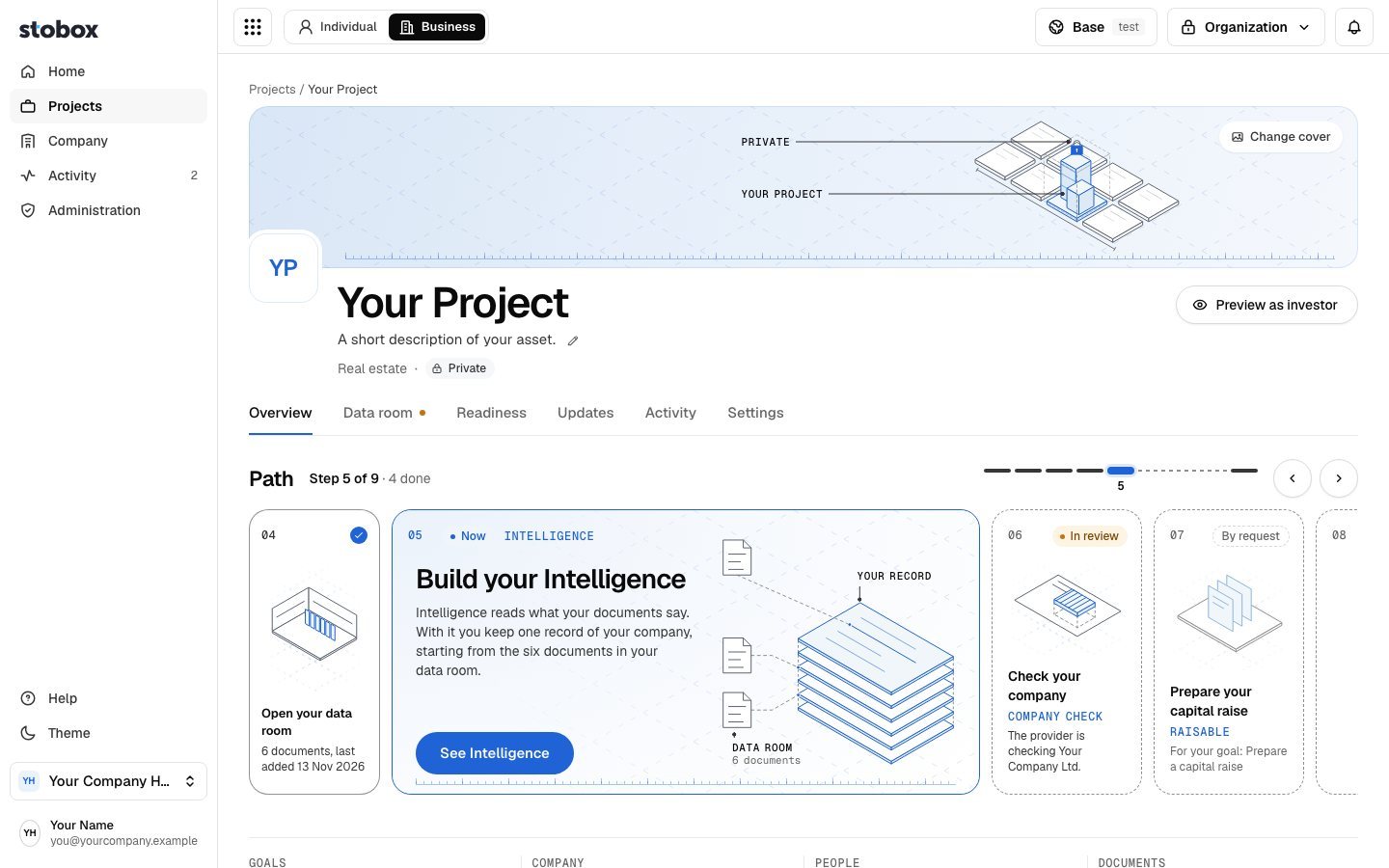
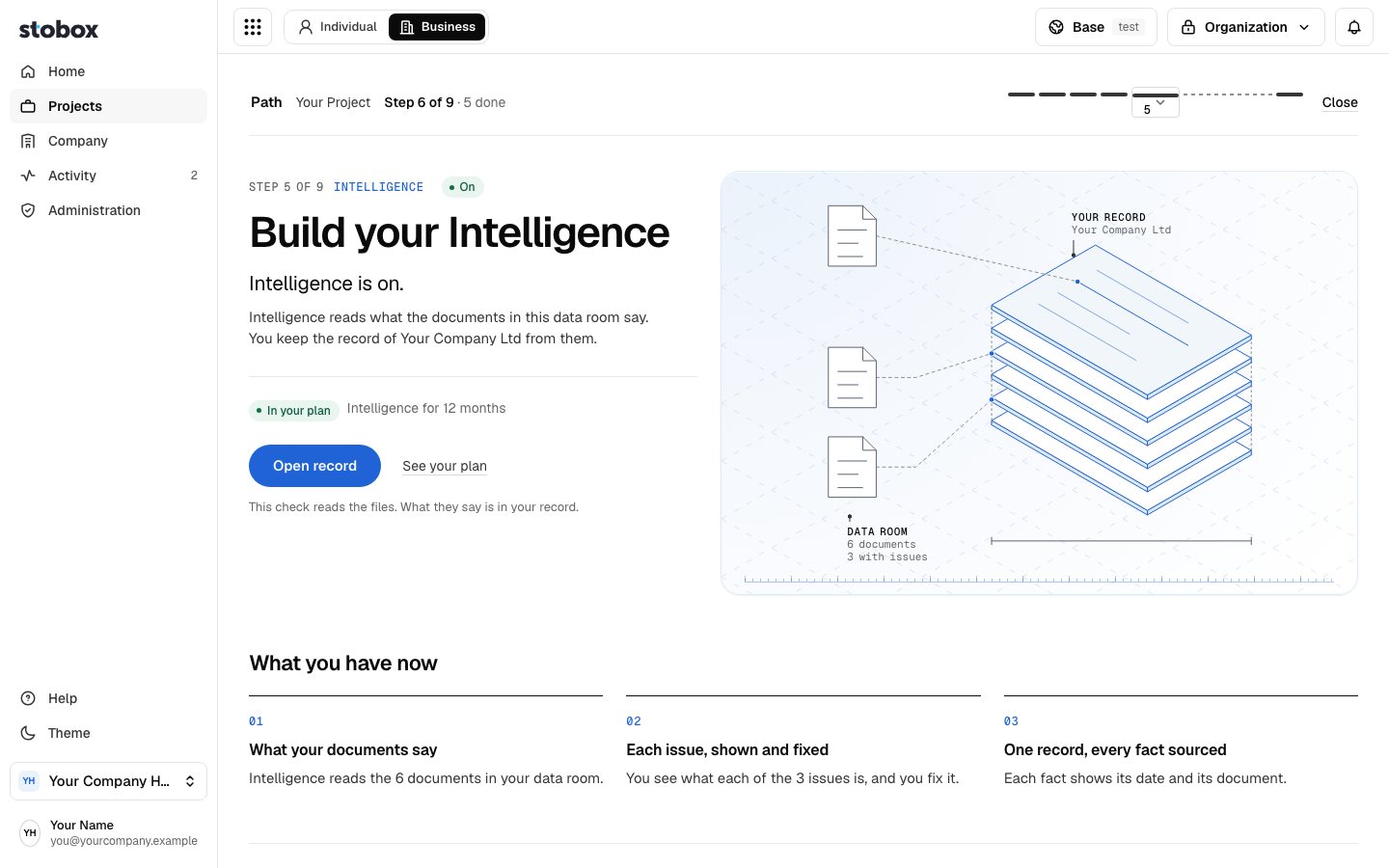
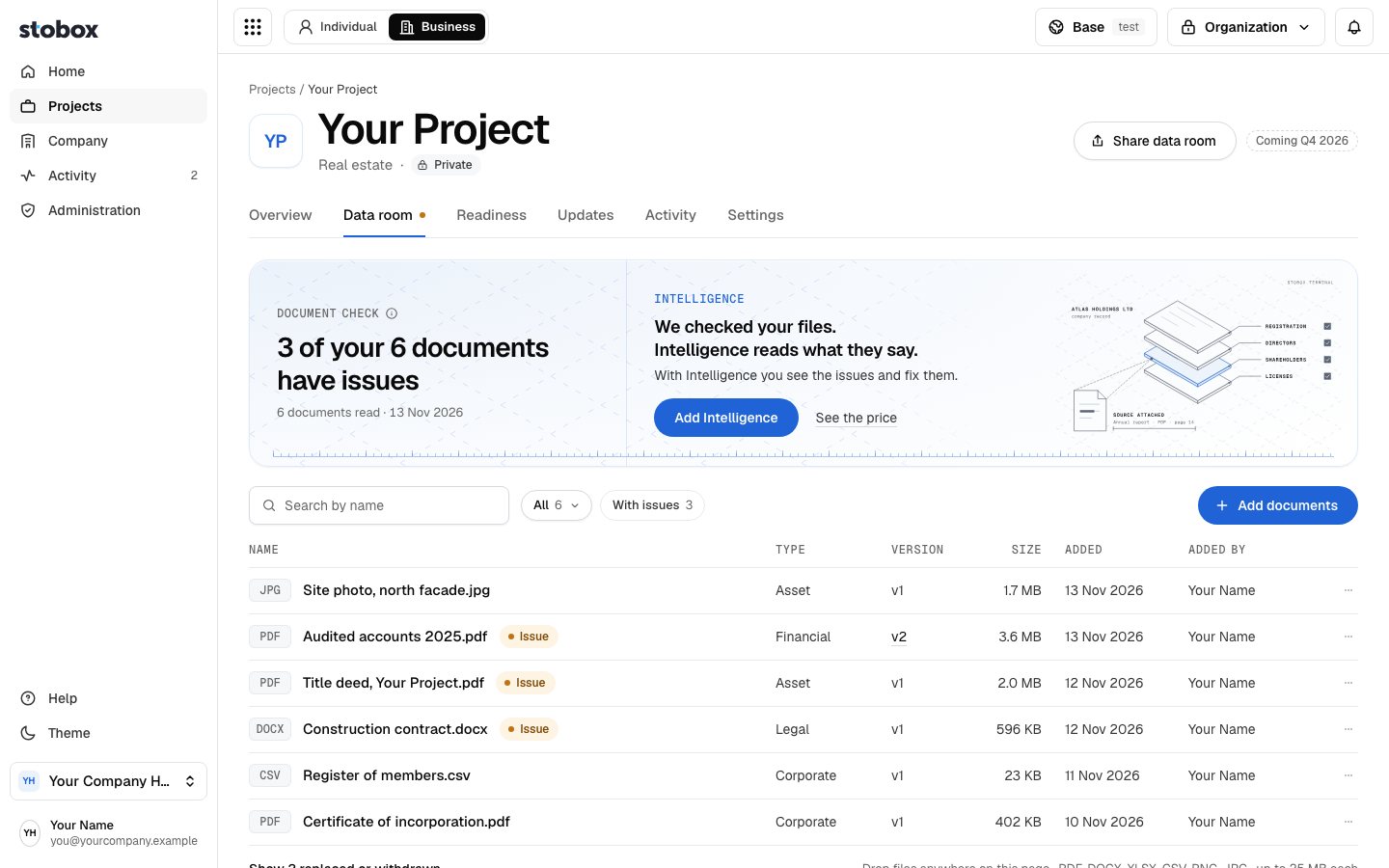
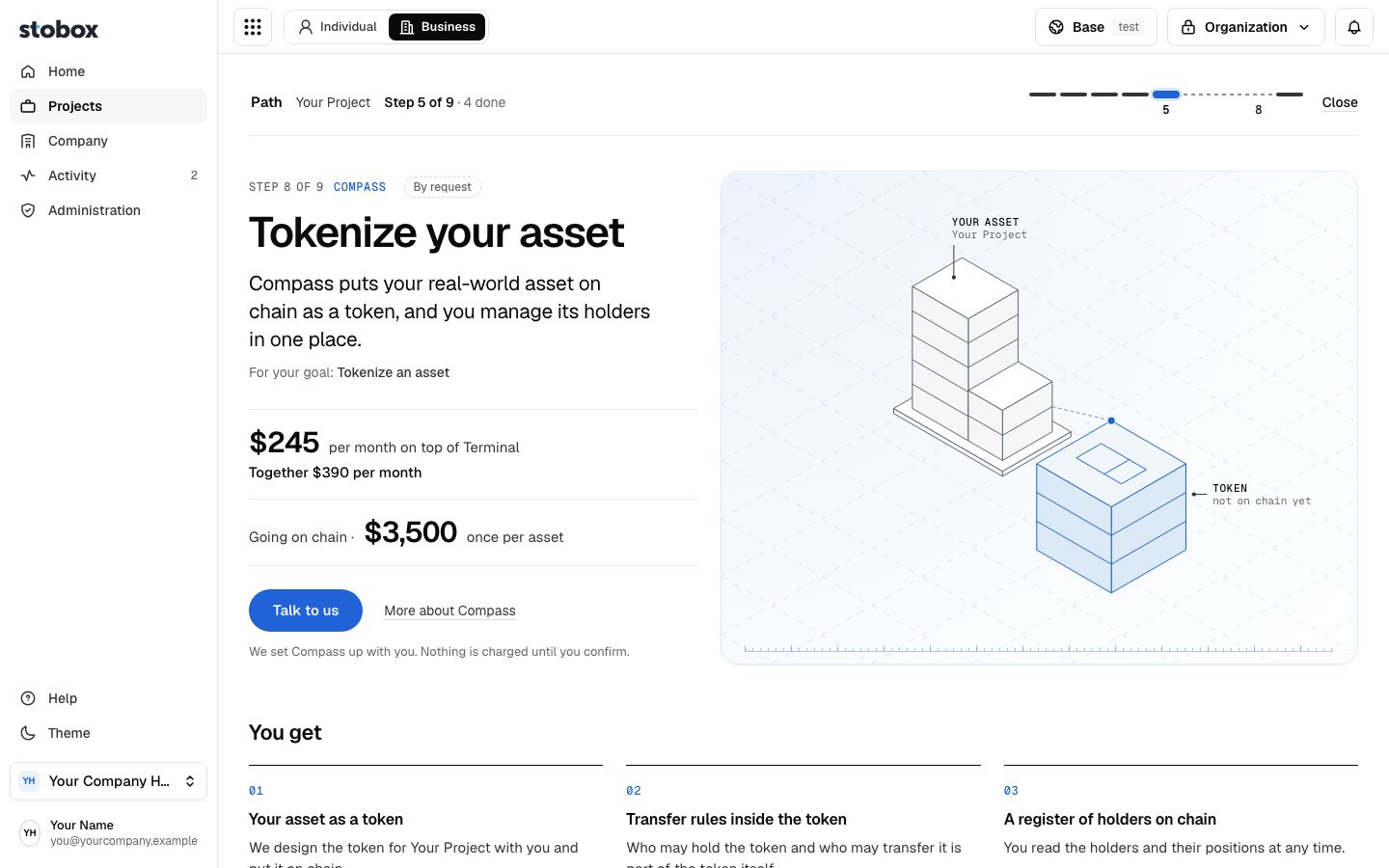
The theme of these four weeks, that the record matters more than the token, is the one Stobox builds on. On 24 November Stobox RWA Terminal 5.0.16 reached Production at app.stobox.io, and stobox.io moved to a new version the same day. The Terminal gives every project a path of nine steps from the organization to monitoring, a data room that keeps every version of every document, and a free readiness score. Inside it, Stobox Intelligence builds one verified record of a business, every fact with its document and who stands behind it, so the next investor, lender or collateral desk gets a link to the record instead of a pack rebuilt from scratch. That is the question MAS put in writing this month: an eligible asset does not make an eligible token until the record behind it can be shown. And Stobox Compass issues security tokens primarily on Base using ERC-7943, with transfers checked against the asset’s rules before they move.
“One record, verified once, that travels from organizing the asset to raising against it to tokenizing it – without being re-keyed three times.”
Gene DeyevFounder and CEO, StoboxThe New Stobox, 7 JulyTo be explicit for transparency: the thirteen developments in this digest were selected on their importance to the tokenization industry, not their relationship to Stobox. This section is disclosed separately for that reason.
If this edition was useful, subscribe to the Stobox RWA & Tokenization Digest to get the next one in your inbox. If you are weighing whether to put an asset you own on-chain, the readiness score takes about eight minutes and shows the two areas to work on first, and our guide to tokenization explains the steps in order.
Frequently Asked Questions
What happened in tokenization between 28 October and 24 November 2026? Core market infrastructure went live. DTCC launched its Tokenization Service on 28 October, OKXICE opened a 24/7 tokenized securities venue on 23 November with 67 issuers objecting, the ECB said assets on DLT Pilot Regime platforms will be eligible Eurosystem collateral from June 2027, and Singapore settled SGD100m of tokenised MAS Bills against wholesale central bank digital currency.
How large is the tokenized real-world asset market now? Distributed on-chain value of tokenized real-world assets was $41.19 billion on 25 November 2026, per rwa.xyz, down 3.23% over 30 days by the provider’s own measure. Tokenized US Treasuries were $14.08 billion, tokenized credit $8.07 billion, commodities $7.27 billion and tokenized stocks $3.57 billion. The total is not comparable with the $39.05 billion printed in the previous edition because rwa.xyz restated its series in between.
Is RWA tokenization still growing? Not over this period, measured by on-chain value. The distributed total fell 3.23% in 30 days and stablecoin supply fell by $16.97 billion, from $301.16 billion on 27 October to $284.19 billion on 25 November per DefiLlama. The decline tracks wider crypto de-risking, while institutional infrastructure kept launching.
What is the DTCC Tokenization Service? It is a service of the Depository Trust Company that lets DTC participants create tokenized versions of securities DTC already holds in custody. It went live on 28 October 2026 on the Canton Network and DTCC’s private Besu network, with 20 participants signed, and DTCC plans to connect it to Solana in the second half of 2027.
Why are companies objecting to tokenized versions of their shares? Under the SEC’s Innovation Exemption a venue may trade a third-party tokenized version of a listed stock unless the issuer files an objection, so silence counts as consent. By OKXICE’s notice of 5 November, 67 issuers had objected, including Apple, Microsoft, Alphabet, Amazon, Meta, NVIDIA and Tesla.
What is the difference between issuer-sponsored and third-party tokenized stock? An issuer-sponsored token is put on-chain by the company itself, with its transfer agent keeping the official register in token form, so the token is the share record. A third-party token is a security entitlement created by someone else and backed by shares held in custody. Canton Strategic Holdings traded the first issuer-sponsored shares under the Innovation Exemption on 4 November.
Can tokenized bonds be used as central bank collateral? In the euro area, increasingly yes. DLT-based assets issued in central securities depositories have been eligible since 30 March 2026, and on 23 November the ECB said marketable assets issued on DLT Pilot Regime platforms will become eligible too, with details in spring 2027 and implementation planned for June 2027.
What are tokenized deposits? A tokenized deposit is a bank deposit recorded as a token, so it remains a claim on the bank and sits inside bank regulation. On 16 November DBS and Kinexys by J.P. Morgan launched 24/7 transfers of US dollar tokenized deposits between Singapore and the United States, with Ant International as the first client.
What are tokenized Treasuries and which are the largest? Tokenized Treasuries are tokens of funds or notes that hold short-dated US government debt. On 25 November rwa.xyz listed Ondo’s USDY at $2.38 billion, Circle’s USYC at $2.12 billion, Franklin Templeton’s iBENJI at $1.65 billion and BlackRock’s BUIDL at $1.55 billion as the largest.
What is ERC-3643? ERC-3643 is a permissioned-token standard for securities in which identity, investor eligibility and transfer rules are enforced by the token contract. On 4 November Swift joined the ERC-3643 Association, alongside a demonstration by Apex Group, Chainlink and T-REX Network of bond compliance rules written once and reused across networks.
How do I tokenize real estate, a fund or private equity? Start with the legal structure and the register, not the chain. Decide who may hold the instrument, under which offering rules, and who keeps the official record of ownership; then choose the token standard and network that enforce those rules. A readiness assessment and a check of your data room against what investors ask for are practical first steps.