






Stobox Technologies now carries an independent company valuation
Stobox Technologies Inc. is valued by Eqvista with its Real-Time Company Valuation® – an independent, market-based estimate, dated at each mark. Here is what Stobox is, who Eqvista is, why valuations matter, what goes into a professional appraisal, and what the number does and does not mean.

By Gene Deyev, Founder and CEO of Stobox
14 July 2026 · 13 min read

Contents 9 sections
Most private companies treat their valuation like a state secret. It gets calculated once a year, lands as a static PDF, circulates among a handful of insiders, and sits in a folder until the next funding round forces a refresh. Nobody outside the cap table ever sees the number – let alone the reasoning behind it. Stobox is doing the opposite.
Stobox Technologies Inc. is independently valued by Eqvista, whose Real-Time Company Valuation® – a market-based estimate reviewed by NACVA-certified valuation analysts – stood, at its latest mark on 14 July 2026, at approximately $17.4 million, or about $1.74 per share. It is not a self-reported number, and it is not a marketing figure. It is a third party putting a defensible estimate on the business and keeping it current.
This article walks through the full context: what Stobox is, who Eqvista is, why company valuations exist at all, what a professional valuation actually comprises, how the figure is produced, and – just as important – what it does not mean.
You can see the latest figure, the confirmed history, and the methodology on the dedicated Stobox valuation page.
What Stobox Technologies is
Stobox Technologies Inc. is a US-incorporated company that provides end-to-end tokenization of real-world assets as a managed engagement. That phrase is doing a lot of work, so let's unpack it. When an asset owner – a fund, a real-estate operator, an energy company, an SME – wants to raise regulated capital by issuing tokenized securities, the technology is the easy part. The hard part is everything around it: legal framing, compliance architecture, financial design, custody, distribution, and ongoing governance. Stobox handles that entire chain. Not a software vendor selling a login, but a tokenization partner that delivers advisory, legal coordination, and live investor access.
The delivery rests on a three-product technology stack – the Stobox 4 platform, the STV3 token protocol, and Stobox DID (decentralized identity for compliant investor verification) – connected to a FINRA- and EU-linked distribution network. Since 2018, Stobox has worked with hundreds of clients across dozens of jurisdictions, structuring companies and real assets so they can raise capital and issue compliant digital securities.
One more detail matters for reading this article: Stobox applies its own medicine to itself. A portion of the company's equity is tokenized as STBX – Class C shares issued through Stobox Tokenized Equities Ltd., on the same compliant stack we provide to clients. When a company asks investors and clients to trust tokenized equity as an instrument, submitting the underlying business to independent, ongoing valuation is part of the same discipline.
What Eqvista is
Eqvista is an independent equity-management and business-valuation firm. Its core platform manages cap tables, share issuances, and equity plans for private companies – it reports supporting companies representing over $300 billion in assets – and its valuation practice produces independent business appraisals performed by NACVA-certified valuation analysts (the National Association of Certified Valuators and Analysts, the leading US professional body for business valuation).
Eqvista offers two very different kinds of valuation work, and the distinction matters throughout this article:
- Formal appraisals, such as 409A valuations – confidential engagements that conclude a defensible fair market value of a company's stock as of a specific date, for tax and financial-reporting purposes.
- The Real-Time Company Valuation® – a market-based estimate that combines machine-learning models trained on a large base of private-market data with public and private comparables, reviewed by the same NACVA-certified analysts. It is marked more often than the once-a-year cadence of a traditional appraisal, and each mark carries its date.
What Stobox publishes – here and on the valuation page – is the second: the market-based estimate, which Eqvista makes shareable. The company's formal 409A appraisal is a separate, confidential document; more on that below.
The important word in both cases is independent. The figure is not produced, controlled, or adjusted by Stobox. We supply the financial data; Eqvista supplies the judgment.
Why valuations exist – and why they matter
A private company has no ticker. No exchange publishes its price every second, so when a real question arises – what is a share of this business worth? – someone has to answer it with method rather than opinion. That question arises more often than people think:
- Equity compensation and tax compliance. Under Internal Revenue Code Section 409A, a US private company that grants stock options must set the strike price at or above the fair market value of its common stock. An independent appraisal by a qualified valuator creates a "safe harbor": the valuation is presumed reasonable, and the burden shifts to the IRS to prove otherwise. Get this wrong, and employees face immediate taxation and penalties on their options.
- Financial reporting. Auditors and accountants need a supportable fair market value for equity on the books – which is precisely why formal appraisals exist as confidential, purpose-built documents.
- Transactions and investor decisions. Fundraising rounds, secondary sales, buy-sell agreements, and tokenized equity offerings all need a reference point that both sides can examine and challenge.
- Governance and trust. For a company whose business is making private assets transparent and investable, an outside valuation is a credibility instrument. It tells clients, investors, and partners: an independent professional has put a dated number on this business.
The legal backbone of valuation practice in the United States is Revenue Ruling 59-60, the IRS's foundational guidance on valuing closely held stock. It defines fair market value as the price at which property would change hands between a willing buyer and a willing seller, neither under compulsion, both reasonably informed. It also lists the factors every valuation must weigh: the nature and history of the business, the economic and industry outlook, book value and financial condition, earning capacity, dividend capacity, goodwill and intangibles, prior sales of the stock, and the market prices of comparable public companies. Sixty-five years later, every serious appraisal is still built on that scaffolding.
What a professional valuation comprises
If you have never seen a business appraisal, it is worth understanding the anatomy, because the headline number is the least interesting part. A professional valuation – whether a formal 409A engagement or a market-based estimate – is an argument: a documented chain of evidence and judgment that a third party can audit step by step. The standard building blocks:
- Purpose and standard of value. What is being valued, as of what date, for what purpose, and under which professional standards. The same company can carry different values for different purposes – that is by design, not a contradiction.
- Company description and capital structure. What the business does and how ownership is divided.
- The three approaches. Every analyst must consider the income approach (the present value of future cash flows), the market approach (pricing the company against comparable public companies and real transactions), and the asset-based approach (summing the value of the parts). Which approach carries the weight depends on the facts: asset-heavy holding companies suit the asset approach; mature cash generators suit the income approach; growing technology companies are usually valued by the market approach, because the market for comparable businesses is the most observable evidence of what buyers actually pay.
- Comparable company analysis. For the market approach, the analyst screens for guideline public companies and transactions in the same or similar business, derives pricing multiples (such as enterprise-value-to-revenue), and adjusts for differences in scale, growth, and risk.
- Financial analysis. Historical statements and, where supportable, forecasts – the raw material the multiples are applied to.
- Allocation of equity. How total equity value is distributed across share classes, using recognized methods (the Current Value Method, the Option Pricing Method, or the Probability-Weighted Expected Return Method) depending on how complex the capital structure is.
- Premiums and discounts. Adjustments for the differences between the subject company and the comparables. The most important for private companies is the discount for lack of marketability (DLOM): a shareholder in a public company can be in cash within days, while a holder of private stock cannot – there is no exchange, no continuous bid, and securities law restricts resale of unregistered shares. Markets price that difference, and decades of restricted-stock and pre-IPO studies quantify it. This is why a formal fair-market-value conclusion for private common stock is typically lower than an undiscounted headline estimate of the same company: it prices a minority stake that cannot be sold overnight, which is deliberately the most conservative lens available.
- Conclusion of value, assumptions, and the analyst's representation. The final figure, its limits, and the appraiser's attestation of independence.
Understanding this anatomy explains why "what is the company worth?" never has a single answer – and why the differences between numbers are usually methodology, not mystery.
What the latest number is
As of the latest mark (July 14, 2026), Eqvista's Real-Time Company Valuation® of Stobox Technologies Inc. is $17,383,677, with an implied value of about $1.74 per share (the estimate divided by shares outstanding). This is a market-based estimate of the company – not a fair market value of any security, not an offering price, and not a quoted market price.
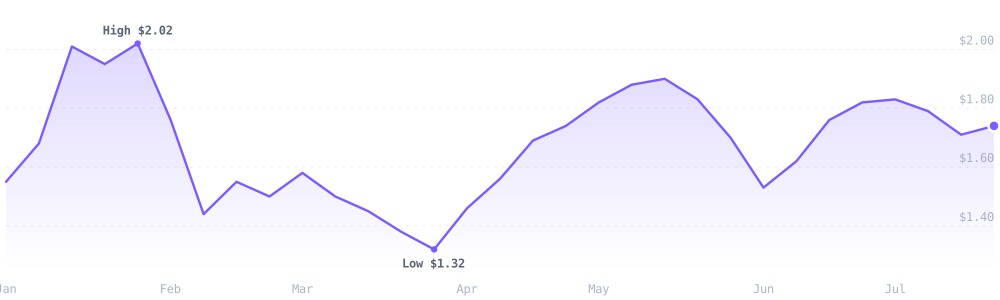
For context, three confirmed marks tell the recent story:
- December 31, 2025 – $15.5M ($1.55 / share)
- July 6, 2026 – $18.3M ($1.83 / share)
- July 14, 2026 – $17.4M ($1.74 / share)
Illustrative trend transcribed from Eqvista's chart (approximate); the confirmed marks above are the exact figures. Past performance does not indicate future value.
Across the January–July 2026 window, the per-share estimate has moved in a band of roughly $1.32 to $2.02. So the honest read is not a straight line up. The company valuation has risen meaningfully since the end of 2025, but it has also come off its early-July high – the estimate reflects market conditions at the date of each mark, and it moves in both directions. That is the point of a market-based valuation: it is supposed to track reality, not flatter it.
How the figure is calculated
Eqvista's Real-Time Company Valuation® combines three things:
- A model – AI and machine-learning models trained on a large base of private-market data, calibrated against public and private-market comparables, sector transactions, and investor sentiment.
- Analyst review – the model output is reviewed by NACVA-certified valuation analysts, which is what makes the figure defensible rather than an unchecked algorithmic guess.
- A basis – for Stobox, the estimate is primarily a market (comparables) approach: it indexes the company against what comparable companies in blockchain technology and digital-asset infrastructure are actually worth in observable transactions.
In other words, it applies the same market-approach discipline described in the anatomy above – comparable companies, pricing multiples, professional review – rather than at the once-a-year cadence of a formal appraisal.
It is, importantly, separate from the company's 409A valuation. The 409A is an independent appraisal of the fair market value of the common stock, prepared solely for IRC §409A and financial-reporting/tax purposes (for example, to set option strike prices). Like nearly all 409A reports, it is a confidential document with contractual limiting conditions, so its contents and conclusions are not published here or anywhere else. Its fair market value is determined independently – after adjustments such as the discount for lack of marketability described above – and, by the nature of those adjustments, a figure of that kind is typically lower than an undiscounted company estimate. The two serve different purposes and should not be conflated.
Why we are publishing it
Two reasons, both straightforward.
First, transparency is the product. Stobox builds infrastructure for structuring companies and real assets, raising regulated capital, and issuing compliant tokenized securities. A company in that business should be willing to stand behind an independent, third-party view of its own worth. Publishing an outside valuation – including the periods where it dips – is more credible than never showing a number at all.
Second, it is consistent with how we operate on ourselves. We tokenized a portion of our own equity as STBX, on the same compliant stack we provide to clients. Pairing that with an independent, analyst-reviewed valuation is part of the same idea: put our own company through the same scrutiny we ask others to accept.
What this valuation is not
This matters, so it is worth stating plainly.
The figure is a market-based estimate of the company, Stobox Technologies Inc. (Eqvista's Real-Time Company Valuation®). It is not:
- The company's 409A valuation. The 409A is a separate, confidential appraisal of the fair market value of the common stock, prepared solely for tax and financial-reporting purposes and subject to contractual confidentiality. Its contents are not shown here, and its value is determined independently of this estimate.
- The STBX token price. STBX is a separate regulated security token representing Class C equity issued by Stobox Tokenized Equities Ltd. The estimate is not the STBX offering price and not a quoted price for any token.
- A tradeable or guaranteed price. Private-company equity is illiquid. There is no live market where you can transact at this number, and past marks do not guarantee future value.
- An offer or investment advice. This is informational context, not a solicitation to buy any security and not a recommendation. Any offering is made solely through official Offering Documents and licensed channels, to eligible investors, where permitted.
A valuation is a useful lens for understanding a business. It is not a substitute for the offering documents, professional advice, or your own diligence.
Frequently asked questions
What is Stobox Technologies Inc.'s valuation? As of July 14, 2026, Eqvista's Real-Time Company Valuation® of Stobox Technologies Inc. is $17,383,677 – approximately $17.4 million – with an implied value of about $1.74 per share (the estimate divided by shares outstanding). It is a market-based estimate: not the company's 409A fair market value, not an offering price, and not a tradeable market price.
Who produced the valuation? Eqvista, an independent equity-management and valuation firm whose figures are reviewed by NACVA-certified valuation analysts, via its Real-Time Company Valuation® product.
How is the number calculated? Primarily via a market (comparables) approach: machine-learning models calibrated to public and private-market comparables in blockchain technology and digital-asset infrastructure, with the output reviewed by NACVA-certified analysts. Each mark is dated.
Is this the same as Stobox's 409A? No. This is Eqvista's Real-Time Company Valuation®, a market-based estimate that Eqvista makes shareable. The 409A is a separate, confidential appraisal prepared solely for IRC §409A / tax and financial-reporting purposes; its contents are subject to contractual confidentiality and are not published, and its fair market value is determined independently of this estimate.
Is the valuation the same as the STBX token price? No. The figure is a market-based estimate of the company. STBX is a separate regulated security token (Class C equity, issued by Stobox Tokenized Equities Ltd.), offered only through Offering Documents to eligible investors.
Can I buy shares in Stobox at this valuation? No. This article is informational only and is not an offer to sell or a solicitation to buy any security.
See the latest figure and the confirmed history on the Stobox valuation page, learn how Stobox equity is tokenized as STBX, or see how to invest in Stobox – US accredited investors under Reg D 506(c) via Silicon Prairie, and eligible international investors via tokenized shares.
Disclosures: The figure referenced above is Eqvista's Real-Time Company Valuation® of Stobox Technologies Inc. – an independent, third-party, market-based valuation estimate. It is not the company's 409A valuation, which is a separate, confidential appraisal prepared solely for IRC §409A and financial-reporting/tax purposes; the 409A's contents are subject to contractual limiting conditions and are not published, and its fair market value of the common stock is determined independently of this estimate. The per-share figure shown is the estimated company value divided by shares outstanding and is not a fair market value or an option strike price. Stobox does not produce, control, or guarantee the figure. It is an estimate, may be revised, is not audited financial statements, and is provided for informational purposes only. It is not an offer to sell, a solicitation of an offer to buy, or a recommendation regarding any security; it is not investment, legal, tax, or financial advice; and it is not a tradeable, quoted, or guaranteed price for STBX, any share, or any token. Private-company equity is illiquid and high-risk; you may lose your entire investment. See our Legal & disclosures page.